
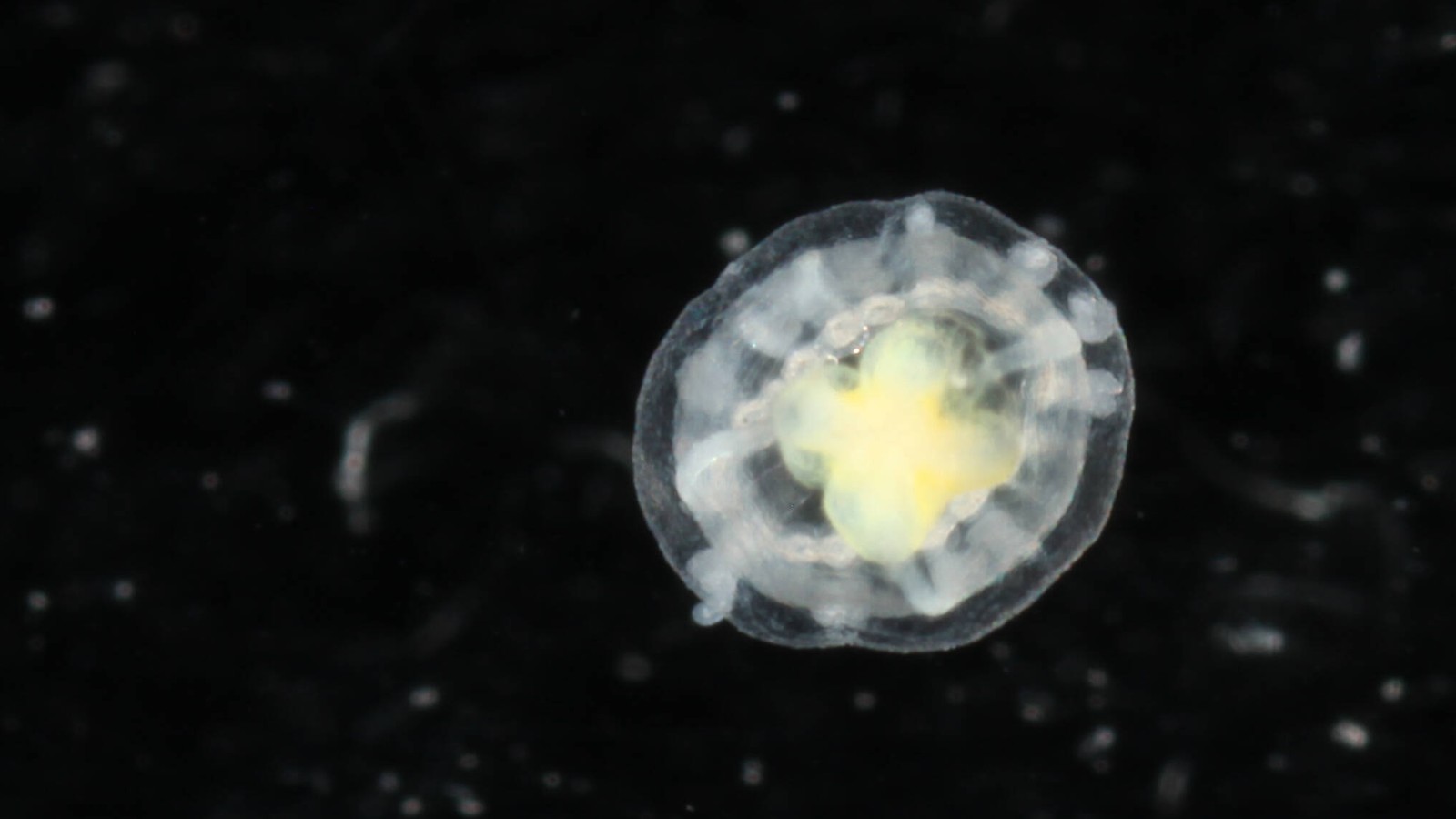
In the summer of 1988, a German biology student named Christian Sommer was scooping up tiny hydrozoans off the coast of Rapallo, Italy, for a routine research project. He wasn’t trying to solve the riddle of death. He just wanted some jellyfish polyps to study in petri dishes back at the lab.
Table of Contents
Instead, he watched one refuse to die. A stressed, aging jellyfish in his dish didn’t decay the way it was supposed to — it shrank, pulled its tentacles back in, collapsed into a blob, and then regrew itself into a brand-new juvenile polyp. It had, in effect, hit rewind on its own life cycle. Sommer had accidentally found the only animal known to biologically reverse its own aging.
Quick answer
The animal is Turritopsis dohrnii, a tiny jellyfish species that, when injured, sick, starving, or simply old, can revert from its adult ‘medusa’ form back into an earlier polyp stage and start its life cycle over — a process called transdifferentiation, first documented by biologists Christian Sommer, Giorgio Bavestrello, Ferdinando Boero, and Stefano Piraino in the late 1980s and 1990s.
A student, a petri dish, and a jellyfish that wouldn’t cooperate
Sommer wasn’t alone — fellow researcher Giorgio Bavestrello was also collecting Turritopsis specimens around the same time near Rapallo, on the Italian Riviera. The two weren’t hunting for immortality; they were interested in ordinary hydrozoan reproduction, the kind of unglamorous lab work that fills most of a marine biologist’s career.
So when their jellyfish, instead of dying on schedule, kept demoting itself back into a polyp — the anemone-like, stationary form jellyfish start life as — it wasn’t an obvious headline. It looked more like an experimental error. Except it kept happening, dish after dish.
From weird lab fluke to a real biological process
It took most of a decade for the finding to become a proper scientific story. In 1996, Stefano Piraino and Ferdinando Boero, working with colleagues, published the paper that gave the phenomenon its name: transdifferentiation, the process by which one type of specialized cell converts directly into another type, bypassing the usual route through stem cells. Their paper, published in The Biological Bulletin, described medusae ‘transforming into polyps’ — an unprecedented reversal for a complex, multi-organ animal.
That’s the twist worth sitting with: this isn’t a jellyfish that simply doesn’t age, the way a rock doesn’t age. Its cells are actively reprogramming themselves — muscle cells becoming nerve cells, nerve cells becoming something else entirely — essentially undoing specialization and starting the developmental clock over. It’s less ‘fountain of youth’ and more ‘biological time machine,’ and it can, in theory, do this indefinitely.
The part most people miss
Here’s the layer that gets flattened in every viral headline: ‘immortal’ does not mean invincible. A Turritopsis dohrnii still gets eaten by predators, killed by disease, or crushed — same as any other jellyfish. ‘Biologically immortal’ specifically means it doesn’t appear to have a hard biological deadline from aging itself; it can, under the right stress, dodge death by reverting rather than dying of old age. And the science behind why is still being actively argued over. In 2022, researchers led by Maria Pascual-Torner and Carlos López-Otín at the University of Oviedo published the first full genome of T. dohrnii in the Proceedings of the National Academy of Sciences, comparing it to a mortal relative, Turritopsis rubra, and reporting that the immortal species carries roughly double the DNA-repair-related genes. It was treated as a landmark aging study. But in 2023, jellyfish biologist Maria Pia Miglietta of Texas A&M published a rebuttal in the same journal, arguing the comparison’s central premise was shaky — the study that supposedly proved T. rubra can’t rejuvenate never actually tested whether it could. In other words: even the ‘proof’ of what makes this jellyfish special is still a live scientific dispute, not settled fact. That’s usually where the most interesting science actually lives — in the argument, not the headline.
Meanwhile, one person has spent longer staring at this animal than anyone alive: Shin Kubota, a biologist at Kyoto University’s Seto Marine Biological Laboratory in Shirahama, Japan, who has studied jellyfish since 1979 and maintains the world’s only known captive colony of Turritopsis. He hand-feeds them, has documented individual medusae cycling through rejuvenation roughly ten times, and — because apparently that’s not enough dedication — writes and performs karaoke songs about them. If the immortal jellyfish has a human counterpart in persistence, it’s him.
Sources
Piraino, S., Boero, F., Aeschbach, B., & Schmid, V. — ‘Reversing the Life Cycle: Medusae Transforming into Polyps and Cell Transdifferentiation in Turritopsis nutricula (Cnidaria, Hydrozoa),’ The Biological Bulletin (1996), the foundational paper naming the transdifferentiation process observed in the species.
Pascual-Torner, M., et al. — ‘Comparative genomics of mortal and immortal cnidarians unveils novel keys behind rejuvenation,’ Proceedings of the National Academy of Sciences (2022), the University of Oviedo genome study, and Miglietta, M.P. — the 2023 PNAS letter disputing its comparative premise.
American Museum of Natural History (amnh.org) and Kyoto University’s Seto Marine Biological Laboratory, for background on Turritopsis dohrnii’s life cycle and on Shin Kubota’s decades of captive research.
Explore more: More true tales from the wild animal kingdom.
the immortal jellyfish FAQs
Is the immortal jellyfish actually immortal?
It’s ‘biologically immortal,’ meaning it can avoid dying of old age by reverting to a juvenile polyp stage — but it can still be killed by predators, disease, or injury, just like any other jellyfish.
Who discovered the immortal jellyfish?
German student Christian Sommer first observed the reversal in 1988 near Rapallo, Italy, while collecting specimens with Giorgio Bavestrello; the process was formally described in 1996 by Stefano Piraino, Ferdinando Boero, and colleagues.
What is the immortal jellyfish’s scientific name?
Turritopsis dohrnii, a small hydrozoan species originally native to the Mediterranean, now found in warm waters worldwide.
How does the jellyfish ‘age backwards’?
Through transdifferentiation — its specialized adult cells convert directly into different cell types, allowing the adult medusa to collapse and regrow into a young polyp, effectively restarting its life cycle.
Tales You Can Hold
Fun-facts books for curious kids, personalized books that star your child, and more from the FYI Tales Bookstore. Visit the Bookstore.
Photo: Bachware / CC BY-SA 4.0, via Wikimedia Commons.