
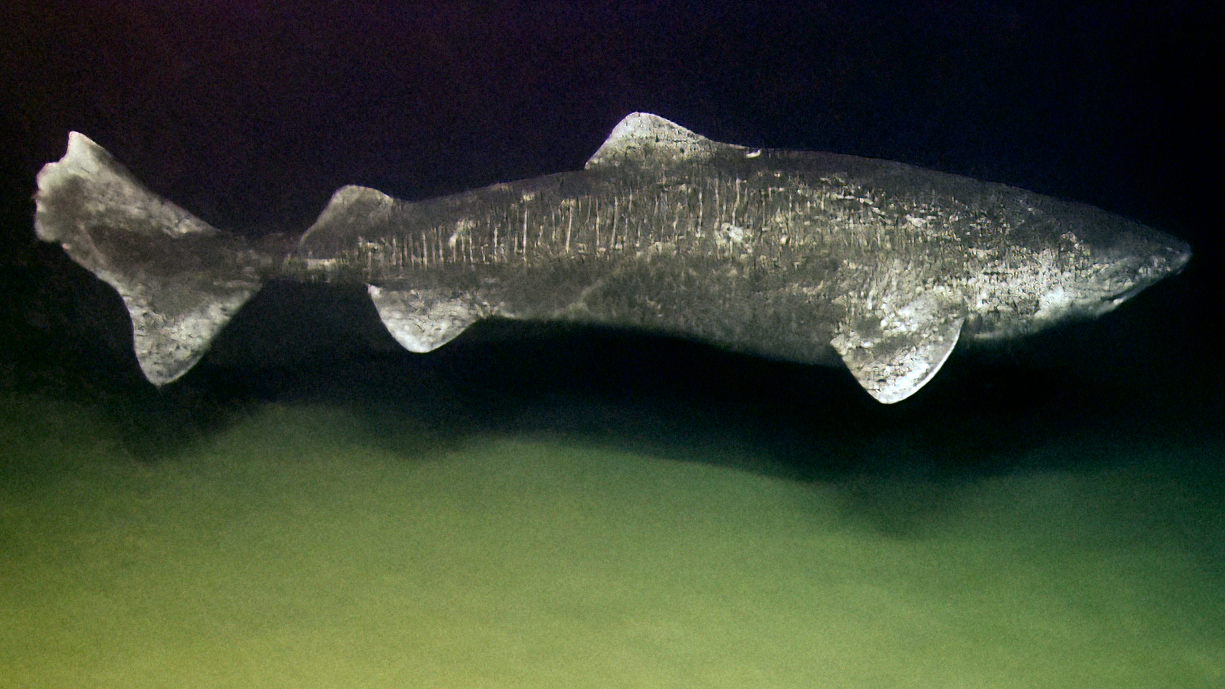
Somewhere in the black, near-freezing water off Greenland, there is a shark alive today that was already old when George Washington was born. Not metaphorically old — actually, provably old, in the way scientists can only pin down using leftover radiation from Cold War nuclear tests.
Table of Contents
The animal is a Greenland shark, a slow, sluggish, almost comically unremarkable-looking fish that turned out to be the longest-lived vertebrate ever documented. The story of how researchers figured out its age involves eyeballs, atomic bombs, and a very patient marine biologist named Julius Nielsen.
Quick answer
In 2016, a team led by biologist Julius Nielsen of the University of Copenhagen used radiocarbon dating on the eye lenses of Greenland sharks and estimated the largest one, a 16-foot female, at roughly 392 years old, give or take about 120 years. Even the low end of that range puts her birth well before 1776, making her — and sharks like her — older than the United States.
A biologist, a fishing net, and 28 eyeballs
Greenland sharks are not glamorous. They are big, dull gray, slow-moving scavengers that cruise the Arctic and North Atlantic at depths where almost nothing else bothers to live, eating whatever they can catch or find dead — fish, seals, the occasional reindeer that wandered onto thin ice. For decades, nobody had a reliable way to tell how old one was. The trick marine biologists usually use — counting growth rings in a fish’s vertebrae or fin spines, like tree rings — doesn’t work well on this species because its cartilage doesn’t lay down clear annual bands.
So Julius Nielsen and colleagues from the University of Copenhagen and the Virginia Institute of Marine Science tried something else. Between 2010 and 2013, they collected 28 female Greenland sharks that had died as bycatch in fishing nets, ranging from about 2.5 feet to over 16 feet long. Instead of bones, they went for the eyes — specifically, the lens nucleus, a layer of crystalline protein that forms before birth and then never turns over again. Whatever carbon isotopes were in the water when the shark was a pup get locked into that tissue for the rest of its life, like a chemical time capsule.
The bomb that dated the shark
That time capsule works because of an unlikely historical marker: atmospheric nuclear weapons testing in the 1950s and early 1960s released a huge pulse of carbon-14 into the atmosphere, which then spread through the oceans and into marine life. Any shark born during or after that spike carries a detectable signature of it in its eye tissue. Sharks born before it don’t — which is exactly what the researchers found in their larger, older specimens, letting them extrapolate backward using known radiocarbon decay and growth-rate data instead.
The results, published in Science in August 2016, were startling. The team calculated a lifespan of at least 272 years across their sample, and the two largest sharks — 16.2 and 16.5 feet long — came out to roughly 335 and 392 years old. Growth rate turned out to be almost absurdly slow, under half an inch a year, and the researchers concluded females don’t reach sexual maturity until they’re about 13 feet long, somewhere around 150 years old. That knocked the previous record holder, a bowhead whale estimated at 211 years, out of first place. The Greenland shark became the longest-lived vertebrate known to science — and somewhere in that population is an animal that was already swimming decades before the first English colonists reached Jamestown, let alone before the Continental Congress ever met.
The part most people miss
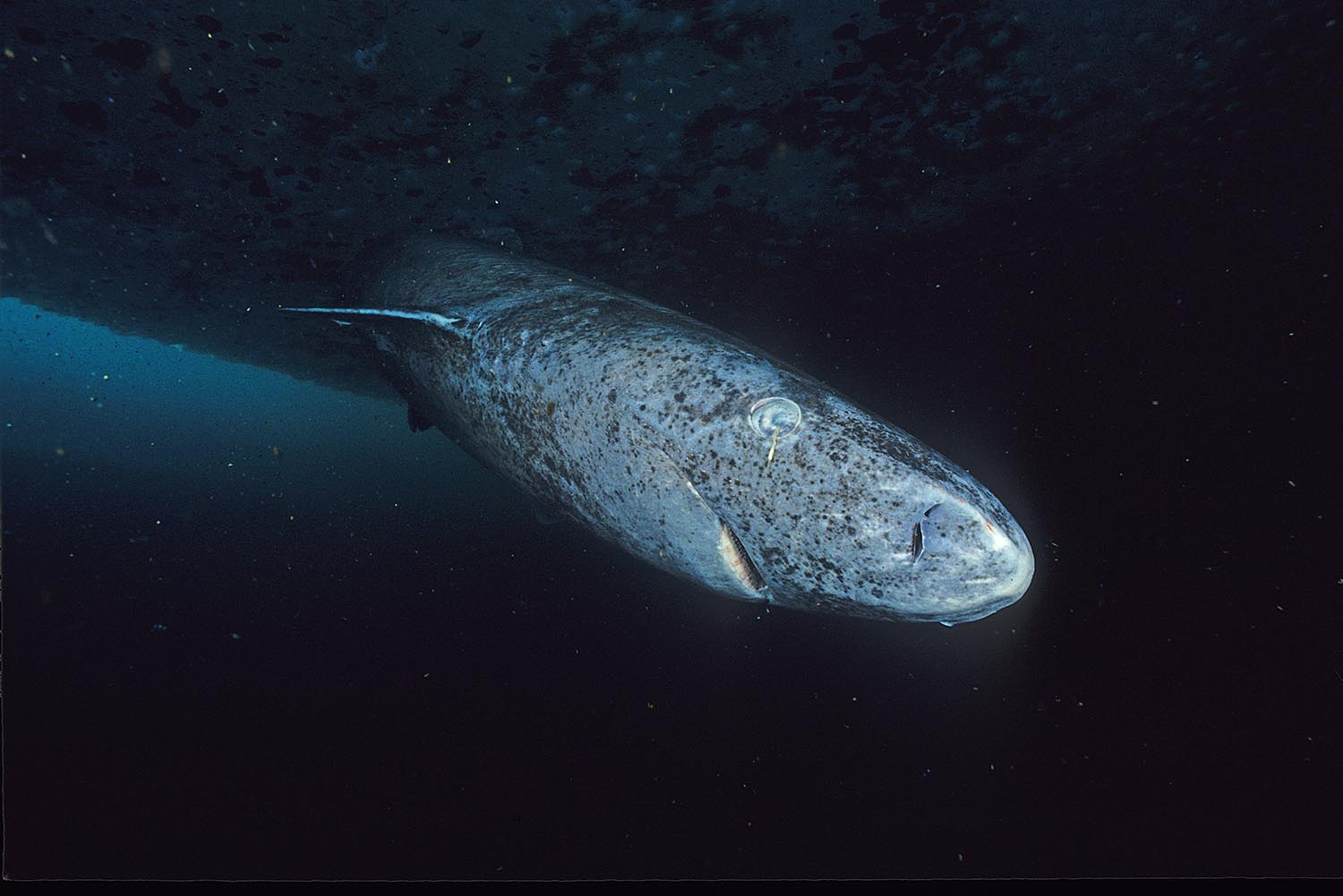
Here’s the twist buried in the story: the same eyes that let scientists date these sharks are, in the vast majority of cases, half-blind. A parasitic copepod called Ommatokoita elongata attaches itself to the cornea and feeds on it, clouding the eye and often leaving the shark able to sense only light, not shapes. Studies of the species suggest the great majority of wild Greenland sharks carry the parasite in at least one eye. So the animal that quietly outlived every king, war, and invention of the modern era has likely spent much of that time swimming half-blind through Arctic darkness, relying on smell and electroreception instead of sight. And there’s a second twist for anyone tempted to try one: Greenland shark flesh is toxic straight out of the water, loaded with urea and trimethylamine oxide that can cause vomiting and drunken-looking disorientation if eaten fresh. In Iceland, it’s turned into a national dish called hákarl by burying and fermenting the meat for months, letting the toxins break down and drain out until what’s left is safe — if famously pungent.
Sources
Julius Nielsen et al., “Eye lens radiocarbon reveals centuries of longevity in the Greenland shark (Somniosus microcephalus),” Science, vol. 353, no. 6300 (August 2016), the original peer-reviewed study behind the age estimates.
Virginia Institute of Marine Science, news coverage of the study detailing co-author Richard Brill’s role and the growth-rate and maturity findings.
ScienceDaily’s August 2016 summary of the University of Copenhagen research team’s findings, plus published research on the Ommatokoita elongata eye parasite and on the toxicity of raw Greenland shark flesh.
Explore more: More true wild animal tales.
Greenland shark FAQs
How old is the oldest known Greenland shark?
The oldest individual measured in the 2016 study was estimated at about 392 years old, with a margin of error of roughly ±120 years, meaning she could be anywhere from about 270 to over 500 years old.
How do scientists determine a Greenland shark’s age?
They use radiocarbon dating on the eye lens nucleus, a protein layer that forms before birth and never changes afterward, using the carbon-14 spike from mid-20th-century nuclear weapons testing as a time marker.
Why can’t scientists just count rings like they do on other fish?
Greenland sharks don’t lay down clear annual growth rings in their vertebrae or fin spines the way many bony fish do, so traditional aging methods don’t work on the species.
Is it true Greenland sharks are often blind?
Yes — a parasitic copepod called Ommatokoita elongata commonly attaches to their corneas, and research suggests the large majority of wild Greenland sharks are affected in at least one eye.
Tales You Can Hold
Fun-facts books for curious kids, personalized books that star your child, and more from the FYI Tales Bookstore. Visit the Bookstore.
Photo: NOAA Okeanos Explorer Program / Public domain, via Wikimedia Commons.