
In September 1896, crowds at Coney Island’s Old Iron Pier lined up for a new thrill ride that didn’t loop, drop, or spin. It carried riders seven feet up a 25-degree incline at not much more than walking pace, then let them off exactly where they’d started, on solid ground. They called it the “inclined elevator,” and over two weeks roughly 75,000 people paid to ride it.
Table of Contents
It wasn’t really a ride. It was a job interview. The machine was the first working escalator, and its inventor wasn’t hoping to entertain the boardwalk crowd so much as impress the men who ran New York’s bridges and planned Boston’s future subway. Coney Island was where he could prove, cheaply and publicly, that his invention could move people better than stairs, elevators, or their own two feet.
Quick answer
Yes: the escalator’s public debut wasn’t in a department store or a subway station. Engineer Jesse W. Reno installed the first working escalator, which he called an “inclined elevator,” as a temporary attraction at Coney Island’s Old Iron Pier in 1896, where roughly 75,000 people rode it in about two weeks.
A patent nobody built
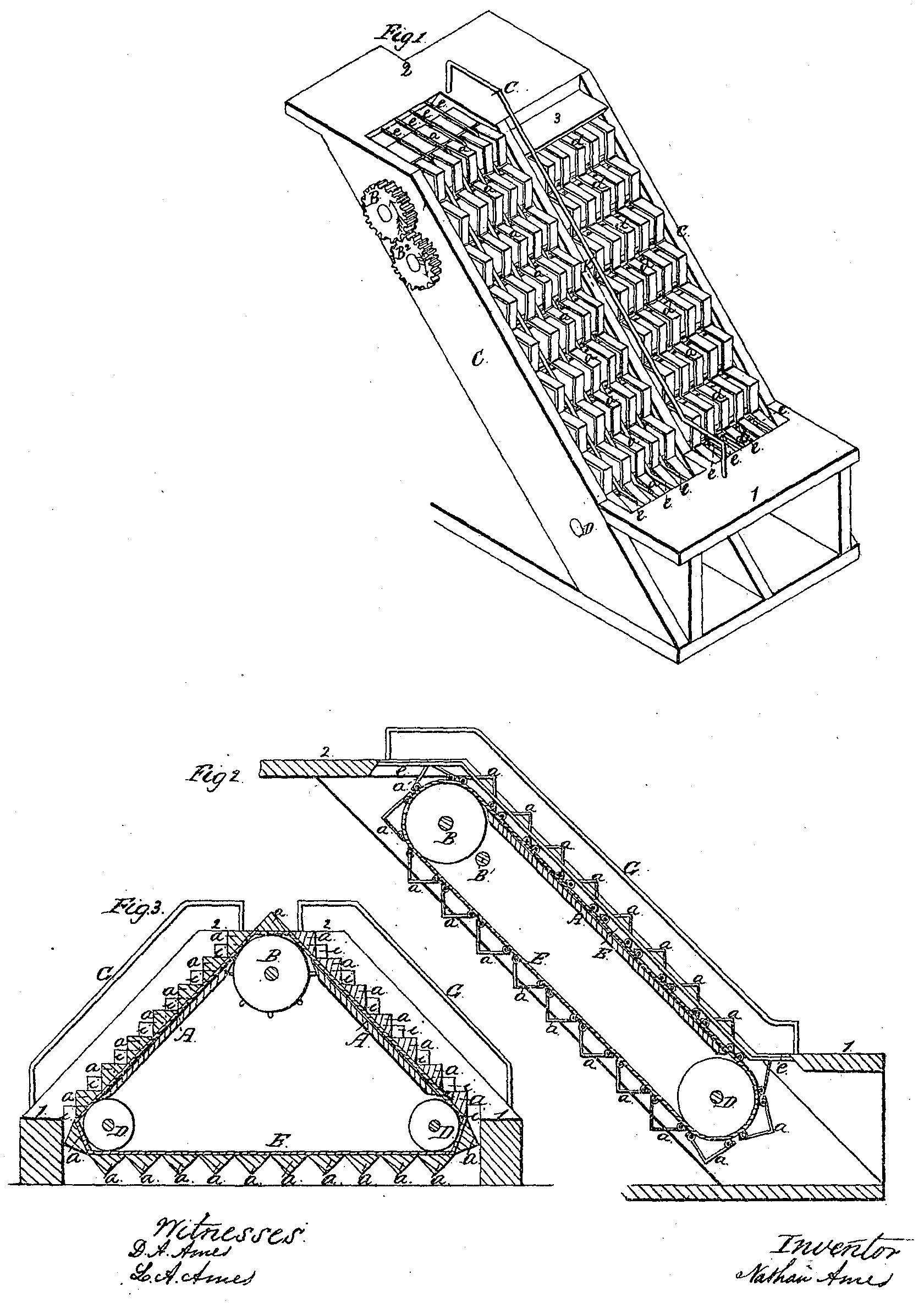
The idea of a moving staircase predates Reno by decades. In 1859, a Massachusetts patent attorney named Nathan Ames patented “Revolving Stairs” — a theoretical design with steps that could be upholstered for comfort and powered by hand or hydraulics. Ames never built one; his patent sat on a shelf, more thought experiment than machine.
Jesse Wilford Reno, a Lehigh University-trained engineer, took the idea further. On March 15, 1892, he patented an “Endless Conveyor or Elevator”: a looping belt set at an angle, studded with cast-iron cleats for grip, with a moving handrail alongside for balance. There were no steps, just a slanted conveyor belt doing the work of a staircase. Reno had the patent. What he didn’t have yet was proof it worked, or anyone willing to pay for one.
Selling city hall with a beach ride
So Reno built one and put it where thousands of people already showed up looking to be amazed: the Old Iron Pier at Coney Island. For two weeks it carried curious New Yorkers seven feet up its 25-degree slope at around 23 meters a minute — an amusement, but also a working demonstration.
The pitch, according to contemporary accounts, was aimed less at fairgoers than at officials: the trustees of the Brooklyn Bridge, the operators of the elevated railways, and planners of Boston’s still-unbuilt subway. Reno’s machine, boosters argued, could move roughly 3,000 people an hour continuously and without an attendant — “manifestly superior” to a vertical elevator that had to stop, load, and unload one carful at a time. After Coney Island, the demonstration unit moved again, to the Manhattan side of the Brooklyn Bridge, for more of the same audition.
The part most people miss
Reno never got to name his own invention. That credit went to a rival. Around the same years, engineer Charles Seeberger was developing a competing design with flat, hinged steps instead of a bare sloped belt — closer to what you’d stand on today. Seeberger partnered with the Otis Elevator Company, and their joint machine won first prize at the 1900 Paris Exposition Universelle. Seeberger trademarked the name for it, stitching together Latin fragments — “scala” for steps, plus a prefix and suffix borrowed from “elevator” — into “escalator.”
Otis eventually bought out both men: Reno’s moving handrail and inclined belt, Seeberger’s flat steps and comb plates, folding the best of each into the machine that now carries millions of people a day. The “escalator” trademark itself didn’t survive as private property either — in 1950, the U.S. Patent Office ruled it had become a generic term, partly because Otis’s own advertising had used it that way for decades. The machine Reno risked his money proving on a beach boardwalk ended up everywhere, except in his own name for it.
Sources
This account draws on Jesse W. Reno’s patent record and biography as documented on Wikipedia, Untapped New York’s reporting on the Old Iron Pier demonstration, and the National Inventors Hall of Fame’s profile of Reno, cross-checked against Guinness World Records’ entry for the first escalator.
Explore more: More true stories about everyday objects.
escalator FAQs
Who really invented the escalator?
Jesse W. Reno built and patented the first working version, a sloped conveyor belt he called an “inclined elevator,” in 1892 and demonstrated it in 1896. But the flat-step design most escalators use today, and the name “escalator” itself, came from his rival Charles Seeberger, working with the Otis Elevator Company.
Where was the first escalator installed?
At the Old Iron Pier in Coney Island, New York, in 1896, where it ran for about two weeks as a paid amusement ride, carrying an estimated 75,000 riders.
Why was the first escalator a fairground ride instead of a store fixture?
Reno needed a cheap, public way to prove his machine worked before pitching it to transit officials like the Brooklyn Bridge trustees. Coney Island’s crowds gave him both an audience and a stress test.
Tales You Can Hold
Fun-facts books for curious kids, personalized books that star your child, and more from the FYI Tales Bookstore. Visit the Bookstore.
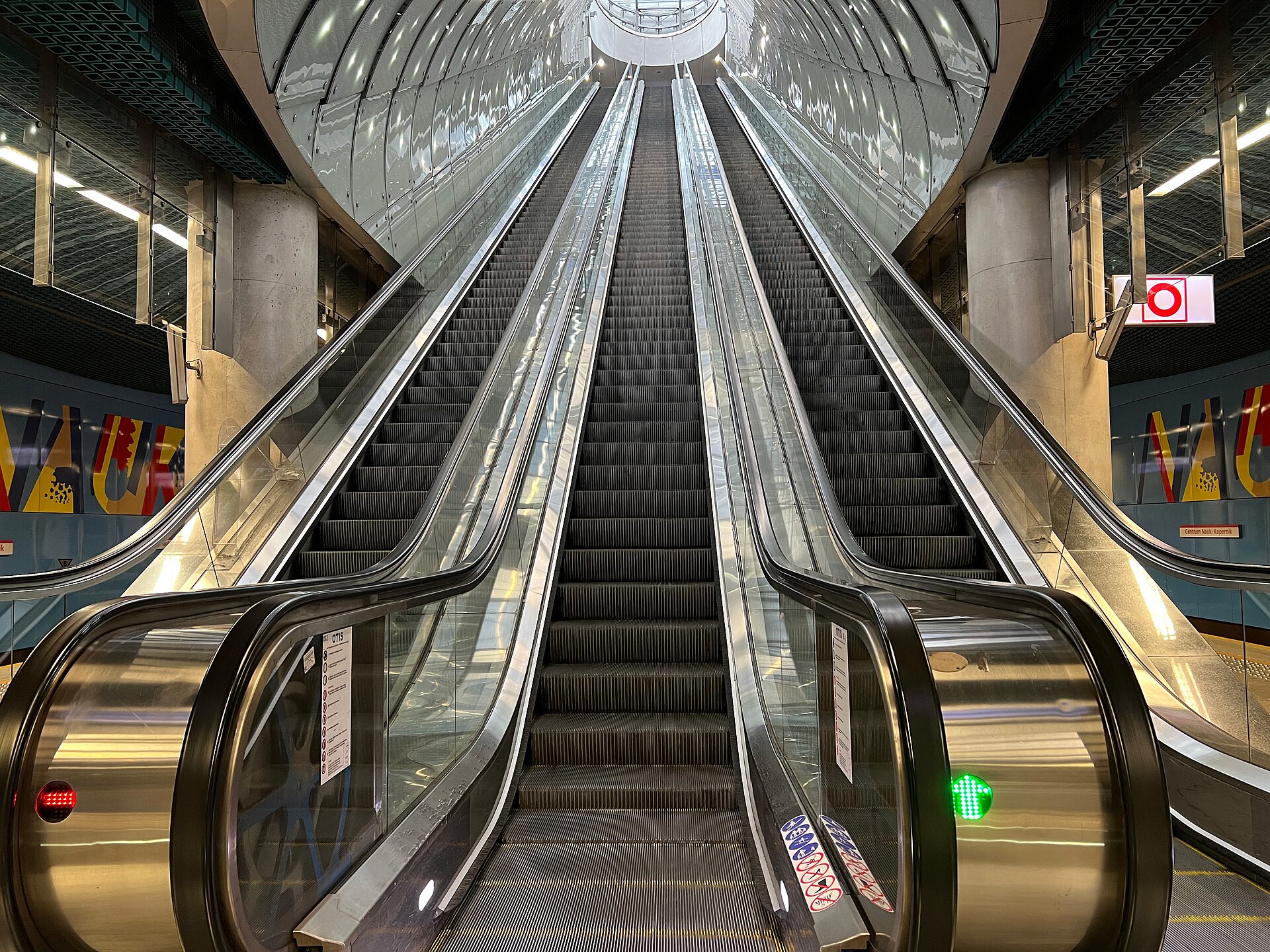
Photo: Chepry 💬 (Andrzej Barabasz) 📷 🇵🇱 / CC BY-SA 4.0, via Wikimedia Commons.