
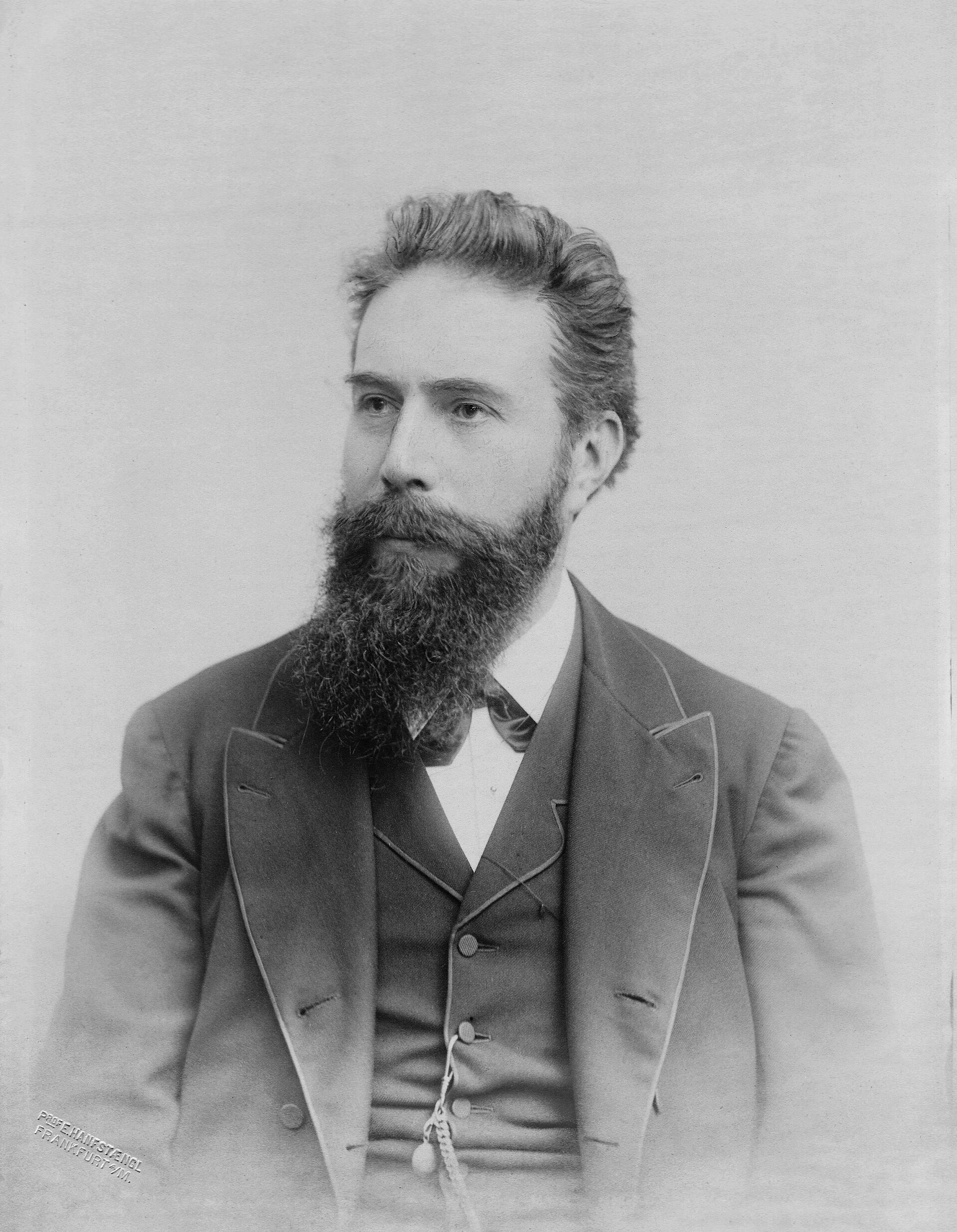
On a Friday evening in November 1895, a 50-year-old physics professor named Wilhelm Conrad Röntgen was alone in his lab at the University of Würzburg, running current through a sealed glass tube wrapped in black cardboard. Nothing about the tube should have produced light outside its own walls. Then, a few feet away on a bench, a screen he wasn’t even using started to glow.
Table of Contents
Röntgen didn’t publish a triumphant announcement that night. He didn’t tell his wife. He barely left the room for the next several weeks, eating and sleeping in the lab while he tried to figure out what he’d stumbled onto — and whether it was real.

Quick answer
X-rays were discovered by accident on November 8, 1895, when German physicist Wilhelm Röntgen noticed a barium platinocyanide screen glowing across his darkened lab while he tested a covered, energized vacuum tube — light that shouldn’t have been able to reach it. He spent weeks investigating the mysterious rays in secret before publishing his findings that December.
A shimmer he wasn’t looking for
Röntgen was investigating cathode rays — streams of particles produced inside vacuum tubes when high voltage passes through them, a hot topic among physicists like Heinrich Hertz and Philipp Lenard at the time. To study the effect cleanly, he’d wrapped his Crookes-Hittorf tube in black cardboard so no visible light could escape and confuse his observations.
He darkened the room, switched on the current, and caught a faint shimmer coming from a bench several feet away. When he struck a match, he found the source: a small screen coated in barium platinocyanide, a chemical he happened to have sitting out for an unrelated experiment, glowing faintly in the dark. The covered tube was somehow throwing off something invisible that traveled through the air, and even through solid objects, to make that screen light up.
The hand, the ring, and the skeleton on the wall
Not knowing what he was dealing with, Röntgen called the phenomenon ‘X-rays’ — using the mathematical symbol for an unknown quantity — and spent weeks testing what could and couldn’t stop them. Paper, wood, and flesh let the rays pass through; dense materials like bone and lead blocked them.
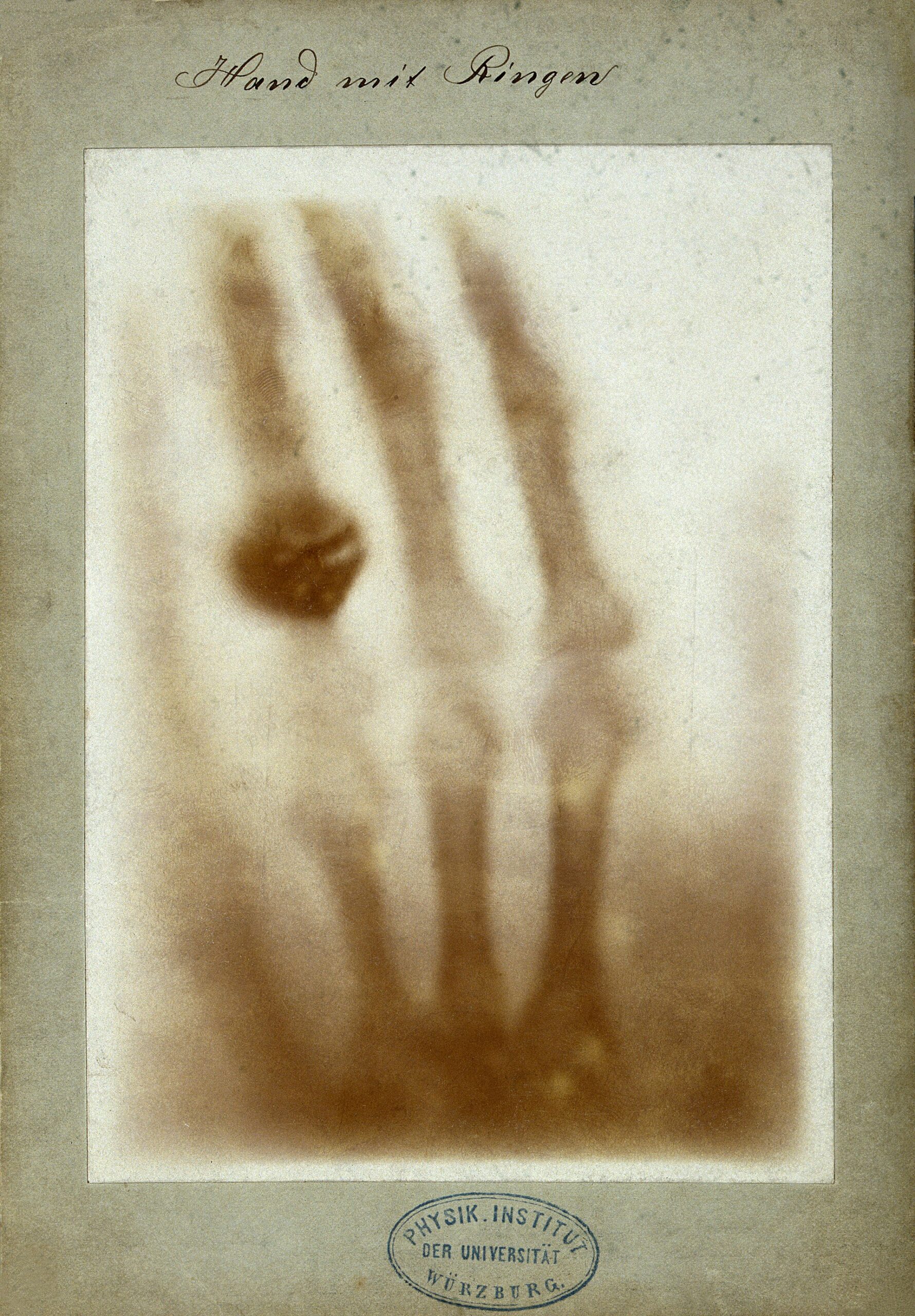
On December 22, 1895, he asked his wife, Anna Bertha, to place her hand on a photographic plate for about fifteen minutes while he aimed the rays at it. What developed was a ghostly image of the bones in her hand, with her wedding ring floating clearly around one finger. According to the story that’s been retold ever since, Bertha looked at the picture of her own skeleton and said, ‘I have seen my death.’ A few days later, Röntgen submitted his paper, ‘On a New Kind of Rays,’ to the Würzburg Physical-Medical Society, and the image of Bertha’s hand became the first X-ray photograph of a living person’s body ever published.
The part most people miss
The world didn’t wait politely. Within weeks of Röntgen’s announcement in January 1896, newspapers and magazines were running poems and cartoons about the ‘new photography,’ an English company was advertising X-ray-proof underwear for the modest, and portrait studios opened up offering paying customers a picture of their own bones. Serious medicine moved just as fast in the other direction: by June 1896, only six months after the announcement, battlefield surgeons were already using X-ray machines to locate bullets in wounded soldiers. What took much longer to arrive was the version most people actually remember — the shoe-store fluoroscope that let kids wiggle their toes and watch the bones move inside a new pair of shoes. Those machines didn’t show up until the 1920s, built on a fluoroscope Boston physician Jacob Lowe developed to check World War I veterans’ foot injuries before repurposing it for shoe fitting in 1920. Decades of children irradiating their feet for fun followed, until rising awareness of radiation risk phased the machines out of stores by the 1950s.
Through all of it, Röntgen could have made a fortune. Doctors and instrument makers wanted the technology immediately, and it would have been trivial for a physicist of his stature to patent the process. He refused, on the same principle later followed by Marie and Pierre Curie with radium: he believed a discovery this useful to humanity shouldn’t be locked behind a license. When he won the first Nobel Prize in Physics in 1901, he donated the prize money to his university, and true to form, he skipped giving a speech at the ceremony. The man who accidentally handed the world a way to see inside itself walked away from the payday almost as quickly as he’d found the glow.
Sources
Nobel Prize outreach materials and the Nobel Foundation’s official history of the 1901 Physics Prize, covering Röntgen’s award, his declination of a Nobel lecture, and his refusal to patent the discovery.
The American Physical Society’s ‘This Month in Physics History’ retrospective on November 8, 1895, corroborating the barium platinocyanide screen, the tube setup, and the timeline of Röntgen’s first paper.
The Oak Ridge Associated Universities’ Health Physics Museum and Wikipedia’s entry on the shoe-fitting fluoroscope, documenting Jacob Lowe’s 1919-1920 development of the shoe-store X-ray machine and its spread through the 1920s-1950s, well after Röntgen’s original 1895-96 discovery and its immediate commercial and medical fallout.
Explore more: more accidental inventions that changed the world.
X-rays FAQs
Who discovered X-rays and when?
German physicist Wilhelm Conrad Röntgen discovered X-rays on November 8, 1895, at the University of Würzburg, while testing a covered vacuum tube and noticing an unrelated screen glow across the room.
Why are they called ‘X-rays’?
Röntgen used ‘X’ because it’s the mathematical symbol for an unknown quantity — he had no idea what kind of radiation he’d found, so the placeholder name stuck permanently.
What was the first X-ray image of?
The first X-ray photograph of a living person was taken on December 22, 1895, of the bones in the hand of Röntgen’s wife, Anna Bertha, wedding ring included.
Did shoe stores really have X-ray machines?
Yes, but not right away. Shoe-fitting fluoroscopes let customers view the bones in their feet inside new shoes, but the technology wasn’t developed for that purpose until 1919-1920, roughly a quarter century after Röntgen’s discovery, and stayed common in stores into the 1950s.
Tales You Can Hold
Fun-facts books for curious kids, personalized books that star your child, and more from the FYI Tales Bookstore. Visit the Bookstore.
Photo: Erwin Hanfstaengl / Public domain, via Wikimedia Commons.