

Order a croissant in Paris and you’re eating a lie shaped like a crescent moon. The pastry France has trademarked as its national breakfast — the one stacked in every boulangerie window from Montmartre to Marseille — didn’t start in France at all. It started in Vienna, arrived in Paris by way of a steam oven, and didn’t even get its flaky, buttery layers until the 20th century was already underway.
Table of Contents
The real story involves an Austrian entrepreneur with a talent for marketing, a bakery that outlasted him by generations, and a French cookbook writer who quietly invented the technique that made the croissant taste like a croissant. Along the way, two beloved legends — one about Marie Antoinette, one about a battle with the Ottoman Empire — turn out to be almost entirely made up.

Quick answer
No — the croissant isn’t originally French. It descends from the Austrian kipferl, a crescent-shaped bread documented in Central Europe for centuries, which was brought to Paris in the late 1830s by Viennese baker August Zang. French bakers didn’t give it the flaky, laminated dough we associate with croissants today until the early 1900s.
A Viennese baker sets up shop on Rue de Richelieu
In 1838 or 1839, a Viennese businessman named August Zang (1807–1888) opened the Boulangerie Viennoise at 92 Rue de Richelieu in Paris. Zang wasn’t primarily a baker by trade — he was a former army officer and publisher with a sharp eye for a market opening — but he brought with him something Parisians hadn’t seen: the Viennese steam oven, which produced bread with a shinier, crisper crust than French ovens of the day.
Among the Austrian specialties Zang sold was the kipferl, a crescent-shaped roll with roots going back to at least the 12th or 13th century in Austria and Hungary. It was made from a dense, brioche-like dough — nothing like the shatteringly flaky pastry we know now. Parisians went wild for it anyway. Zang’s shop was such a hit that copycat ‘Viennese bakeries’ sprang up almost immediately — by 1840, Paris already had roughly a dozen Viennese-style bread houses employing about a hundred workers between them. Zang stayed in the business for about a decade before heading back to Vienna in 1848, when the revolutions of that year briefly lifted Austrian press censorship; he seized the opening to launch a newspaper, Die Presse, which is still published today. The bakery he left behind didn’t fold when he did — records show it was still trading under new ownership, run by a baker named Philibert Jacquet, as late as 1909.
The recipe France actually invented
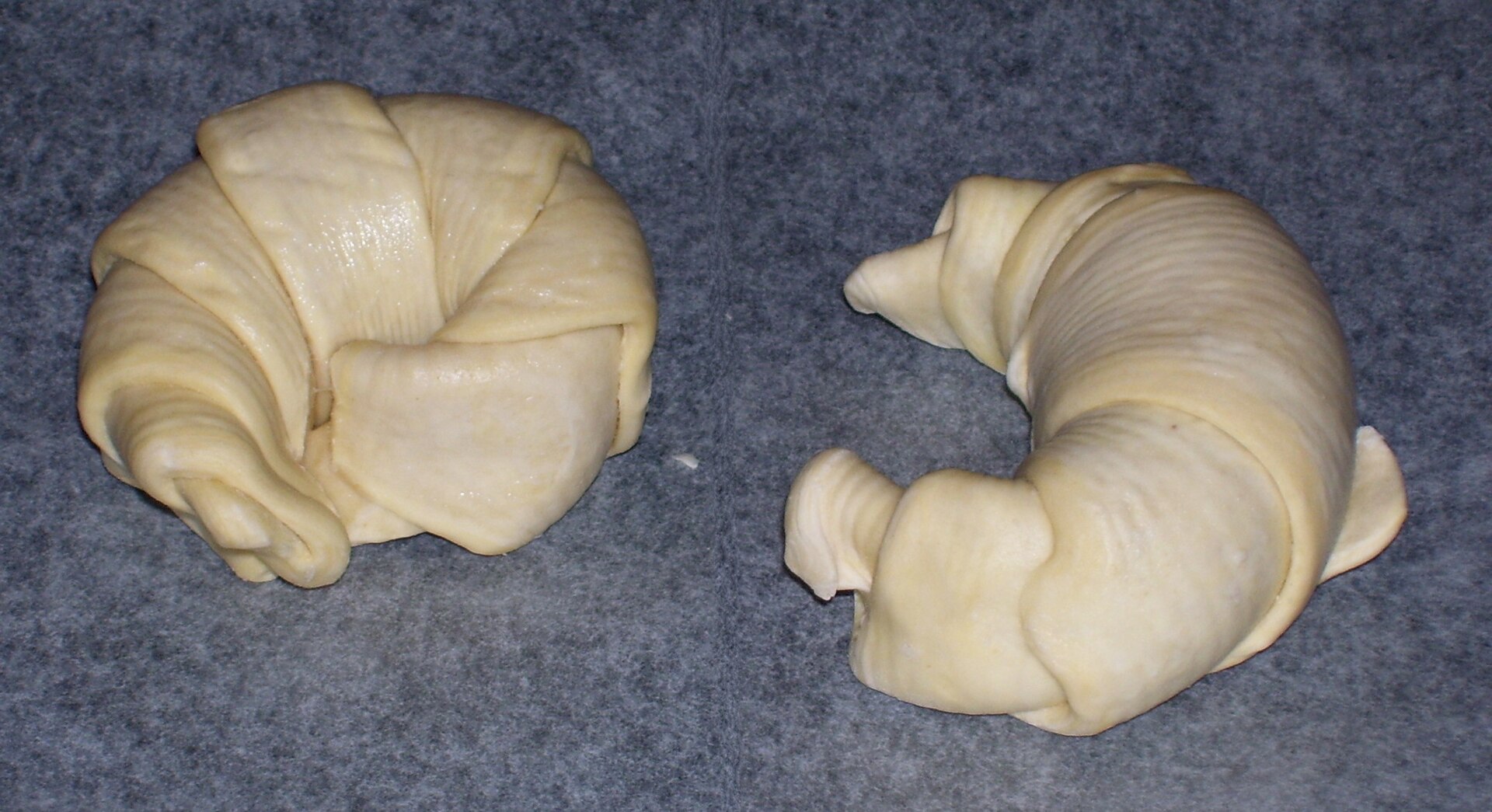
Here’s the twist: the crescent shape came from Austria, but the croissant everyone actually thinks of — thin, buttery, dozens of paper-thin layers that shatter when you bite in — is a French invention, and a surprisingly recent one. Zang’s kipferl-style pastry used a plain, yeasted dough, not the folded, laminated dough that defines a modern croissant.
That technique — repeatedly folding butter into dough to create the flaky layers, known in French as pâte feuilletée levée — starts showing up in French culinary literature only around the turn of the 20th century. A recipe in a 1906 Paris cookbook, Colombié’s Nouvelle Encyclopédie culinaire, is often cited as the first to match the modern croissant’s texture and taste, and in 1915 the French chef Sylvain Claudius Goy published a laminated-dough croissant recipe in his cookbook La Cuisine Anglo-Americaine — a version some food historians credit with locking in the technique bakers still use. In other words: France didn’t invent the croissant’s shape. France invented the croissant.
The part most people miss
The croissant’s most cinematic origin story — that Viennese bakers invented the crescent shape in 1683 to celebrate defeating the besieging Ottoman army, biting into the crescent moon on the Turkish flag — is almost certainly fiction. Culinary historians note the tale doesn’t appear in writing anywhere until 1938, when food historian Alfred Gottschalk repeated it in the famous French reference work Larousse Gastronomique — more than 250 years after the siege supposedly inspired it, and with no earlier source to back it up. The kipferl was already centuries old by 1683, siege or no siege. A second popular legend, that Marie Antoinette carried her beloved Austrian kipferl to the French court when she married Louis XVI in 1770, has the same problem: charming, widely repeated, and unsupported by any document from her lifetime. What actually made the croissant French wasn’t a queen or a battle — it was decades of anonymous Parisian bakers quietly reworking an Austrian import, in a bakery that changed hands and kept baking long after the man who founded it went home to start a newspaper.
Sources
Wikipedia’s entries on August Zang, Sylvain Claudius Goy, and the Croissant compile primary details on the Boulangerie Viennoise’s 1838/1839 opening, its rapid imitation across Paris, Zang’s 1848 departure for Vienna, the bakery’s continued operation under later owner Philibert Jacquet as of 1909, and the documented emergence of laminated-dough recipes in early-20th-century French cookbooks.
The Connexion France feature ‘The Austrian who transformed le petit déj’ and the Institute of Culinary Education’s ‘A Brief History of the Croissant’ trace the kipferl-to-croissant timeline and the Zang biography, while both that ICE piece and Europeana’s ‘The History of the Croissant’ address the Marie Antoinette and 1683-siege legends directly, noting the absence of contemporary evidence for either.
Explore more: more true food origin stories.
croissant FAQs
Is the croissant really French?
The shape isn’t — it comes from the Austrian kipferl. But the flaky, laminated-dough croissant eaten today was developed by French bakers in the early 1900s, so in its modern form, yes, it’s a French creation built on an Austrian base.
Did Marie Antoinette bring the croissant to France?
No credible evidence supports this popular story. Historians have found no documentation from her lifetime connecting her to the pastry’s arrival in France.
Was the croissant really invented to celebrate a victory over the Ottomans?
That’s a legend, not history. It first appears in print in 1938, over 250 years after the 1683 siege of Vienna it claims to commemorate, and the crescent-shaped kipferl already existed long before that battle.
Tales You Can Hold
Fun-facts books for curious kids, personalized books that star your child, and more from the FYI Tales Bookstore. Visit the Bookstore.
Photo: Petr Kratochvil / CC0, via Wikimedia Commons.