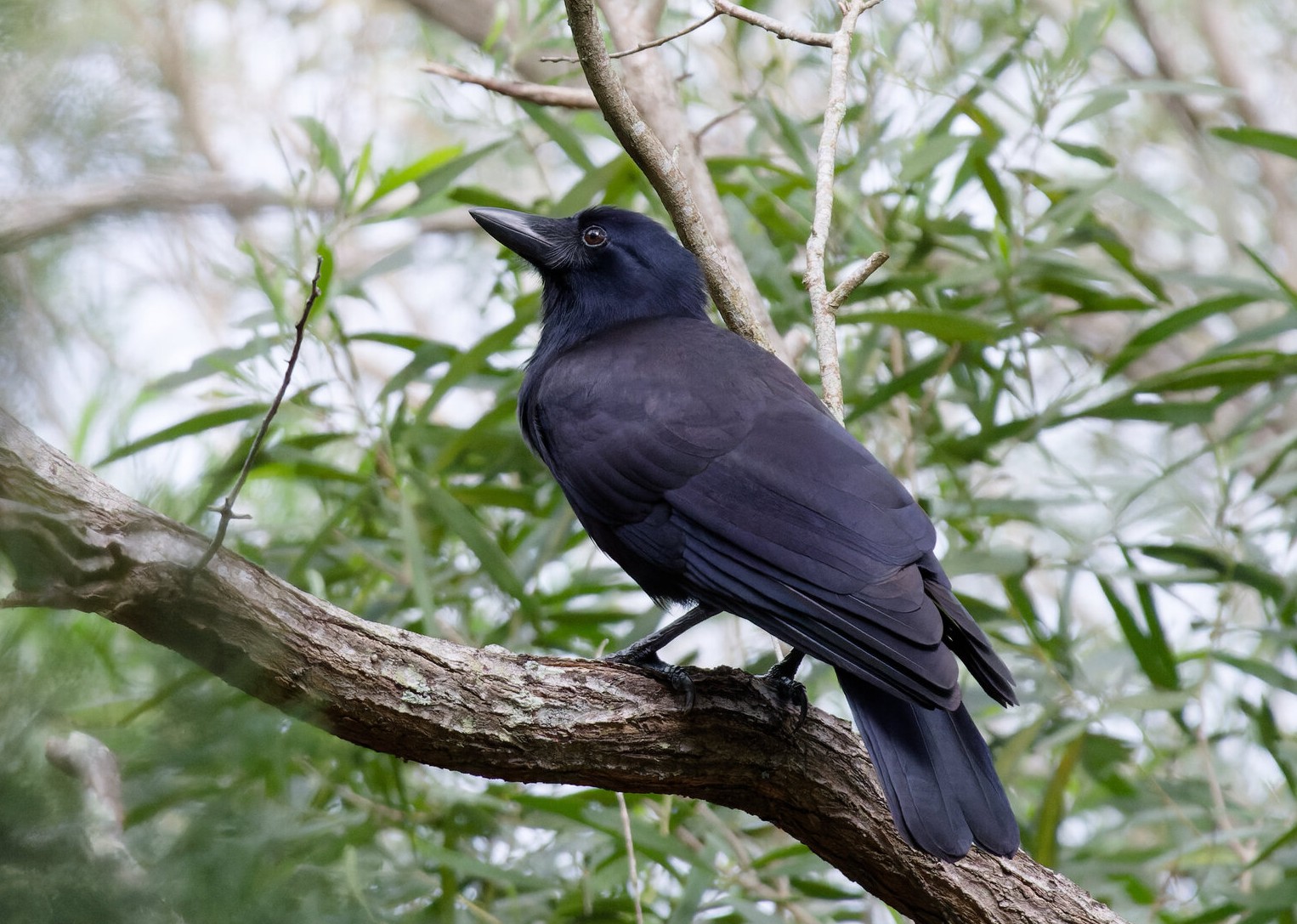
Picture two crows and a puzzle. At the bottom of a clear vertical tube sits a tiny bucket of meat. Next to the tube lie two wires: one bent into a hook, one dead straight. The male crow, Abel, grabs the hooked wire and flies off with it. That leaves Betty with a straight wire and a problem that shouldn’t be solvable.
Table of Contents
Betty solved it by making a hook. She did it in front of Oxford scientists who had never taught her how, and the result ran in Science in 2002. It became one of the most famous animal-intelligence stories of the century. The twist is that the scientists who started the story were not the ones who complicated it. Betty herself did that, years later, without meaning to.
Quick answer
In 2002, a captive New Caledonian crow named Betty bent a straight piece of wire into a hook to lift a bucket of food from a tube. She did it with no demonstration and almost no experience with wire. Later research suggests the skill may be part of what these crows naturally do, though the scientists disagree over how much insight Betty showed.
Two crows, one hooked wire
The experiment was run by Alex Weir, Jackie Chappell and Alex Kacelnik, then at the University of Oxford. Their subjects were New Caledonian crows, a species from the Pacific island group of the same name. In the wild these birds are known for making tools. They tear strips from pandanus leaves and trim twigs and ferns into hooks to pull insects out of crevices.
Betty and Abel were captive birds, and Betty had been wild-caught as a young bird. The researchers wanted to see whether the crows would choose a hooked wire over a straight one to fish the bucket out of the tube. They did. Then, on one trial, Abel took the hooked wire and left Betty with the straight one.
According to the Oxford group’s own account, Betty wedged one end of the straight wire under a piece of sticky tape and pulled on the other end with her beak. The wire bent. She had made a hook. The group says this came on only the fifth time the crows had encountered wire or any bendable material at all.
Not a fluke
A single lucky bend would have been a curiosity. Betty kept going. The Science paper, titled “Shaping of Hooks in New Caledonian Crows,” reported that she repeatedly bent wire into hooks, using a variety of techniques. Her hooks worked, and she used them to lift the bucket.
The Oxford team described this as the first time an animal had been seen making a new tool for a specific task without a long stretch of trial and error. That framing made Betty a textbook example of animal intelligence, and the paper ran in the 9 August 2002 issue of Science.
Betty later took on harder tests. In a 2006 follow-up, she was given aluminium strips that sometimes had to be bent and sometimes had to be straightened to fit the task. She adjusted them appropriately, including on four of five trials that required unbending. That test was designed to rule out a single memorized movement.
The plot twist: are crows just born to bend?
Here the tale gets an asterisk, and the asterisk is the honest part. Betty was wild-caught. Nobody could say what she had done with sticks and leaves as a young bird in New Caledonia. “Never taught by a person” is not the same as “never did anything similar before.”
In 2016 a study in Royal Society Open Science went looking for the answer. It examined 18 wild-caught New Caledonian crows in aviaries. Together they produced 85 hooked tools, and 10 of the 18 birds deliberately bent their tools, using three distinct techniques. Its authors concluded that tool bending is part of the natural behavioural repertoire of these crows.
That does not make Betty ordinary. It does mean her wire hook may have been an existing skill applied to a new material, rather than a flash of invention. The researchers of the 2016 paper say Betty may well have shown behaviour that was already part of her repertoire. They also report that experiments with eight other captive crows showed similar bending without convincing evidence of insightful behaviour.
The part most people miss
The popular retelling usually stops at the hook. The layer that matters more is that the debate never had a clean winner. One camp saw a bird reasoning about how hooks work. The other saw a species with a built-in knack for shaping hooked tools, one that Betty happened to show off with wire. Both camps used Betty’s data, and neither could re-run her life story.
Betty died in 2005, and the 2016 authors note that later work on other crows did not settle the insight question. What her wire did was force scientists to ask how they would tell invention from instinct in the first place. That question is now a standard part of animal-cognition research, and a straight piece of garden wire started it.
So the dinner-table version is this. A crow bent a wire into a hook, and it may have been genius or it may have been talent. The fact that no one can cleanly separate the two is what made her famous.
Sources
Behavioural Ecology Research Group, University of Oxford: page on crow tool manufacture (Betty, Abel and the wire hook).
Royal Society Open Science, “Tool bending in New Caledonian crows” (2016), via PubMed Central.
Weir and Kacelnik, “A New Caledonian crow (Corvus moneduloides) creatively re-designs tools by bending or unbending aluminium strips” (2006), Oxford Behavioural Ecology Research Group PDF.
Weir, Chappell and Kacelnik, “Shaping of Hooks in New Caledonian Crows,” Science 297:981 (2002).
Wikipedia, “New Caledonian crow” (background on wild tool use).
Explore more: More Wild Animal Tales.
Betty the crow FAQs
Who was Betty the crow?
Betty was a captive female New Caledonian crow at the University of Oxford. In a 2002 experiment led by Alex Weir, Jackie Chappell and Alex Kacelnik, she bent a straight wire into a hook to retrieve food. She died in 2005.
Did anyone teach Betty to bend wire?
No. The researchers reported that she had not been shown how, and that she had almost no prior experience with wire. She was wild-caught, though, so what she did as a young bird in the wild is unknown.
Do wild crows make hooks on their own?
Yes. New Caledonian crows in the wild fashion hooked tools from twigs and ferns to extract insects. A 2016 study also found that 10 of 18 wild-caught crows deliberately bent their tools, which suggests hook-making is part of their natural behaviour.
Tales You Can Hold
Fun-facts books for curious kids, personalized books that star your child, and more from the FYI Tales Bookstore. Visit the Bookstore.
Photo: Donald Davesne / CC BY 4.0, via Wikimedia Commons.