
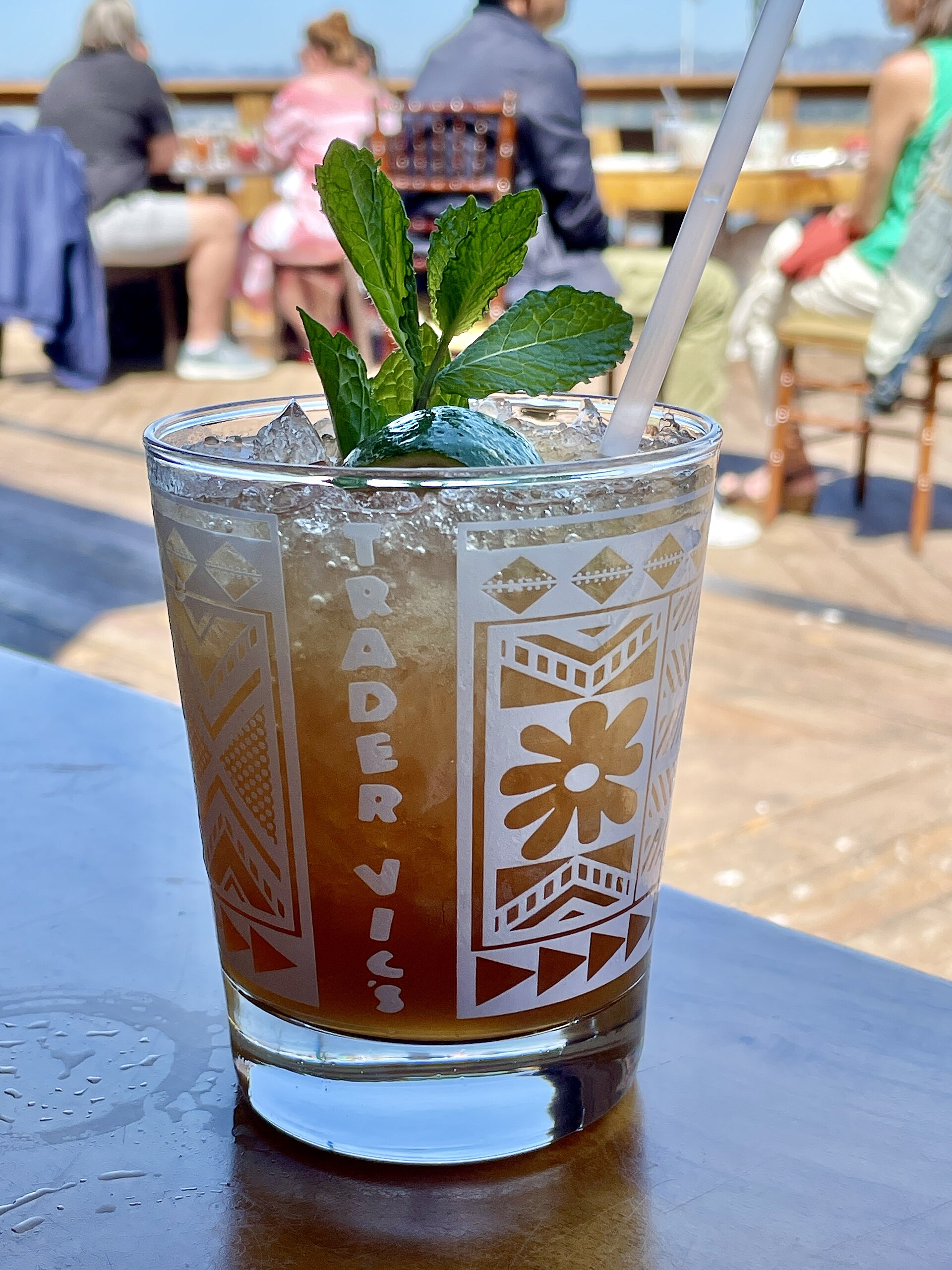
In 1970, two aging restaurant owners who had spent decades building competing island fantasies out of bamboo, rum, and flaming volcanoes finally let lawyers deal with something bartenders had been arguing about for thirty years: who actually invented the Mai Tai.
Table of Contents
One man had a story with named witnesses, a specific bottle of rum, and a Tahitian phrase for a name. The other had an earlier drink, a fiercely guarded secret recipe, and no paper trail at all. One of them won a private legal settlement over the commercial use of the name — which is not quite the same thing as history crowning him the inventor, and tiki historians still argue over which one it should have been.
Quick answer
Victor “Trader Vic” Bergeron said he invented the Mai Tai in 1944 at his Oakland restaurant. Ernest “Donn Beach” Gantt, owner of the older Don the Beachcomber chain, claimed he’d built a similar drink years earlier. A 1970 out-of-court settlement resolved a trademark dispute in Bergeron’s favor and forced Beach’s licensees to stop using the name commercially — but that private deal didn’t legally crown Bergeron the drink’s inventor for all time, and it didn’t give anyone lasting exclusive rights to what is now just a generic cocktail name poured at bars everywhere.
A rum, a guest from Tahiti, and a phrase
Bergeron’s version of events, which he told for the rest of his life, goes like this: one night in 1944 he pulled a bottle of 17-year-old J. Wray & Nephew Jamaican rum from behind the bar, built a drink around it with lime, orange curaçao, orgeat, and rock candy syrup, and served it to friends visiting from Tahiti. One of them took a sip and reportedly said “Mai Tai — Roa Ae,” Tahitian for “out of this world — the best.” The name stuck, and so did the drink: it became one of the best-known cocktails of the twentieth century.
That bottle detail isn’t decoration — Wray & Nephew’s 17-year rum was rare even then, and the Mai Tai’s popularity is often credited with helping drink the world’s remaining stock dry within a couple of decades. Bergeron later had to rebuild the recipe around blended aged Jamaican rum once the original ran out.
The other tiki king says ‘not so fast’
Here’s the wrinkle: Bergeron wasn’t the first person running a fake-tropical bar stocked with rum drinks. Ernest Raymond Beaumont Gantt — who legally changed his name to Donn Beach — opened Don the Beachcomber in Hollywood in 1933, more than a decade before Bergeron’s Oakland night. Beach built the entire tiki bar concept, and he claimed a drink he called the Q.B. Cooler predated and inspired what Bergeron later sold as the Mai Tai.
The dispute stayed a bar-stool argument for years until it became a business problem. Around 1968–1970, a company licensing the Don the Beachcomber name put a Mai Tai mix on the market, directly threatening Trader Vic’s trademark on the name he’d built a restaurant empire around. Bergeron sued, and the case was settled out of court in 1970: he retained commercial trademark rights to the name in the U.S., and the licensee agreed to stop using it in marketing. Carrie Guild, one of the Tahitian guests from that 1944 night, signed an affidavit backing Bergeron’s account, which is a big part of why his origin story became the standard one told in bars ever since. But it was a private settlement between two businesses, not a court ruling on cocktail history — and it didn’t stop ‘Mai Tai’ from becoming exactly the kind of generic drink name any bartender can use today without asking Trader Vic’s permission.
The part most people miss
Donn Beach never lost the fight because his drink didn’t exist — he lost it because nobody could prove what his drink actually was. Beach ran his bar like a vault: bottles behind the counter carried no labels, only numbers, and his recipes were written entirely in that numeric code so a bartender couldn’t quit, memorize the formulas, and open a rival tiki bar down the street with his exact drinks. It worked brilliantly as a trade-secret strategy for thirty years — and then it backfired completely. When it came time to argue that the Q.B. Cooler predated the Mai Tai, there was no readable recipe to point to. Decades later, tiki historian Jeff “Beachbum” Berry spent years tracking down surviving fragments of Beach’s coded recipes and cross-referencing old bartenders just to reconstruct what Beach had actually been pouring in the 1930s. Even that painstaking reconstruction didn’t produce a smoking-gun original Mai Tai — just a related, more complicated ancestor drink. Bergeron won the 1970 settlement in part because he was the one who left a paper trail. Beach’s secrecy protected his business for a generation and then cost him the credit in the history books, even though it never touched anyone’s right to serve a Mai Tai today.
Sources
Wikipedia’s entry on the Mai Tai, which documents both Bergeron’s and Beach’s competing invention claims and the 1944-versus-1933 dating dispute.
The Castle Museum’s history of the Castle Cocktail Lounge, which covers the 1970 trademark lawsuit, the confidential out-of-court settlement, and the Guild family affidavits.
Prohibition Denver’s account of the Trader Vic vs. Don the Beachcomber dispute, which details the settlement terms and notes that many historians still credit Beach with the moral, if not legal, claim.
Explore more: More true food origin stories.
Mai Tai FAQs
Did Don the Beachcomber really invent the Mai Tai first?
He claimed an earlier, similar drink called the Q.B. Cooler predated it, but no verifiable written recipe from that era has ever surfaced to prove it, so historians treat it as an unresolved rival claim rather than settled fact.
What does the name ‘Mai Tai’ actually mean?
According to Trader Vic’s own account, it comes from a Tahitian exclamation, ‘Mai Tai — Roa Ae,’ meaning roughly ‘out of this world — the best.’
Does Trader Vic’s own the Mai Tai name today?
Not in any way that stops anyone from making one. A 1970 out-of-court settlement resolved a specific commercial trademark dispute in Bergeron’s favor at the time, but it was a private deal, not a lasting legal monopoly — ‘Mai Tai’ functions as a generic cocktail name today, served at bars worldwide with no license from Trader Vic’s required.
Tales You Can Hold
Fun-facts books for curious kids, personalized books that star your child, and more from the FYI Tales Bookstore. Visit the Bookstore.
Photo: Kevdo / CC BY-SA 4.0, via Wikimedia Commons.