
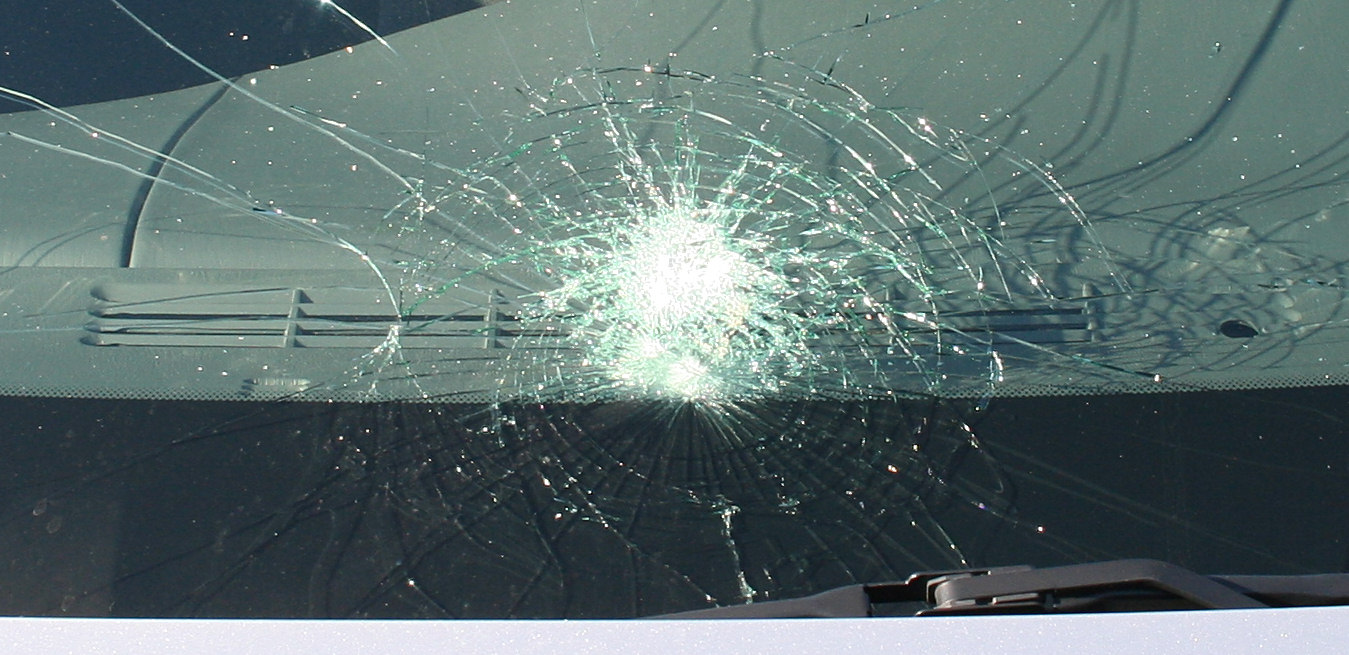
In November 1903, a French chemist named Édouard Bénédictus knocked a glass flask off a shelf in his Paris laboratory. Glass hitting a stone floor should mean a sweep and a dustpan. Instead, the flask cracked into a spider’s web of fracture lines and just… stayed together, holding its shape like a cracked windshield rather than scattering across the room.
Table of Contents
Bénédictus was curious enough to ask why. The answer sat in an old, unwashed flask, a lucky accident, and a habit most chemists would have ignored. What happened next took six more years, a newspaper story about a car crash, and a fair amount of competition from a rival inventor most people have never heard of — before that flask turned into the safety glass in your car windshield today.

Quick answer
Laminated safety glass traces to 1903, when French chemist Édouard Bénédictus dropped a glass flask that had been coated in a residue of cellulose nitrate (the plastic film left behind after a solution called collodion evaporated). The flask cracked but didn’t shatter apart, which gave him the idea for glass bonded to a plastic interlayer — a product he patented in 1909 and sold under the name Triplex.
A flask that refused to fall apart
The flask that fell off Bénédictus’s shelf wasn’t ordinary glassware. It had previously held a solution of collodion, a syrupy mix of cellulose nitrate (a plastic derived from treated cotton) dissolved in alcohol and ether — the same stuff used at the time to dress wounds and coat early photographic plates. Nobody had rinsed it out. Over time, the solvent evaporated and left behind an invisible, thin plastic film clinging to the inside of the glass.
So when the flask hit the floor, it broke the way glass always breaks: countless fine fracture lines racing across the surface. But that thin film held the fragments in place, like a pane of glass with an internal skeleton. Most chemists would have swept it up without a second thought. Bénédictus, who kept detailed lab notebooks, wrote the incident down and moved on to other work — for years, that’s where it stayed, a curiosity and nothing more.
The newspaper story that changed his mind
What pulled the idea off the shelf, according to Bénédictus’s own later account, was a newspaper report about an automobile accident in which flying glass badly injured people in the crash. Cars were new, roads were rough, and windshields were plain glass that shattered into knife-like shards on impact — a real and growing hazard as automobiles spread across France in the early 1900s.
Bénédictus reportedly returned to his lab, remembered the flask, and built the first sheet of what he called Triplex: two layers of glass sandwiching a thin film of cellulose nitrate, pressed and bonded together. He filed his patent in 1909 and, in 1911, founded the Société du Verre Triplex to manufacture it. The timeline from accident to patent ran roughly six years — a reminder that most ‘eureka’ moments are really ‘eventually’ moments.
Triplex didn’t take over the automotive world overnight. Manufacturing laminated sheets by hand was slow and expensive, so the earliest large-scale customer wasn’t the car industry at all — it was the military, which used laminated glass in gas mask eyepieces during the First World War. Automakers came around more gradually; Ford is credited with putting laminated safety glass into production windshields starting in 1929, with British manufacturers following in the early 1930s.
The part most people miss
Here’s the twist that gets left out of most retellings: Bénédictus wasn’t actually the first person to patent laminated glass. An English solicitor named John Crewe Wood filed a British patent in 1905 — four years before Bénédictus — for a very similar idea: glass layered with a transparent plastic interlayer, in Wood’s case bonded with Canada balsam, a natural tree resin long used to cement optical lenses together. Wood even started a company, the Safety Motor Screen Company, to sell his version as an automobile windshield. It’s why some serious histories of the technology, including academic accounts of the chemistry, list Wood’s patent as the earlier filing even while Bénédictus remains the name attached to the popular origin story. Wood’s product ran into manufacturing problems and never scaled, while Bénédictus’s cellulose-nitrate version, backed by a real company and eventually big industrial licensees, became the version the world actually adopted — and remembered. It’s a pattern that shows up again and again in invention history: the person credited with ‘inventing’ something is often the one who commercialized it successfully, not necessarily the one who thought of it first.
Sources
Wikipedia’s entry on Édouard Bénédictus and laminated glass, which lays out the flask accident, the 1909 patent, and the founding of the Société du Verre Triplex.
McGill University’s Office for Science and Society, ‘What is Safety Glass?’, which corroborates the collodion-flask story and traces the material’s evolution from cellulose nitrate to cellulose acetate to modern polyvinyl butyral interlayers.
Glassonweb.com’s history of PVB laminated glass in the automotive industry, by Luc Moeyersons, which documents John Crewe Wood’s earlier 1905 patent and the Safety Motor Screen Company alongside Bénédictus’s later, more successful commercialization.
Explore more: more accidental inventions.
safety glass FAQs
Who really invented safety glass?
French chemist Édouard Bénédictus is generally credited with inventing laminated safety glass after a 1903 lab accident and a 1909 patent, though English solicitor John Crewe Wood filed a similar laminated-glass patent in 1905, four years earlier.
What caused the original safety glass accident?
A glass flask that had once held a cellulose nitrate solution (collodion) was dropped in Bénédictus’s Paris laboratory in 1903. The solvent had evaporated and left an invisible plastic film coating the inside of the flask, which held the broken glass together on impact.
When did safety glass become standard in cars?
Laminated glass saw its first major use in gas mask eyepieces during World War I, well before cars adopted it widely. Ford began installing it in production windshields starting in 1929, with other automakers following through the 1930s.
Tales You Can Hold
Fun-facts books for curious kids, personalized books that star your child, and more from the FYI Tales Bookstore. Visit the Bookstore.
Photo: Tysto / Public domain, via Wikimedia Commons.