In the spring of 1921, a horse-racing reporter typed nine words that outlived every horse he ever covered. Buried in a New York Morning Telegraph column about a trainer shipping his string north for the season, John J. Fitz Gerald mentioned an unremarkable-sounding destination: “the big apple.” He had no idea he’d just given the most famous city on Earth its nickname.
Table of Contents
The real story isn’t a marketing stunt dreamed up by a copywriter — it starts on the backstretch of a Louisiana racetrack, gets carried north by stable hands nobody bothered to name, nearly dies out completely, and only survives because an ad man dug it back up during one of New York’s roughest decades. Here’s what the record actually shows.
Quick answer
New York is called the Big Apple because sportswriter John J. Fitz Gerald popularized the phrase in his New York Morning Telegraph horse-racing column starting in 1921, after hearing Black stable hands at a New Orleans racetrack use it to describe New York’s top-tier tracks. The nickname faded by the late 1950s, then was deliberately revived in 1971 by New York City’s tourism bureau.
A Tip Overheard at the Fair Grounds
Fitz Gerald covered thoroughbred racing for the Morning Telegraph, and in his May 3, 1921 column he wrote that a trainer’s horses, including one called Tippity Witchet, were “scheduled to start for ‘the big apple’ to-morrow” after a strong spring at the Maryland tracks. It read like racetrack shorthand because it was one — Fitz Gerald later credited two unnamed Black stable hands he’d overheard at the Fair Grounds Race Course in New Orleans, discussing where a horse was headed next. To them, “the big apple” meant New York: the richest purses, the toughest fields, the place every serious horseman wanted to reach.
Etymologist Barry Popik spent years cross-referencing racing schedules and dated that overheard conversation to around January 1920, more than a year before it made print. Fitz Gerald liked the phrase enough to name his column after it — “Around the Big Apple” — and by February 1924 he was writing flatly: “There’s only one Big Apple. That’s New York.”
From the Backstretch to the Bandstand
The phrase mostly stayed inside racing circles through the 1920s, but jazz musicians picked it up in the following decade and gave it a second life. Touring bands used to say there were “many apples on the tree,” but playing New York — the biggest stages, the best-paying gigs — meant you’d made it to the Big Apple. The line inspired a dance craze and a hit song of the same name in the late 1930s, tying the nickname to Harlem’s nightlife almost as tightly as to the racetrack.
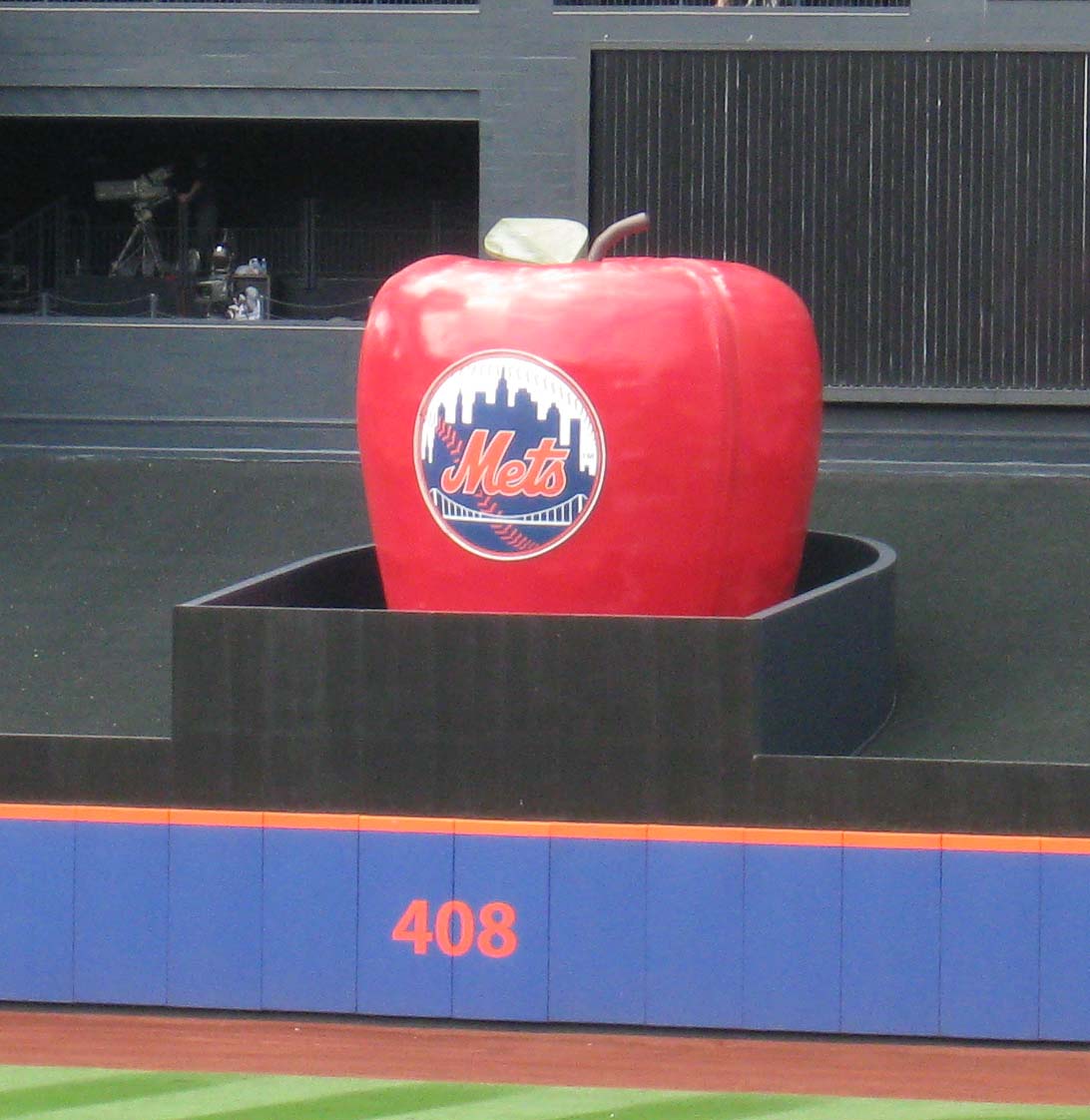
Then it nearly vanished. Columnist Walter Winchell kept using it into the early 1950s, but by decade’s end “the Big Apple” sounded dated, and most New Yorkers had quietly dropped it. It took a city in crisis to bring it back: in the early 1970s, with tourism sagging, Charles Gillett of the New York Convention and Visitors Bureau resurrected the old jazz-and-racetrack phrase for a promotional campaign built around a red apple logo. Volunteers handed out real apples on street corners, and this time the name stuck for good.
The part most people miss
Fitz Gerald’s 1921 column isn’t actually the oldest print sighting of “big apple.” Writer Edward Sandford Martin used the phrase back in 1909, in a book called The Wayfarer in New York, describing the nation’s wealth flowing toward the city the way sap feeds one fruit while the rest of the tree gets comparatively little. But language researcher William Safire and others draw a line between a one-off metaphor and an adopted nickname — Martin coined an image; Fitz Gerald, quoting working horsemen, gave the city a name people actually kept using. There’s also a persistent legend that the nickname traces to a Manhattan brothel madam named Eve, which the same researchers have traced and debunked as a much later invention with no historical backing. The honest version is messier and better: unnamed Black stable hands’ racetrack slang, kept alive by one sportswriter’s ear for a good line, and saved decades later by an ad campaign.
Sources
This account draws on Barry Popik’s etymological research documenting the May 3, 1921 New York Morning Telegraph citation and Fitz Gerald’s later columns; the Wikipedia entry for “Big Apple,” which compiles the Edward Sandford Martin citation, the jazz-era usage, and the 1971 tourism campaign; and the New York Public Library’s history of the nickname, based on Gerald Cohen and Barry Popik’s book Origin of New York City’s Nickname ‘The Big Apple.’
Explore more: more true stories behind everyday words and phrases.
the Big Apple FAQs
Who actually coined the term ‘Big Apple’ for New York?
No single person coined it outright. Unnamed Black stable hands at a New Orleans racetrack used the phrase around 1920; sportswriter John J. Fitz Gerald overheard it, printed it in 1921, and made it famous.
Why did New York almost stop being called the Big Apple?
The nickname faded after its 1920s-1930s heyday in horse racing and jazz circles. By the late 1950s it sounded old-fashioned and largely dropped out of everyday use until a 1971 tourism campaign revived it.
Is the story about a brothel owner named Eve true?
No. That’s a popular but unsupported legend. Researchers who traced the nickname’s actual print history found no evidence connecting it to a brothel madam.
Tales You Can Hold
Fun-facts books for curious kids, personalized books that star your child, and more from the FYI Tales Bookstore. Visit the Bookstore.
Photo: Richiekim / CC BY-SA 3.0, via Wikimedia Commons.