
Right now, somewhere inside you, a factory is running that never gets a day off: the surface of your stomach is quietly dissolving in its own acid, and your body is replacing it just as fast. By the end of this week, nearly every cell lining that organ will be gone, swapped for a new one, and you won’t feel a thing.
Table of Contents
This isn’t a wellness-blog exaggeration. It’s a well-documented piece of human biology, first mapped out cell-by-cell by researchers tracing radioactive markers through the stomachs of lab animals. What they found explains not just how your gut survives its own digestive juices, but why things go wrong when the rebuilding process gets sabotaged.
Quick answer
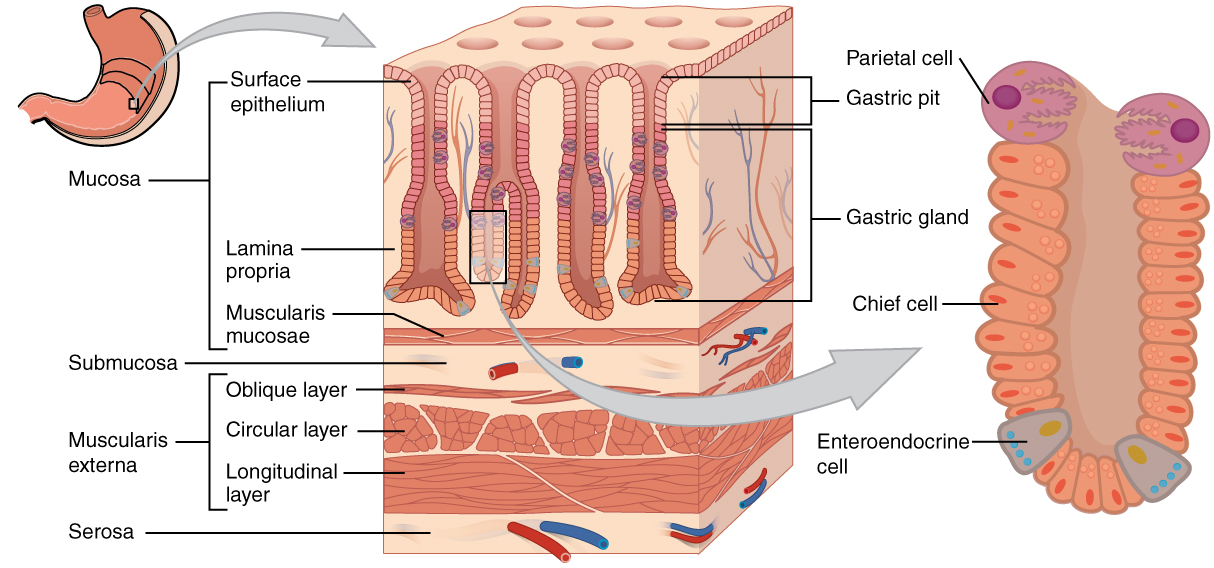
The cells on the surface of your stomach lining are replaced roughly every 3 to 5 days, among the fastest cell turnover rates in the human body. New cells are constantly produced by stem cells in a zone called the isthmus, deep inside the stomach’s tiny glands, and pushed upward to replace cells worn away by acid and digestion.
An acid bath your cells can’t survive for long
Gastric acid sits around pH 2, acidic enough to be genuinely corrosive to living tissue. It has to be that strong to break down food and kill off swallowed bacteria. The problem is that the stomach itself is made of living tissue too, sitting in a bath of the very acid it produces, alongside enzymes built to shred proteins.
The reason your stomach doesn’t digest itself is a defense system with several layers, but the headline one is a coating of mucus mixed with bicarbonate that clings to the epithelial surface. That gel keeps the immediate surface of the lining close to neutral pH even while the open stomach cavity a few millimeters away sits at pH 2. Any cell that does get damaged doesn’t get repaired so much as replaced outright, and fast.
Mapping the factory floor
The people who actually worked out where new stomach cells come from were anatomists Sherif M. Karam and Charles Philippe Leblond at McGill University, whose radioautography studies, published as a series in The Anatomical Record in 1993, injected mice with tritium-labeled thymidine, a building block of DNA, and then tracked which cells lit up as they divided and migrated over time.
They found the action happens in a narrow band inside each gastric gland called the isthmus. Stem cells there divide continuously, and their daughter cells migrate in two directions: some travel up toward the stomach’s surface to become short-lived mucus-secreting cells, replaced within about 3 to 5 days, while others migrate down into the gland to mature into acid- and enzyme-producing cells that stick around for weeks to months before they, too, get replaced.
Nearly two decades later, researcher Nick Barker and colleagues went further, identifying a specific stem cell marker called Lgr5 at the base of the stomach’s pyloric glands. Their 2010 study in Cell Stem Cell showed these Lgr5-positive cells could be grown in a dish into self-organizing, long-lived clusters of gastric tissue, essentially proving in a petri dish what Karam and Leblond had mapped inside a living animal: a small population of stem cells is quietly rebuilding the whole structure, on a loop, for your entire life.
The part most people miss
For decades, doctors assumed stomach ulcers came from stress, spicy food, or excess acid alone, and treated them accordingly. That changed because of Australian physicians Barry Marshall and Robin Warren, who in the early 1980s kept finding spiral-shaped bacteria in biopsies from ulcer patients and suspected the bacteria, not lifestyle, were the real cause. When the medical establishment was skeptical, Marshall drank a broth swimming with the bacterium, Helicobacter pylori, and developed gastritis within about a week, biopsy-confirmed. He then cured himself with antibiotics. Marshall and Warren won the 2005 Nobel Prize in Physiology or Medicine for the discovery. The lesson connects directly back to the renewal story: H. pylori doesn’t dissolve the stomach lining by itself, it burrows into the protective mucus layer and disrupts it, tipping the balance so acid damage outpaces the stomach’s normal 3-to-5-day rebuild cycle. Ulcers, in other words, are often less a story about acid and more a story about a broken renewal system.
Sources
Frontiers in Cell and Developmental Biology, “Gastric Stem Cells: Physiological and Pathological Perspectives” (2020), which synthesizes the radioautography turnover data originally established by Sherif M. Karam and Charles Philippe Leblond at McGill University in their 1993 Anatomical Record series.
Barker, N. et al., “Lgr5+ve Stem Cells Drive Self-Renewal in the Stomach and Build Long-Lived Gastric Units In Vitro,” Cell Stem Cell (2010), on the identification of Lgr5-marked gastric stem cells.
The Nobel Prize organization’s biographical and interview materials on Barry J. Marshall, 2005 Nobel Laureate in Physiology or Medicine, documenting the H. pylori self-experiment with Robin Warren.
Explore more: More Amazing Body stories.
stomach lining FAQs
How long does it take for the stomach lining to fully regenerate?
The surface layer of mucus-producing cells turns over roughly every 3 to 5 days. Deeper cells that produce acid and digestive enzymes live longer, typically weeks to months, before they’re replaced.
Why doesn’t the stomach digest itself?
A sticky layer of mucus mixed with bicarbonate coats the lining and keeps the pH near neutral right at the cell surface, even though the open stomach cavity can be as acidic as pH 2. Constant cell replacement backs up that chemical barrier.
What actually causes most stomach ulcers?
Most peptic ulcers are caused by infection with Helicobacter pylori bacteria, a discovery made by Barry Marshall and Robin Warren, who won the 2005 Nobel Prize for it. The bacteria damage the protective mucus barrier faster than the stomach can rebuild it.
Where do new stomach lining cells come from?
They’re produced by stem cells clustered in a region called the isthmus inside each of the stomach’s gastric glands. Those stem cells divide continuously, sending new cells migrating up to the surface or down into the gland.
Tales You Can Hold
Fun-facts books for curious kids, personalized books that star your child, and more from the FYI Tales Bookstore. Visit the Bookstore.
Photo: Henry Vandyke Carter / Public domain, via Wikimedia Commons.