
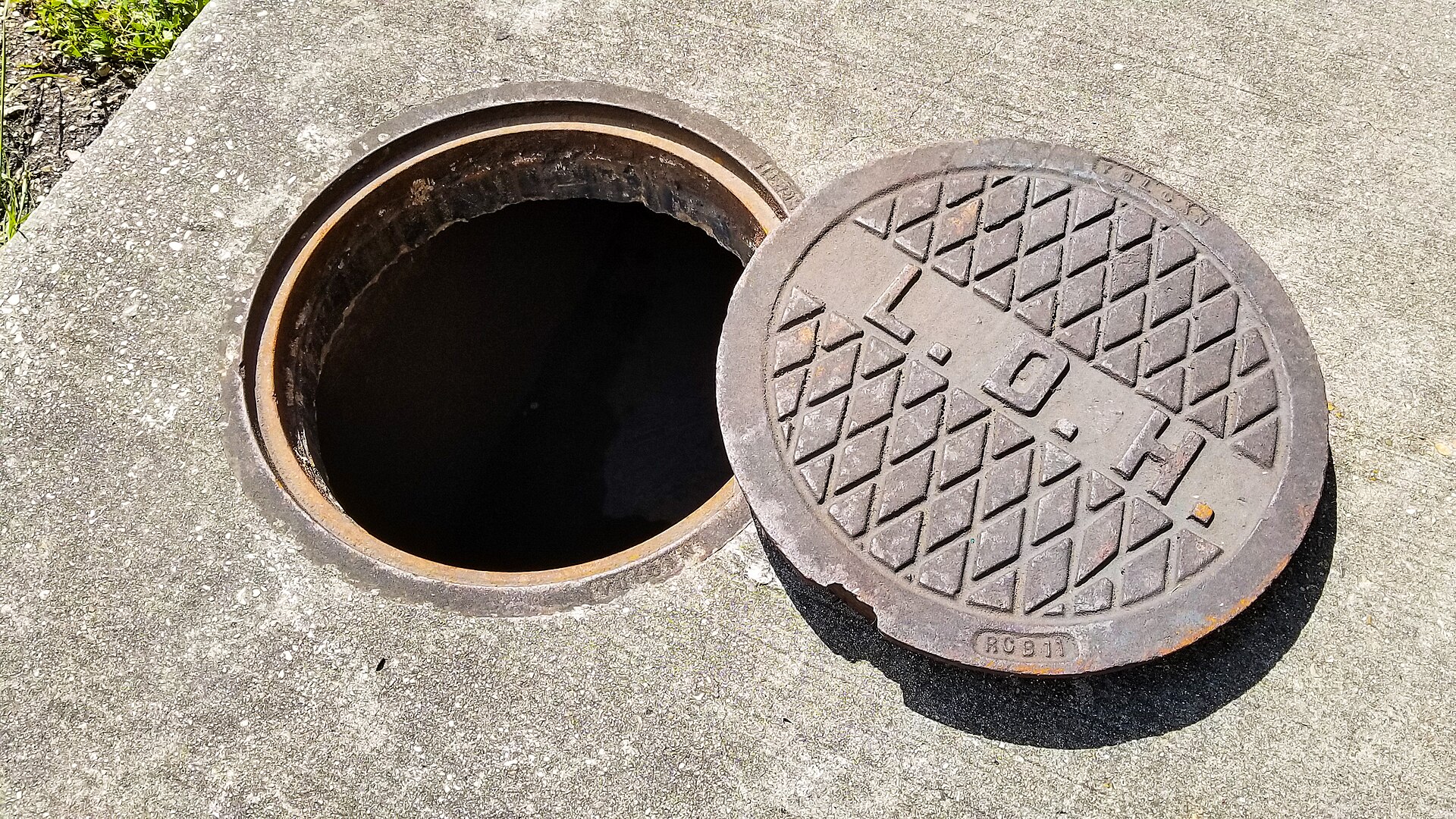
For decades, nervous job candidates walked into interviews at Microsoft and got hit with a question that had nothing to do with software: why are manhole covers round? Legend says it was Bill Gates’s favorite way to watch someone think on their feet. The trouble is, Microsoft probably didn’t invent the question at all — and the tidy answer everyone gives isn’t even the whole engineering story.
Table of Contents
The real explanation for round manhole covers is genuinely satisfying geometry, but it’s tangled up with two other stories that rarely get told alongside it: the shape’s math has a loophole nobody has ever actually built, and a manhole cover once became the accidental hero of a Cold War nuclear test that may or may not have flung it into space.
Quick answer
Manhole covers are round because a circle is the one basic shape that cannot fall down through its own opening no matter how it’s turned or dropped, while it can also be rolled by one worker instead of carried, and it never needs to be lined up at a particular angle to fit.
The shape that can’t cheat gravity
Take a square manhole cover the same width as its hole. Tilt it on its diagonal, and that diagonal is about 1.4 times longer than the sides — which means a square cover can be angled and dropped straight down into the hole it’s supposed to be sealing. Rectangles and ovals have the same problem. A circle doesn’t: its width is identical in every direction, so it always rests on the rim no matter how it’s rotated or tipped.
That single property saves lives and shins in a very literal way — sewer and utility covers sit over shafts that can run many feet deep, often below fast-moving traffic, so a cover that could accidentally drop onto a worker below is a serious hazard. Round covers also don’t have to be aligned before they’re set in place, and because a cylinder is a naturally strong shape against the surrounding soil’s pressure, the round frame and round cover have shared the job since cast-iron street hardware became common in the mid-1800s, when foundries were casting them by the thousands for the sewer and gas-line booms of growing industrial cities.
The interview question that ate its own history
By the 1990s, ‘why are manhole covers round’ had become shorthand for a certain kind of tech-company interview: an odd, seemingly pointless riddle meant to reveal how a candidate thinks, not what they know. It got folded into corporate folklore as a Microsoft classic, then a Google classic, and was cemented in pop culture by William Poundstone’s 2003 book on brainteaser interviews, ‘How Would You Move Mount Fuji?’
But the question is much older than any tech company. The geometric insight behind it — that only a shape of constant width can’t fall through a same-sized hole — comes out of 19th-century recreational mathematics, long before Silicon Valley existed to take credit. Former Google engineer Gayle Laakmann McDowell has said the Google association was largely a myth too; the rumor mill had simply pinned it on whichever giant tech employer was fashionable to gossip about at the time. Eventually the brainteaser era itself fell out of favor — Google’s own head of hiring, Laszlo Bock, said in 2013 that brainteasers were ‘a complete waste of time’ because they didn’t actually predict who’d be good at the job.
The part most people miss
Here’s the twist that even the interview-question fans usually don’t know: the circle isn’t the only shape that works. Mathematicians call the circle’s property ‘constant width,’ and it turns out there’s a whole family of other shapes with the same trick — most famously the Reuleaux triangle, a rounded triangle built from three overlapping arcs. Like a circle, a Reuleaux triangle can’t fall through a hole matching its width, from any angle. It even has an advantage a circle doesn’t: it won’t roll away down the street if a worker isn’t careful. So why has almost no city ever used one? Mathematician David Eppstein went looking for a real-world Reuleaux manhole cover and came up empty, noting he could find no evidence anyone has actually manufactured one for use — the shape survives only as a favorite illustration in geometry classes, not in the street. And in an entirely different corner of manhole-cover trivia, a cast-iron cap became a minor character in Cold War history: during the 1957 Pascal-B nuclear test in Nevada, physicist Robert Brownlee calculated that a heavy steel cap placed over the shaft could have been blown upward at roughly 41 miles per second when the device beneath it detonated — fast enough, in theory, to have left Earth’s atmosphere. It shows up in one blurry frame of high-speed film and was never seen again. Brownlee himself doubted it survived the trip, believing it was far more likely vaporized by atmospheric friction, and no evidence has ever confirmed it reached space — but the story of ‘the manhole cover that outran a rocket’ still circulates as one of the great unresolved footnotes of the nuclear testing era.
Sources
Mental Floss, ‘The Reason Why Manhole Covers Are Round,’ for the core geometry explanation and diagonal-distance reasoning.
David Eppstein (UC Irvine computer scientist and mathematician), personal blog post ‘The Mythical Reuleaux Manhole Cover,’ for the finding that no real Reuleaux-triangle manhole cover has ever been documented in use.
Reporting on the 1957 Pascal-B test of Operation Plumbbob and physicist Robert Brownlee’s velocity calculations, alongside Snopes’s review of the ‘manhole cover launched into space’ legend and its unconfirmed status; and reporting on the history of the manhole-cover interview riddle, including Gayle Laakmann McDowell’s and Laszlo Bock’s comments on its use and decline in tech hiring.
Explore more: more everyday object origin stories.
manhole cover FAQs
Why are manhole covers round instead of square?
A round cover can’t fall through its own opening no matter how it’s tilted, because its width is the same in every direction — a square cover’s diagonal is longer than its sides, so it can slip through if angled just right.
Did Microsoft really invent the manhole cover interview question?
No. The puzzle circulated in recreational math circles for decades before tech companies adopted it, and reports suggest the Microsoft (and later Google) association was more office folklore than documented company policy.
Is a circle the only shape that can’t fall through its hole?
No — any ‘curve of constant width,’ like the Reuleaux triangle, has the same property. No city is known to have actually used one for manhole covers, though.
Did a manhole cover actually get launched into space?
It’s unconfirmed. A 1957 nuclear test calculation suggested a steel cap could have reached extreme speed, but the physicist behind the estimate doubted it survived intact, and there’s no confirmed evidence it ever reached space.
Tales You Can Hold
Fun-facts books for curious kids, personalized books that star your child, and more from the FYI Tales Bookstore. Visit the Bookstore.
Photo: Bart Everson / CC BY 2.0, via Wikimedia Commons.