
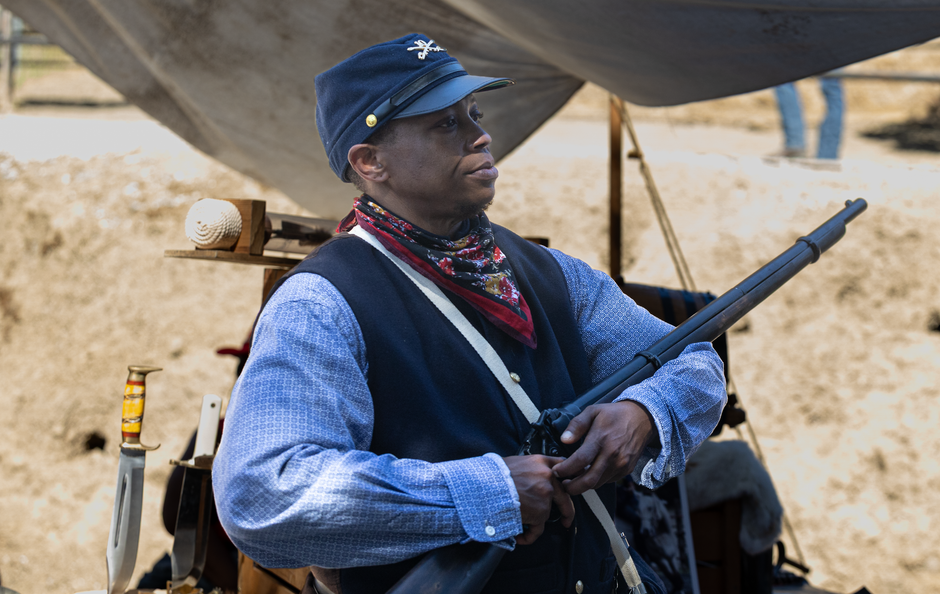
Picture a canvas surgical tent in 1863: lantern light, a soldier clenching a lead bullet between his molars so he won’t scream while a surgeon saws through bone, no anesthesia within a hundred miles. It’s one of the most vivid images in American folklore about the Civil War — and according to the historians who’ve actually gone digging through the primary sources, it almost certainly never happened, at least not as the origin of the phrase.
Table of Contents
The real story behind ‘bite the bullet’ is older, weirder, and starts nowhere near a hospital tent. It begins on a parade ground, with a British soldier tied to a wooden frame called a halbert and lashed with a whip that had nine knotted tails — and it took another century, plus a newspaper serial about a friend going blind, to turn a grim battlefield ritual into the everyday phrase we use for gritting our teeth through anything unpleasant.
Quick answer
‘Bite the bullet’ almost certainly doesn’t come from battlefield surgery. Soldiers literally biting a bullet is documented as an 18th-century British flogging practice by 1796, and the exact phrase itself is dated by Merriam-Webster’s first-known-use record to 1844 — decades before its most famous early appearance, in Rudyard Kipling’s story The Light That Failed, which ran in newspapers in late 1890 before being published as a novel in 1891.
A grim point of honor
The oldest solid paper trail leads to Francis Grose, a former soldier turned lexicographer who compiled A Classical Dictionary of the Vulgar Tongue, a dictionary of British slang and army jargon. In his entry for a soldier who cries out under punishment (he calls such a man a ‘nightingale’), Grose explains that among grenadiers in some regiments it was ‘a point of honour’ never to cry out while being flogged with the cat o’ nine tails — and that to manage it, they would ‘chew a bullet.’
That’s not a metaphor. It’s a description of soldiers biting down on an actual lead ball, clenched between the teeth, to keep from screaming during a punishment that could lay a man’s back open. It’s grim, it’s real, and it predates the American Civil War by nearly seventy years.
The Civil War myth that swallowed the real story
So how did the phrase end up glued to Civil War amputations? Partly because the image is so cinematic, and partly because the era genuinely did produce horrifying surgical scenes — just not unmedicated ones as often as legend claims. According to the National Museum of Civil War Medicine, anesthesia (usually chloroform, sometimes ether) was used in roughly 95 percent of Civil War surgeries, and the museum’s researchers say a review of primary sources ‘failed to turn up any contemporary references to biting the bullet, especially during surgery.’
What onlookers actually saw was often lightly anesthetized men groaning and thrashing on the table — patients who were unconscious but not fully still, which to a bystander could easily look like agony endured without any relief at all. Military surgical manuals of the period didn’t instruct surgeons to give patients anything to bite down on. The myth, in other words, likely grew out of a misreading of chloroform’s rough edges, not an actual widespread practice.
The part most people miss
Even the paper trail for the phrase itself is messier than the tidy ‘Kipling coined it’ version that gets repeated online. Merriam-Webster’s dictionary entry lists 1844 as the first known use of ‘bite the bullet’ — nearly half a century after Grose’s flogging-era ‘chew a bullet,’ and decades before Kipling ever put pen to paper, though the specific 1844 citation isn’t one that’s widely reproduced or easy to track down independently. What is well documented is the phrase’s breakout literary moment, and it happened a year earlier than most retellings claim: not in Kipling’s 1891 novel The Light That Failed, but in the newspaper serialization that preceded it. The etymology site Wordhistories.net traced a printing to the St. Louis Post-Dispatch on 14 December 1890, syndicating Kipling’s serialized text, in which a friend named Torpenhow grips the increasingly blind painter Dick Heldar and tells him, ‘Bite on the bullet, old man, and don’t let them think you’re afraid.’ Nobody in that scene is anywhere near an actual battlefield or a bullet — by the time it hit newsprint, the phrase was already pure metaphor. There’s one more wrinkle worth knowing: Harriet Tubman did leave an account of assisting at a real Civil War amputation in which a soldier was given a bullet to bite, so the surgery version of the story isn’t invented from thin air — it’s just a rare exception, not the rule, that later got mistaken for the whole origin. And the phrase is often confused with a completely separate, and far more consequential, historical incident: the 1857 Indian Rebellion, sparked in part by rumors that new rifle cartridges soldiers had to bite open were greased with cow and pig fat, offending Hindu and Muslim sepoys alike. That’s a real and pivotal moment in imperial history — it’s just not where ‘bite the bullet’ comes from.
Sources
National Museum of Civil War Medicine, ‘Anesthesia in the Civil War,’ civilwarmed.org — on the 95 percent anesthesia-use figure and the museum’s own review of primary sources finding no contemporary accounts of bullet-biting during surgery.
Phrases.org.uk, ‘Bite the Bullet — Meaning & Origin of the Phrase’ — on Francis Grose’s A Classical Dictionary of the Vulgar Tongue (1796 edition) and the flogging-era origin of soldiers ‘chewing a bullet.’
Wordhistories.net, ‘The Authentic Origin of “To Bite the Bullet”‘ — on the 14 December 1890 St. Louis Post-Dispatch printing of Kipling’s serialized The Light That Failed, the earliest documented appearance of the phrase’s famous literary usage, predating the 1891 book publication.
Merriam-Webster, dictionary entry for ‘bite the bullet’ — listing 1844 as the first known use of the phrase.
Explore more: More true stories behind everyday phrases.
bite the bullet FAQs
Did Civil War soldiers really bite bullets during surgery?
Almost certainly not as standard practice. About 95 percent of Civil War amputations were performed with anesthesia, usually chloroform, and researchers have found no contemporary written accounts describing soldiers biting bullets during operations.
Where does ‘bite the bullet’ actually come from?
The earliest documented practice is British soldiers biting down on a bullet to keep from crying out while being flogged with the cat o’ nine tails, described in Francis Grose’s 1796 dictionary of military and street slang.
When did ‘bite the bullet’ first appear in print?
Merriam-Webster dates the first known use of the exact phrase to 1844. Its best-documented and most famous early appearance, though, is in Rudyard Kipling’s story The Light That Failed, syndicated in newspapers starting in December 1890 — a year before it was published as a novel in 1891.
What does ‘bite the bullet’ mean today?
To force yourself to face something difficult, painful, or unpleasant that you’ve been putting off, with resolve rather than avoidance.
Tales You Can Hold
Fun-facts books for curious kids, personalized books that star your child, and more from the FYI Tales Bookstore. Visit the Bookstore.