
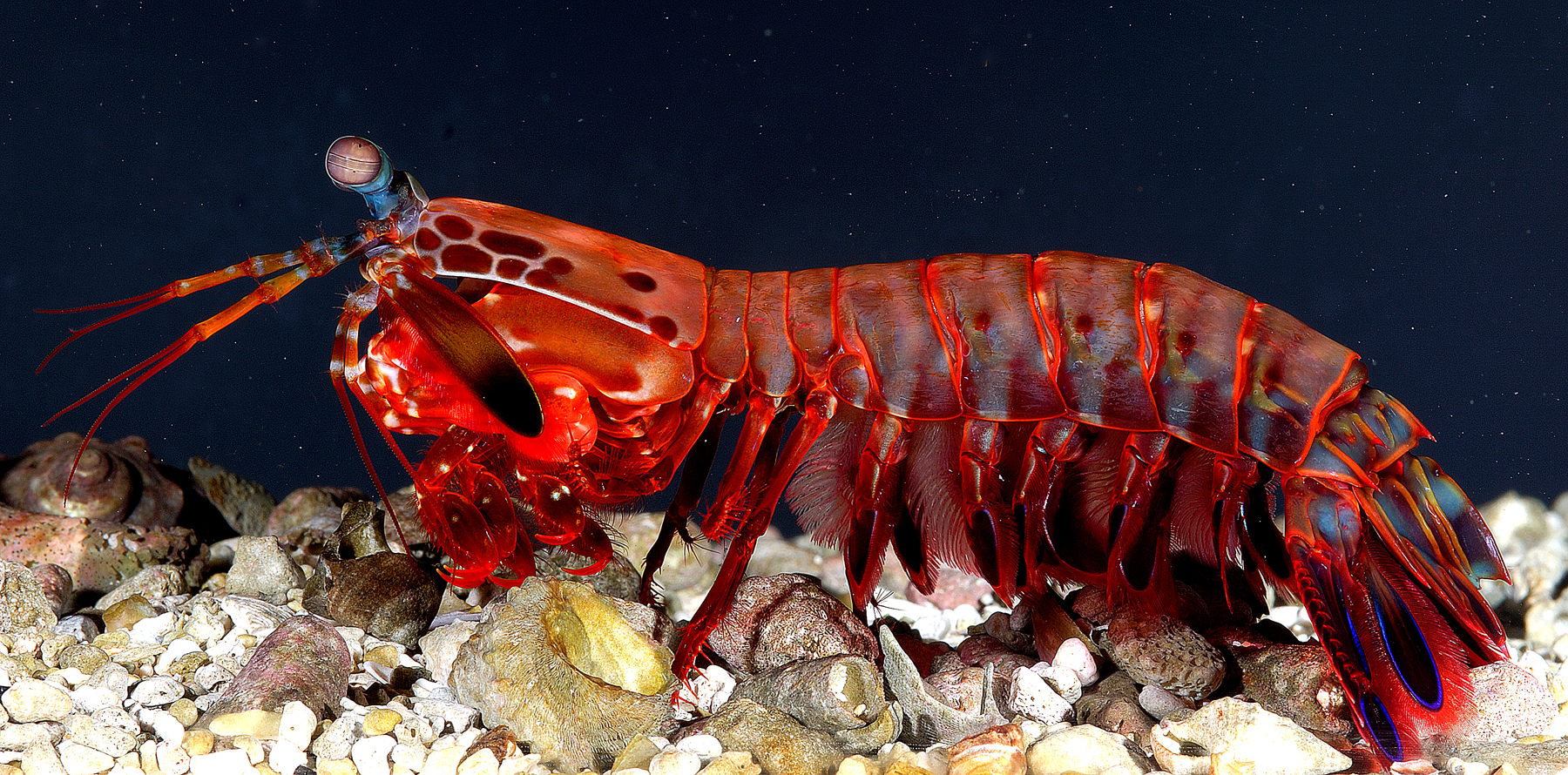
In 1998, keepers at the Sea Life Centre in Norfolk, England, kept finding cracks in a display tank. Not chips. Cracks. The culprit wasn’t a rock, a diver, or a clumsy visitor — it was a four-inch shrimp that had punched clean through quarter-inch glass. Staff moved the animal to a more secure tank in Great Yarmouth and gave it a nickname that stuck: Tyson.
Table of Contents
That shrimp was a mantis shrimp, and its punch isn’t just strong. It’s fast enough that, pound for pound, the acceleration beats a fired bullet. A marine biologist named Sheila Patek spent years with a high-speed camera proving exactly how a creature with no real muscle power to speak of throws a strike that can shatter shells, dent steel probes, and boil the water around it for a fraction of a second.
Quick answer
The peacock mantis shrimp (Odontodactylus scyllarus) swings its clubbed forelimb at roughly 23 meters per second (about 50 mph) with peak accelerations around 6,300–10,000 times the force of gravity — faster acceleration than a .22 caliber bullet leaving a gun barrel, according to research led by biologist Sheila Patek.
A cracked tank in Norfolk
Mantis shrimp had a reputation among aquarium keepers long before scientists measured them properly. Divers called the bigger ones “thumb-splitters,” because a strike to a bare hand could open skin. But it was a specific animal — a mantis shrimp at the Sea Life Centre in Norfolk, England, nicknamed Tyson after the boxer — that turned the reputation into headlines, after it repeatedly cracked the quarter-inch glass of its enclosure in 1998 and had to be relocated to a sturdier tank in Great Yarmouth.
The scientific proof came separately, from a lab bench rather than a public aquarium. Sheila Patek, then a graduate researcher at UC Berkeley and later a professor at Duke University, led a team that filmed mantis shrimp strikes with cameras fast enough to freeze motion measured in thousandths of a second. In a 2004 paper in the journal Nature, co-authored with W. L. Korff and Roy Caldwell, Patek’s group clocked the club’s peak speed at 23 meters per second and peak accelerations of 6,300 to 8,000 times gravity — later work and press coverage of Patek’s research pushed the high end closer to 10,000 g. For comparison, a fighter pilot blacks out around 5 g.
Why a shrimp doesn’t need Popeye arms
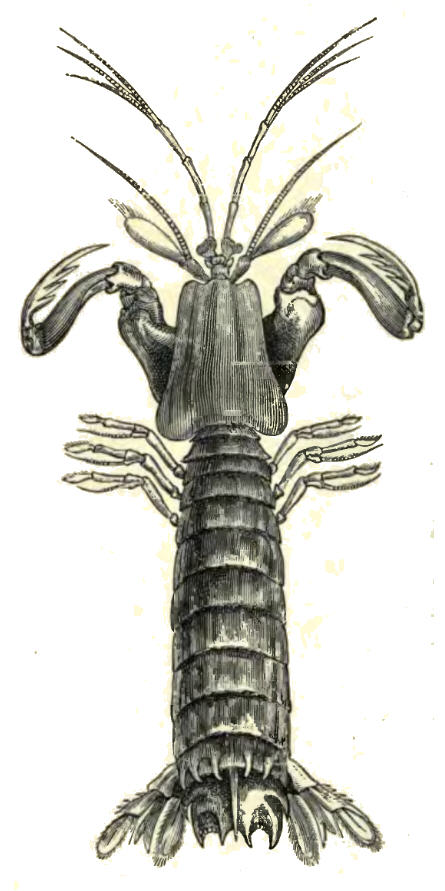
The strange part isn’t just the speed — it’s how a small crustacean gets there without big muscles. Patek’s team found the mantis shrimp doesn’t throw the punch with muscle power directly. Instead, it cranks back a saddle-shaped piece of its own exoskeleton, similar in shape to a Pringle chip, storing elastic energy the way a bent bow stores energy in its limbs. A latch made of tensed muscle holds the whole assembly cocked. When the latch releases, the saddle snaps flat and flings the clubbed appendage forward — no biological motor could contract fast enough to produce that speed directly, so the shrimp built a mechanical slingshot instead.
The strike is so fast that as the club moves through water, it creates a cavitation bubble — a pocket where the water itself vaporizes because the club has left the space too quickly for water to fill it. When that bubble collapses, it releases a second shockwave a fraction of a second after the club itself lands, so prey effectively gets hit twice per punch. High-speed footage from Patek’s lab captured the bubbles forming and popping beside stunned prey, which is part of why a mantis shrimp can crack open a snail shell or a hermit crab’s armor even on a strike that technically misses.
The part most people miss
The bubble collapse doesn’t just make a sound — it briefly gets very hot and, under some conditions, gives off a tiny flash of light, a phenomenon called sonoluminescence, where collapsing cavitation bubbles reach temperatures researchers estimate in the thousands of degrees Celsius, in the same range attributed to the surface of the sun, for an instant too brief and too small to matter to anything nearby. Scientists still don’t fully agree on the exact physics of why collapsing bubbles emit light at all — the phenomenon shows up in labs with plain water and sound waves, no shrimp required — but the mantis shrimp remains one of the few living animals known to trigger it as a side effect of just catching lunch. It’s also worth separating the folklore from the physics: Tyson’s tank-cracking is a real, documented 1998 incident in Norfolk, but confirmed cases of a shrimp actually shattering standard aquarium glass are rare enough that most keepers who own the ‘smasher’ species use plastic or acrylic tanks rather than risk it.
Sources
S. N. Patek, W. L. Korff, and R. L. Caldwell, “Deadly strike mechanism of a mantis shrimp,” Nature, 2004 — the original biomechanics study measuring strike speed and acceleration.
University of California, Berkeley, news release, April 21, 2004, on Patek’s mantis shrimp research, including the spring-and-latch mechanism.
WorldAtlas, “The Mantis Shrimp That Breaks Glass,” and National Wildlife Federation’s National Wildlife magazine (2005), “Who You Callin’ Shrimp?” — coverage of the 1998 Sea Life Centre, Norfolk/Great Yarmouth glass-cracking incident and the Tyson nickname.
Explore more: More wild animal tales.
mantis shrimp FAQs
How fast is a mantis shrimp’s punch?
The peacock mantis shrimp’s club moves at about 23 meters per second (roughly 50 mph), with accelerations measured between 6,300 and 10,000 times the force of gravity — an acceleration rate that outpaces a .22 caliber bullet leaving the barrel.
Can a mantis shrimp really break aquarium glass?
It’s possible and has been documented, most famously with a mantis shrimp nicknamed Tyson that cracked quarter-inch glass at the Sea Life Centre in Norfolk, England, in 1998, but confirmed cases of a full shattered tank are rare. Aquarium keepers who house ‘smasher’ species often use acrylic tanks as a precaution.
How does a shrimp generate that much force without big muscles?
It doesn’t rely on muscle contraction speed at all. It cocks a saddle-shaped spring built into its own exoskeleton, locks it with a muscular latch, then releases the latch so the spring snaps the clubbed limb forward — the same principle as a crossbow or mousetrap.
What is sonoluminescence and why does it relate to mantis shrimp?
Sonoluminescence is a flash of light produced when a collapsing gas bubble reaches extreme, momentary temperatures. Mantis shrimp strikes move fast enough to create cavitation bubbles in water, and their collapse can produce this effect, though the underlying physics of sonoluminescence itself is still debated among physicists.
Tales You Can Hold
Fun-facts books for curious kids, personalized books that star your child, and more from the FYI Tales Bookstore. Visit the Bookstore.
Photo: Roy L. Caldwell, Department of Integrative Biology, University of California, Berkeley / Public domain, via Wikimedia Commons.