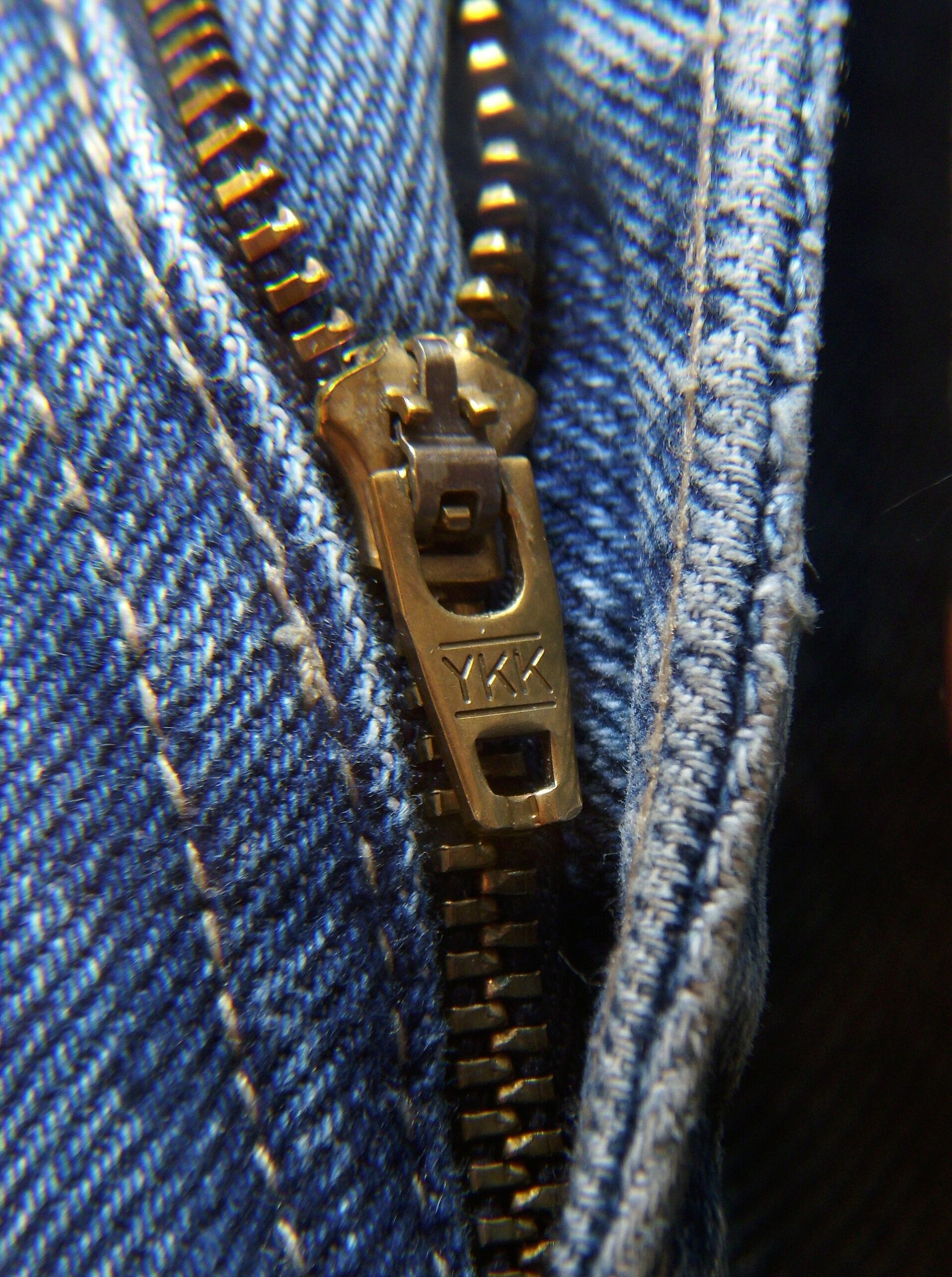
Turn over the nearest zipper pull — on your backpack, your jeans, that jacket by the door — and there’s a good chance three letters are stamped right into the metal: YKK. Nobody chose it as a brand. It’s just there, on something like half of all the zippers made on Earth, and almost no one who’s ever tugged one open knows why.
Table of Contents
The letters aren’t a marketing slogan. They’re initials — what’s left of a Tokyo company’s original Japanese name — and the story behind them has less to do with zippers than with one man’s decision, after his factory burned to the ground, to stop trusting anyone else to make a single part of his product.
Quick answer
YKK stands for Yoshida Kōgyō Kabushiki Kaisha (“Yoshida Manufacturing Corporation”), the company Tadao Yoshida founded in Tokyo in 1934. It stamps its initials into zippers because it makes nearly every part of them itself — brass, thread, and machinery included — and today produces roughly half of the zippers sold worldwide.
A fastener nobody could get right
Long before Yoshida ever touched a zipper, the thing itself struggled to work at all. Elias Howe, better known for the sewing machine, patented an “Automatic, Continuous Clothing Closure” in 1851 and never bothered to develop it. Four decades later, Chicago engineer Whitcomb Judson patented a hook-and-eye “Clasp Locker” and showed it off at the 1893 World’s Fair, where it had a habit of jamming, snagging, and popping open at the worst moments.
It took a Swedish-American engineer named Gideon Sundback, working for Judson’s old company, to actually fix it. In 1917 Sundback patented an interlocking-tooth “Separable Fastener” (U.S. Patent 1,219,881) that is, mechanically, still what’s riding up and down in your pocket today. In 1923, B.F. Goodrich put the redesigned fastener on a line of rubber boots and — based on the sound it made — gave it the name “zipper.”
The company that decided to make everything itself
Tadao Yoshida wasn’t any of those inventors. He was a young salesman working for a Tokyo zipper company when it went bankrupt in 1932. Two years later, in January 1934, he started his own outfit, San-es Shokai, which mostly bought parts from other manufacturers and assembled them like everyone else in the business.
Then, in 1945, wartime bombing raids leveled his Tokyo plant. Yoshida rebuilt from scratch in Uozu, on Japan’s western coast, and this time made a different bet: instead of buying components from suppliers he couldn’t fully vouch for, he’d control every stage of production himself. The company began smelting its own brass, dyeing its own thread and cloth, and — unusually for the industry — engineering its own zipper-making machinery, including the CM6 chain machine it introduced in 1964, which became a manufacturing standard still used today. Yoshida called the philosophy behind it the “Cycle of Goodness”: the idea that no one prospers without rendering benefit to others. The renamed company, Yoshida Kōgyō Kabushiki Kaisha, stamped its initials onto every puller it made.
The part most people miss
Those three letters aren’t decoration — they only mean anything because of the vertical integration behind them. Because YKK controls the process from raw brass to finished zipper, the initials became shorthand in the garment trade for a part that won’t snap or jam, which is also exactly why counterfeit “YKK” stamps have long been a problem for the company: the mark is worth faking precisely because it’s trusted.
But the “Cycle of Goodness” story has a less flattering footnote. In 2007, the European Commission fined YKK €150.3 million as part of a wider €329 million penalty after finding that YKK, Coats, and Prym had spent years fixing prices and carving up markets for zippers and other fasteners across Europe. YKK fought the ruling through the EU courts for years; in 2014 the bloc’s highest court trimmed one portion of the fine, but the core finding of cartel behavior stood. Even the company built on the idea that no one prospers alone spent a decade arranging things so that, for a while, its competitors prospered together — at everyone else’s expense.
Sources
The Wikipedia entry for YKK, covering the company’s founding, name changes, vertical integration, and the 2007 European Commission cartel fine.
YKK Americas’ official “History of the Zipper” page, covering Elias Howe, Whitcomb Judson, Gideon Sundback, B.F. Goodrich, and Tadao Yoshida’s founding and rebuilding of the company.
The Wikipedia entry for Gideon Sundback, confirming his biography and U.S. Patent 1,219,881 for the Separable Fastener.
Reporting on the European Commission’s 2007 fasteners cartel decision and the subsequent EU court appeals through 2014, including coverage from Bloomberg and legal-industry trade press.
Explore more: More true stories behind everyday objects.
YKK FAQs
What does YKK stand for?
Yoshida Kōgyō Kabushiki Kaisha — “Yoshida Manufacturing Corporation” — the company’s official name from 1945 until it rebranded simply as YKK in 1994.
Who actually invented the zipper?
Whitcomb Judson patented an early hook-and-eye version in 1893, but it was Swedish-American engineer Gideon Sundback who fixed its flaws with the interlocking-tooth design he patented in 1917 — the version still used today.
Why does almost every zipper say YKK?
Because one company, founded by Tadao Yoshida in Tokyo in 1934, makes roughly half the world’s zippers and has controlled its own supply chain — brass, thread, and machinery — since rebuilding after World War II.
Was YKK ever in legal trouble?
Yes. In 2007 the European Commission fined YKK over €150 million for taking part in a price-fixing cartel with rivals Coats and Prym; YKK’s appeals were largely rejected through 2014.
Tales You Can Hold
Fun-facts books for curious kids, personalized books that star your child, and more from the FYI Tales Bookstore. Visit the Bookstore.
Photo: Jorgebarrios / CC BY-SA 3.0, via Wikimedia Commons.