
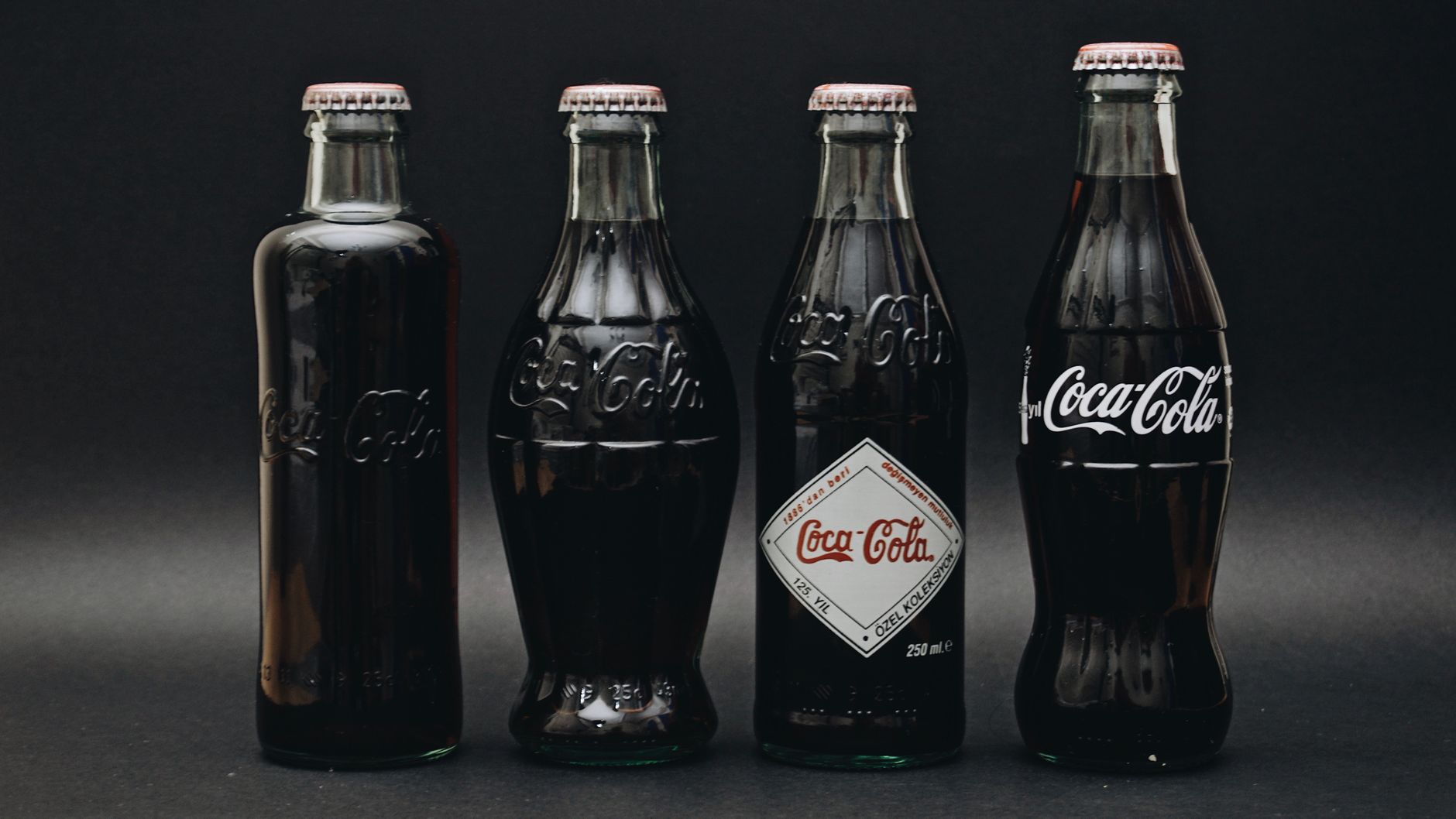
In 1915, a shop foreman at a small Indiana glass factory sent two employees to the public library with an odd assignment: find out what the ingredients in Coca-Cola actually look like. They came back with a sketch of the wrong plant entirely — and that mistake became one of the most recognized shapes on Earth.
Table of Contents
What happened next, inside a scrappy glassworks racing to beat rival bottle makers to a contract, explains why a soft drink ended up in a bottle with ribs, a pinched waist, and a shape you could supposedly identify by touch in a pitch-black room.
Quick answer
The Coca-Cola contour bottle got its ribbed, hourglass shape because designers at the Root Glass Company in Terre Haute, Indiana, researching the drink’s ingredients for a 1915 design contest, based their sketch on an encyclopedia picture of a cacao pod — mistaking it for the coca leaf or kola nut actually used in Coca-Cola.
A contest to beat the copycats
By the mid-1910s, Coca-Cola had a knockoff problem. Rivals were bottling look-alike colas in plain straight-sided bottles, and customers sometimes couldn’t tell the difference on a store shelf. Company lawyer Harold Hirsch pushed for a container so distinctive that a customer could recognize it, in the company’s own words, “by feel in the dark, or lying broken on the ground.” In 1915, Coca-Cola put that challenge to roughly a dozen glass manufacturers, offering a lucrative supply contract to whoever won.
One of the smaller bidders was the Root Glass Company of Terre Haute, Indiana. Company president Chapman Root handed the project to his plant superintendent, Alexander Samuelson, a Swedish immigrant running the shop floor. Samuelson passed the actual design work to a young bottle designer named Earl Dean and an assistant, Clyde Edwards.
The wrong plant, the right shape
Samuelson’s instructions were straightforward: base the new bottle’s shape on the drink’s own ingredients, coca leaf and kola nut, so the design would connect to the product itself. Dean and Edwards headed to the Emeline Fairbanks Memorial Library in Terre Haute and started flipping through encyclopedias. They never found a decent picture of coca or kola. What they did find was an illustration of the cacao pod — the ribbed, oblong pod that chocolate is made from, which has nothing to do with cola at all. Dean liked its shape anyway: the vertical ribs, the swollen middle. He sketched a bottle around it.
Root’s glassblowers turned that sketch into a sample, but the prototype’s middle bulged wider than its base, which made it topple on the bottling line’s conveyor belts. Dean fixed the problem in 1916 by narrowing the waist so the base was the widest point — the shape that stuck. Coca-Cola picked Root’s ribbed, curved design over the other glassmakers’ entries, and Root filed for a design patent, granted on November 16, 1915, under Samuelson’s name rather than Dean’s, since Samuelson was the company officer of record. Six additional glass companies were then licensed to manufacture the bottle so Coca-Cola could scale it nationally, and full-scale advertising built around the new shape began in 1918.
The part most people miss
The bottle’s real legal triumph took far longer to arrive than most retellings suggest. Root’s design patent expired in 1951, and Coca-Cola moved to protect the bottle a different way: as a trademark, the same legal category as a logo or brand name, rather than a time-limited patent. It leaned on a 1949 survey showing that fewer than one percent of Americans couldn’t identify the bottle by its shape alone, and by 1960 it had registered the bottle’s “distinctively shaped contour” as a trademark. But the registration most trademark historians point to as the real landmark — the one covering the bottle’s three-dimensional shape alone, filed May 25, 1976 — wasn’t granted by the U.S. Patent and Trademark Office until February 1, 1977, under Registration No. 1,057,884. Even then, Coca-Cola kept filing fresh shape registrations for later versions of the bottle for decades after, since a trademark only protects the exact form on file. There’s also a persistent bit of folklore worth clearing up: many people assume the bottle was deliberately shaped to echo a woman’s silhouette, hence its old nickname, the “hobble skirt” bottle, after the narrow, ankle-cinched skirts fashionable around 1915. That nickname is real, and the resemblance is real, but it was a coincidence of the era’s fashion, not the design brief. The documented origin, backed by Root’s own records and later accounts from Dean, traces back to a cocoa pod misread for a coca leaf — not a dress.
Sources
The Coca-Cola Company’s official corporate history page, “The History of the Coca-Cola Contour Bottle,” details the 1915 design competition and the Root Glass Company team.
Wikipedia’s entry on Earl R. Dean covers the designer’s role at Root Glass, the library research trip, the cocoa pod inspiration, and the patent filed under Alexander Samuelson’s name.
That’s a Trademark’s analysis of the Coca-Cola bottle shape, along with USPTO trademark registration records (Reg. Nos. 696,147 and 1,057,884), documents the bottle’s trademark history, including the February 1, 1977 registration of its three-dimensional configuration.
Explore more: More Food Lore tales.
Coca-Cola contour bottle FAQs
Who actually designed the Coca-Cola bottle?
Earl R. Dean, a bottle designer at the Root Glass Company in Terre Haute, Indiana, sketched the design in 1915, though the resulting patent was filed under his supervisor Alexander Samuelson’s name.
Is it true the Coca-Cola bottle shape was inspired by a cocoa pod?
Yes. Root’s design team was told to reference coca leaf or kola nut, Coca-Cola’s real ingredients, but couldn’t find good images of either and used an encyclopedia illustration of an unrelated cacao pod instead.
When did the Coca-Cola bottle shape become a trademark?
Coca-Cola first registered the bottle’s shape as a trademark in 1960, but the registration specifically covering the bottle’s three-dimensional configuration on its own was granted by the U.S. Patent and Trademark Office on February 1, 1977, under Registration No. 1,057,884.
Why is it sometimes called the ‘hobble skirt’ bottle?
Because its narrow waist and flared base resembled the hobble skirt fashion popular around 1915, not because designers set out to copy a dress — that’s a nickname that stuck after the fact, not the documented design intent.
Tales You Can Hold
Fun-facts books for curious kids, personalized books that star your child, and more from the FYI Tales Bookstore. Visit the Bookstore.