

In the fall of 1894, two brothers in Battle Creek, Michigan, left a pot of boiled wheat sitting on a counter and walked away. When they came back, the batch had gone stale — dried out and unusable, exactly the kind of ruined dough that gets scraped into the trash. Instead, they ran it through a set of rollers anyway, mostly to see what would happen.
Table of Contents
What came out wasn’t the sheet of dough they expected. It broke apart into flakes — thin, crisp, and, once toasted, strangely good. That kitchen mistake became the recipe for Corn Flakes, a product that would eventually split a family, trigger a courtroom fight over a last name, and put flaked cereal into breakfast bowls worldwide.

Quick answer
Corn flakes were invented in 1894 at the Battle Creek Sanitarium in Michigan, when Dr. John Harvey Kellogg and his brother Will Keith Kellogg accidentally let a batch of boiled wheat go stale before rolling it into sheets. Rather than a flat dough, the stale grain came out as individual flakes. The brothers patented the flaking process in 1895–96, and Will later built it into the company that became Kellogg’s.
A sanitarium kitchen looking for a miracle grain
John Harvey Kellogg was superintendent of the Battle Creek Sanitarium starting in 1876, a Seventh-day Adventist health resort where guests followed a strict vegetarian diet with no alcohol, tobacco, or caffeine. Kellogg treated food as medicine and was constantly experimenting — he’s also credited with early versions of peanut butter and a grain-based coffee substitute for patients who wanted something easier on the digestion than the heavy, meat-forward breakfasts of the era.
His younger brother Will Keith Kellogg worked as his business manager and lab assistant, running the sanitarium’s day-to-day operations while John chased new food ideas. Historical accounts also credit John’s wife, Ella Eaton Kellogg, with suggesting the technique of rolling dough into thin sheets in the first place — a detail that gets left out of the tidy “two brothers” version of the story.
The batch nobody meant to ruin
The brothers were boiling wheat berries to make a flattened wheat-meal product for sanitarium patients when they got pulled away and left the batch sitting too long. By the time they returned, the wheat had staled. On a tight budget, they ran it through the rollers anyway instead of tossing it — and instead of a solid sheet of dough, the flakes separated on their own. Toasted, they held their shape and crunch.
John Harvey Kellogg filed a patent for “Flaked Cereals and Process of Preparing Same” on May 31, 1895; it was granted April 14, 1896, as U.S. Patent No. 558,393, and covered flaking grains generally, not just wheat. John was the only name on the patent, but Will spent years afterward refining the process — including the eventual switch from wheat to corn, which flaked more reliably and tasted better toasted.
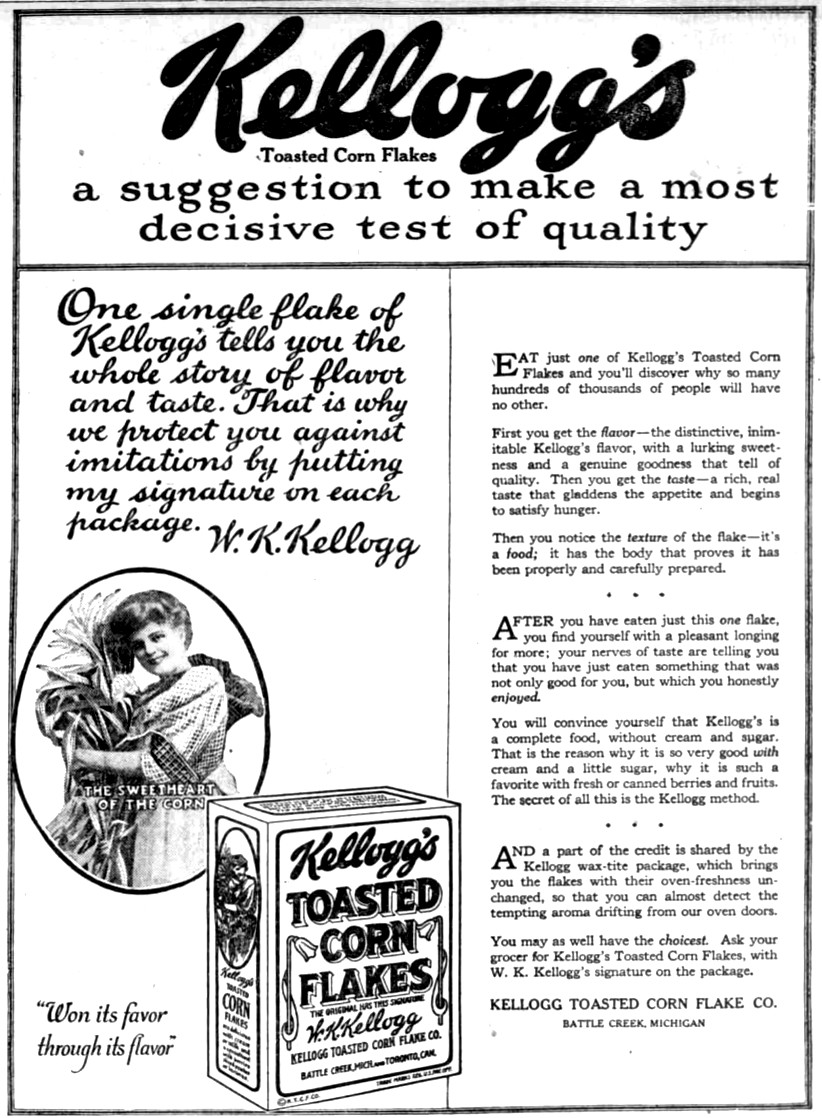
The brothers’ partnership didn’t survive success. In 1906, Will split off to found the Battle Creek Toasted Corn Flake Company, adding sugar, malt, and salt to make the cereal more appealing to a mass market — over John’s objections, since sweetened food ran against his health principles. The rift over credit and the family name became a legal fight that reached the Michigan Supreme Court, which ruled in Will’s favor in 1920, cementing his control over what became the Kellogg Company.
The part most people miss
The popular internet claim is that corn flakes were invented specifically to stop people from masturbating — that’s an overstatement, and fact-checkers have pushed back on it. But the exaggeration sits on top of something that’s genuinely true and stranger than the meme: John Harvey Kellogg was a fierce anti-masturbation crusader who believed that plain, bland, meat-free food dulled sexual urges, and that belief shaped the entire dietary philosophy behind the sanitarium’s food, corn flakes included. Kellogg wrote and lectured extensively on diet as a tool for curbing what he called “self-abuse,” and his broader methods for the cause were far more extreme than a breakfast cereal. Corn flakes weren’t sold with that pitch, but they were born inside a health program built around it — a piece of context that tends to get flattened into a punchline or dropped entirely.
Sources
Wikipedia’s entry on corn flakes details the 1894 accidental discovery, the disputed roles of John Harvey Kellogg, Will Keith Kellogg, and Ella Eaton Kellogg, and the 1895–96 patent (No. 558,393).
The National Inventors Hall of Fame’s profile of John Harvey Kellogg confirms his patent, his role at the Battle Creek Sanitarium, and the forgotten-dough origin of the flaking process.
Snopes’ fact-check on the corn flakes and anti-masturbation claim lays out what’s documented about Kellogg’s dietary beliefs versus the exaggerated version of the story that circulates online.
Explore more: more accidental inventions.
corn flakes FAQs
Did the Kellogg brothers really invent corn flakes by accident?
Yes. Historical accounts and the patent record describe the flakes as the result of a batch of wheat dough that was left out, went stale, and was rolled anyway rather than thrown out — not a planned recipe.
Were corn flakes originally made from corn or wheat?
Wheat first. The accidental discovery in 1894 used wheat berries; the switch to corn, which flaked more reliably, came later through Will Keith Kellogg’s continued experiments.
Is it true corn flakes were invented to stop masturbation?
Not exactly. Corn flakes weren’t created or marketed specifically for that purpose, but they did emerge from John Harvey Kellogg’s broader — and well-documented — belief that a bland, plain diet suppressed sexual urges.
Tales You Can Hold
Fun-facts books for curious kids, personalized books that star your child, and more from the FYI Tales Bookstore. Visit the Bookstore.
Photo: Th78blue / CC BY-SA 4.0, via Wikimedia Commons.