
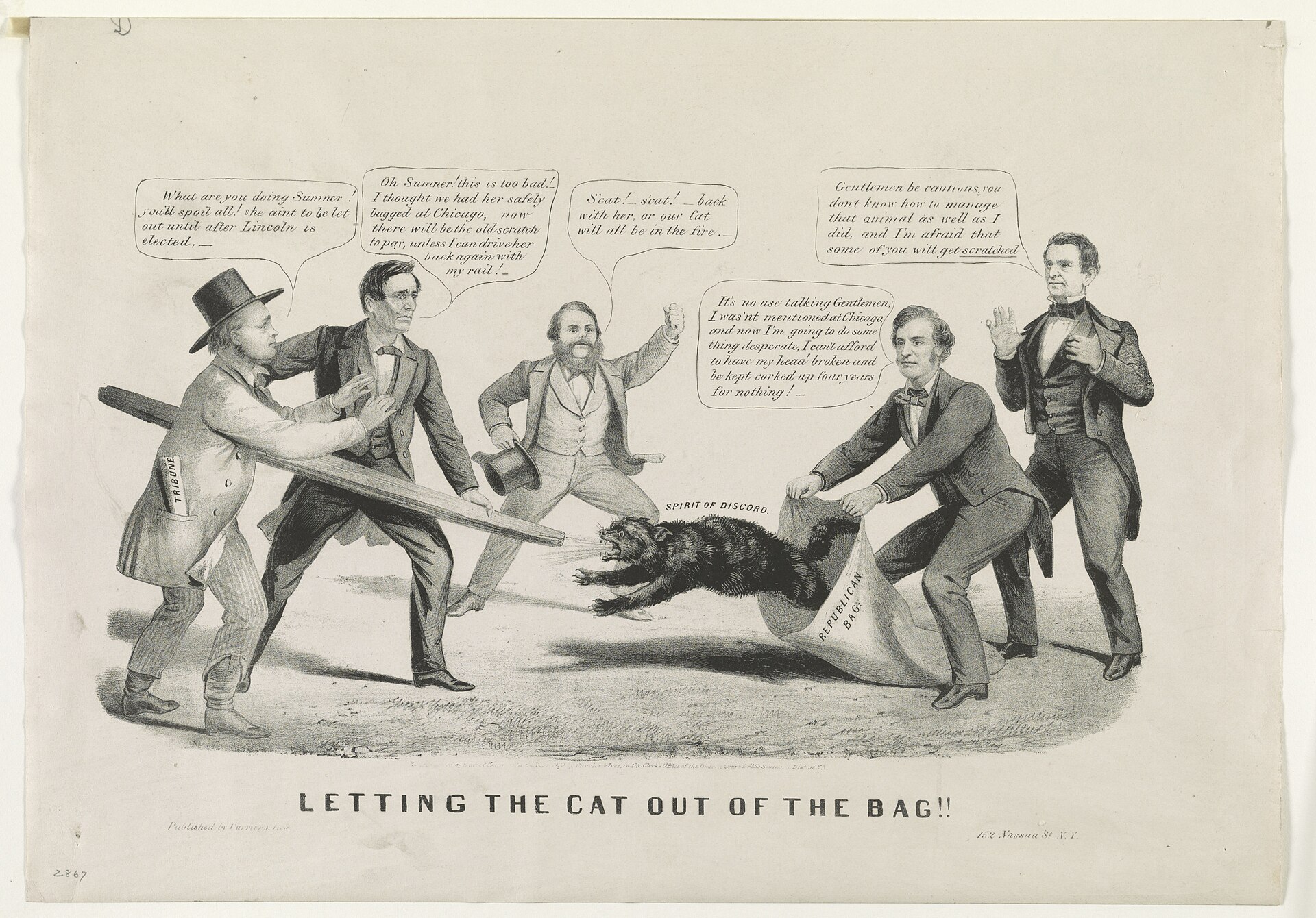
Picture a medieval market stall. A farmer hands over a squirming, tied sack and swears there’s a fat suckling pig inside. The buyer, suspicious, loosens the string right there in the street — and out springs a hissing cat instead of dinner. Scam exposed. Secret revealed. Idiom born. It’s a wonderful story, and it’s the one told in nearly every listicle about where ‘letting the cat out of the bag’ comes from.
Table of Contents
There’s just one problem: nobody has ever found a farmer, a court record, a merchant’s diary, or a single documented case of this actually happening. What historians have found is stranger — the oldest surviving printed use of the phrase is a snarky 1760 book review, and even that review talks about the cat-and-bag saying like everyone already knows it. The real origin, whatever it was, had already slipped into the language and vanished from the record before anyone bothered to write it down.
Quick answer
The earliest print appearance anyone has found of ‘let the cat out of the bag’ is a pun in an April 1760 London Magazine book review — but that’s just the earliest surviving evidence, not the moment the phrase was invented. The reviewer used it as an offhand joke, which tells researchers the expression was already familiar to readers by then. The popular market-fraud origin — where a cat is secretly swapped for a piglet — is a plausible-sounding 19th-century folk explanation that no documentary evidence actually supports.
A farmer, a sack, and a furious customer
The market-fraud theory has real bones to it, which is why it spreads so easily. ‘Pig in a poke’ — a poke being an old word for a small sack — really is centuries old. English playwright John Heywood recorded it in 1555: ‘I wyll neuer bye the pyg in the poke / Thers many a foule pyg in a feyre cloke,’ meaning don’t buy something sight unseen, because a fair wrapper can hide a foul deal. Some sources trace poke-related sayings even earlier, into the 1500s and possibly before.
And the cat-swap idea isn’t pure invention — it’s genuinely how the equivalent idiom works in other languages. Dutch has ‘een kat in de zak kopen’ and German has ‘die Katze im Sack kaufen,’ both literally ‘to buy a cat in the sack,’ both meaning to get swindled. So somewhere in European market culture, the image of a hidden cat standing in for stolen value was clearly alive and well. It just doesn’t line up cleanly with the English phrase’s own paper trail.
The paper trail says something else
Word-history researchers who’ve dug through old print archives — including the etymology site Word Histories and the long-running Phrase Finder — have located the oldest known English-language appearance of ‘let the cat out of the bag’ in a book review in the April 1760 London Magazine. A critic, reviewing a novel called The Life and Adventures of a Cat, complained: ‘We could have wished that the strange genius, author of this piece, had not let the cat out of the bag; for it is such a mad, ranting, swearing, caterwauling puss, that we fear no sober family will be troubled with her.’
That’s a pun, and puns only land if the audience already gets the reference. The reviewer isn’t explaining a new phrase — they’re assuming readers already know it well enough to catch the wordplay on the book’s own title. That single detail is the tell that historians point to: the real coining of the phrase happened earlier, probably in speech, and simply wasn’t written down anywhere that has survived. The cat-and-bag saying and ‘pig in a poke,’ meanwhile, never once appear together in any print source from that era or earlier. If the cat-in-a-sack swindle were the actual backstory, you’d expect at least one writer, somewhere before 1760, to reference the two side by side. Nobody does — not until the 19th century, when writers explaining the phrase’s meaning started stitching the two sayings into one tidy folk tale.
The part most people miss
Here’s the layer almost every quick explainer skips: it’s likely the two idioms were never actually related at all — they were merged after the fact because they rhymed thematically, not historically. ‘Pig in a poke’ is about buying something blind and getting cheated. ‘Let the cat out of the bag’ is about revealing a secret. By the time 19th-century writers went looking for an explanation, the phrase’s genuine origin was already unrecoverable — the 1760 magazine pun was just the earliest scrap anyone could dig up, and it was too thin and too mundane to satisfy anyone wanting a proper backstory. So the two idioms got welded into a single, satisfying-sounding scam story — and it stuck so well that it’s now the default answer everywhere from bar trivia to classroom worksheets. The genuinely interesting mystery isn’t the fake medieval con — it’s that we may never know where the phrase truly came from, only that it was already old news by the time anyone thought to write it down.
Sources
Wikipedia’s entries on ‘Letting the cat out of the bag’ and ‘Pig in a poke,’ which trace the earliest documented citations and lay out the naval cat-o’-nine-tails alternative theory.
Word Histories (wordhistories.net), whose research into 18th-century print archives locates the 1760 London Magazine book review as the earliest confirmed English print appearance and explains why its phrasing shows the expression was already established, as well as why the pig-swap story is considered later folk etymology.
The Phrase Finder (phrases.org.uk), which cross-references the Dutch and German cat-in-a-sack cognates and assesses the competing origin theories.
Explore more: more true stories behind everyday sayings.
let the cat out of the bag FAQs
Did people really sell cats as piglets at markets?
There’s no documented case of it. The idea is plausible-sounding folklore that got attached to the phrase in the 1800s, long after the phrase itself first appeared in print.
What’s the earliest known written use of the phrase?
A pun in an April 1760 issue of The London Magazine, in a review joking that the author of a novel called The Life and Adventures of a Cat had ‘let the cat out of the bag.’ That’s the oldest surviving record, not the moment the phrase was coined — the pun itself shows readers already knew the saying.
Is ‘pig in a poke’ related to ‘let the cat out of the bag’?
They’re often paired in explanations, but no print source links them before the 19th century — ‘pig in a poke’ is far older (1555, possibly earlier) and originally stood on its own.
Tales You Can Hold
Fun-facts books for curious kids, personalized books that star your child, and more from the FYI Tales Bookstore. Visit the Bookstore.
Photo: Popular Graphic Arts / Public domain, via Wikimedia Commons.