In 1546, an English writer named John Heywood published a collection of proverbs and wordplay, and buried inside it is the first time anyone ever wrote down the word “hony moone.” It wasn’t attached to a vacation, a hotel package, or even a happy couple. It was attached to a joke — about a marriage that soured in fifteen weeks flat.
Table of Contents
Today “honeymoon” conjures beaches and bad airport pretzels. But the word’s own history is a dispute historians still argue over: was it born from an old custom of newlyweds drinking honey wine, or from a much darker pun comparing young love to a moon that’s already waning the moment it’s full? The evidence points pretty clearly to one of those — and it’s not the one most people assume.
Quick answer
“Honeymoon” first appeared in English in 1546 as a cynical pun, not a romantic one: newlywed affection was “honey” at first but, like the moon, destined to wane. The sunny meaning we use today — a trip right after the wedding — didn’t attach to the word until the 1790s, more than 200 years later.
A dictionary joke that curdled
John Heywood’s 1546 book, A Dialogue Conteinyng the Nomber in Effect of All the Prouerbes in the Englishe Tongue, is basically a catalog of 16th-century one-liners. In it, he describes a couple whose early bliss doesn’t last: “Abide (quoth I) it was yet but hony moone,” he writes, before the pair tumbles into “sad syghyng” within weeks. The phrase works like a knowing wink — everyone in the room already understood that “honeymoon” meant a honeymoon phase, full stop, the kind that ends.
Six years later, in 1552, the lexicographer Richard Huloet made the pun official by putting it in a dictionary. In his Abecedarium Anglico Latinum, he defined it as “a term proverbially applied to such as be newe maried, which wyll not fall at ye furst,” explaining that the couple’s exceeding love at the beginning was likely to “assuage” — fade — over time. That’s the earliest known definition of the word, and it’s not about a trip. It’s about an expiration date.
Mead, the moon, and the theory that didn’t hold up
The sweeter story you may have heard — that “honeymoon” comes from an old Norse or Teutonic custom of newlyweds drinking mead (honey wine, sometimes called metheglin) for the first month of marriage — is a 19th-century invention, not a medieval record. Word historian Anatoly Liberman, who writes the “Oxford Etymologist” column for Oxford University Press’s blog, traces the mead-custom claim to much later folklore and finds no real evidence it existed when the word first shows up in English. Language researcher Michael Quinion, who ran the etymology site World Wide Words for two decades, is blunter about it, calling the invented mead-drinking rituals “sickly” fabrications with no documentary backing.
What both researchers agree actually happened: by the time Samuel Johnson published his landmark Dictionary of the English Language in 1755, he defined “honeymoon” as “the first month after marriage, when there is nothing but tenderness and pleasure” — but noted it was figuratively taken from the changing moon, “which is no sooner at the full than it decreases.” A century earlier, in 1656, antiquarian Thomas Blount had already put it even more plainly in his Glossographia: “it is hony now, but it will change as the Moon.”
The part most people miss
Two things most retellings skip. First, even the “waning love” theory has a wrinkle: Liberman points out that Huloet’s 1552 definition is the only real source for it, and we have no idea whether Huloet was reporting common usage or just sounding bitter — “honey month,” meaning simply a sweet first month, may be the more literal, original sense that Huloet then editorialized into a warning. In other words, the pessimistic spin on the word might itself be one man’s opinion that stuck. Second, the meaning everyone assumes is original — a trip taken right after the wedding — is actually the newest layer of the word, not the oldest. The first time “honeymoon” shows up attached to post-wedding travel is 1791, in William Beckford’s English translation of a German folktale by Johann Karl August Musäus, and the first native English use of that travel sense doesn’t appear until 1804, in a story by the novelist Maria Edgeworth. So the romantic getaway you picture when you hear the word is a 19th-century graft onto a 16th-century pun about love going stale.
Sources
Richard Huloet’s Abecedarium Anglico Latinum (1552) and John Heywood’s A Dialogue Conteinyng the Nomber in Effect of All the Prouerbes in the Englishe Tongue (1546) are the original documents containing the earliest recorded uses of “honeymoon.”
Oxford University Press’s OUPblog, in Anatoly Liberman’s “Oxford Etymologist” column (“Honeymoon,” March 2008), examines and largely debunks the mead-custom theory while scrutinizing the waning-moon theory.
World Wide Words, the etymology site run by language researcher Michael Quinion, and Word Histories both corroborate the 1546/1552 timeline, the Samuel Johnson 1755 dictionary entry, and the later shift toward the travel meaning.
Explore more: More word origin tales.
Frequently Asked Questions
Did “honeymoon” originally mean a romantic trip?
No. For roughly 250 years after it first appeared in English, “honeymoon” meant the brief, fading period of affection right after a wedding — not a vacation. The travel meaning only caught on starting in the 1790s.
Is it true that honeymoon comes from drinking mead?
That’s a popular legend, but etymologists haven’t found real evidence for it. The claim about newlyweds drinking honey wine for a month traces to 19th-century folklore, not the word’s actual 16th-century origin.
Who first used the word “honeymoon” in writing?
The earliest known use is English writer John Heywood, in his 1546 collection of proverbs, where he used it to describe a marriage’s affection fading within fifteen weeks.
When did honeymoon start meaning a post-wedding vacation?
The travel sense first appears in English in 1791, in a translated German folktale, with the first native English use recorded in 1804 by novelist Maria Edgeworth.
Tales You Can Hold
Fun-facts books for curious kids, personalized books that star your child, and more from the FYI Tales Bookstore. Visit the Bookstore.
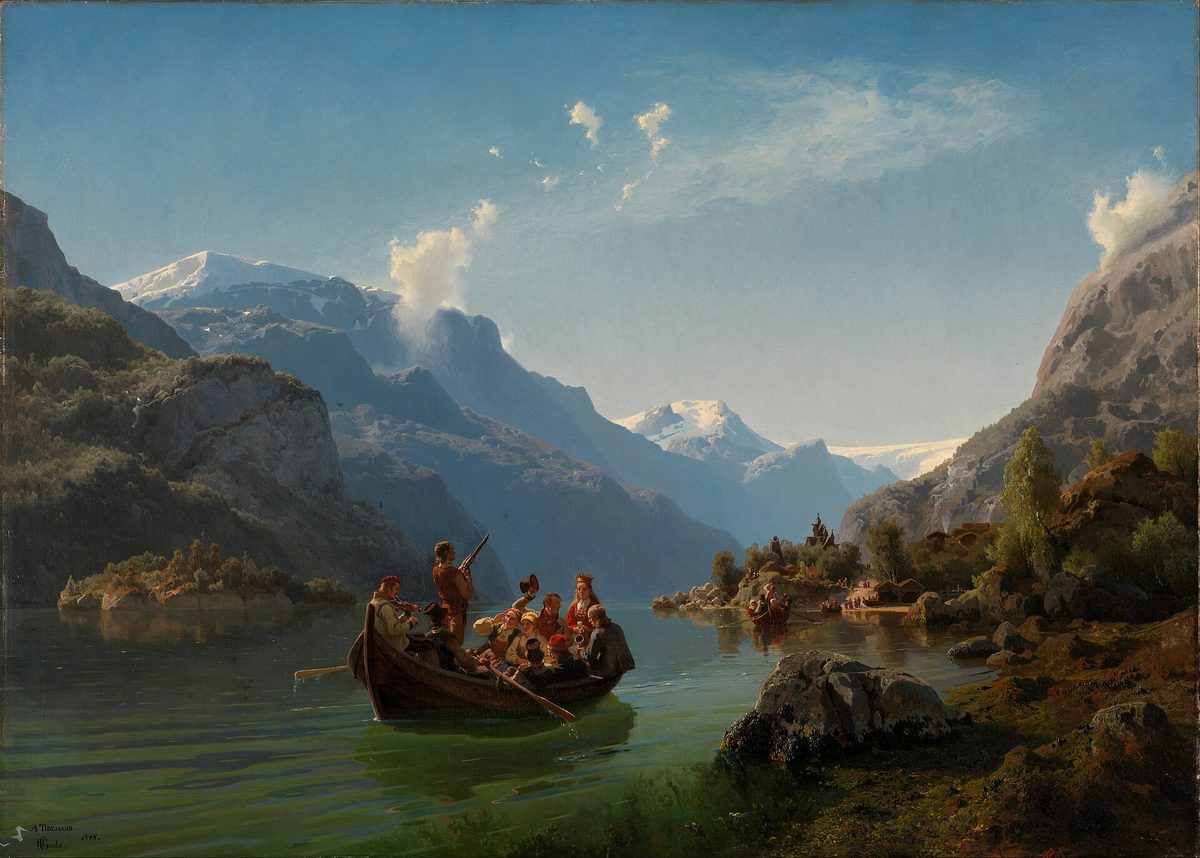
Photo: Adolph Tidemand / Hans Gude / Public domain, via Wikimedia Commons.