
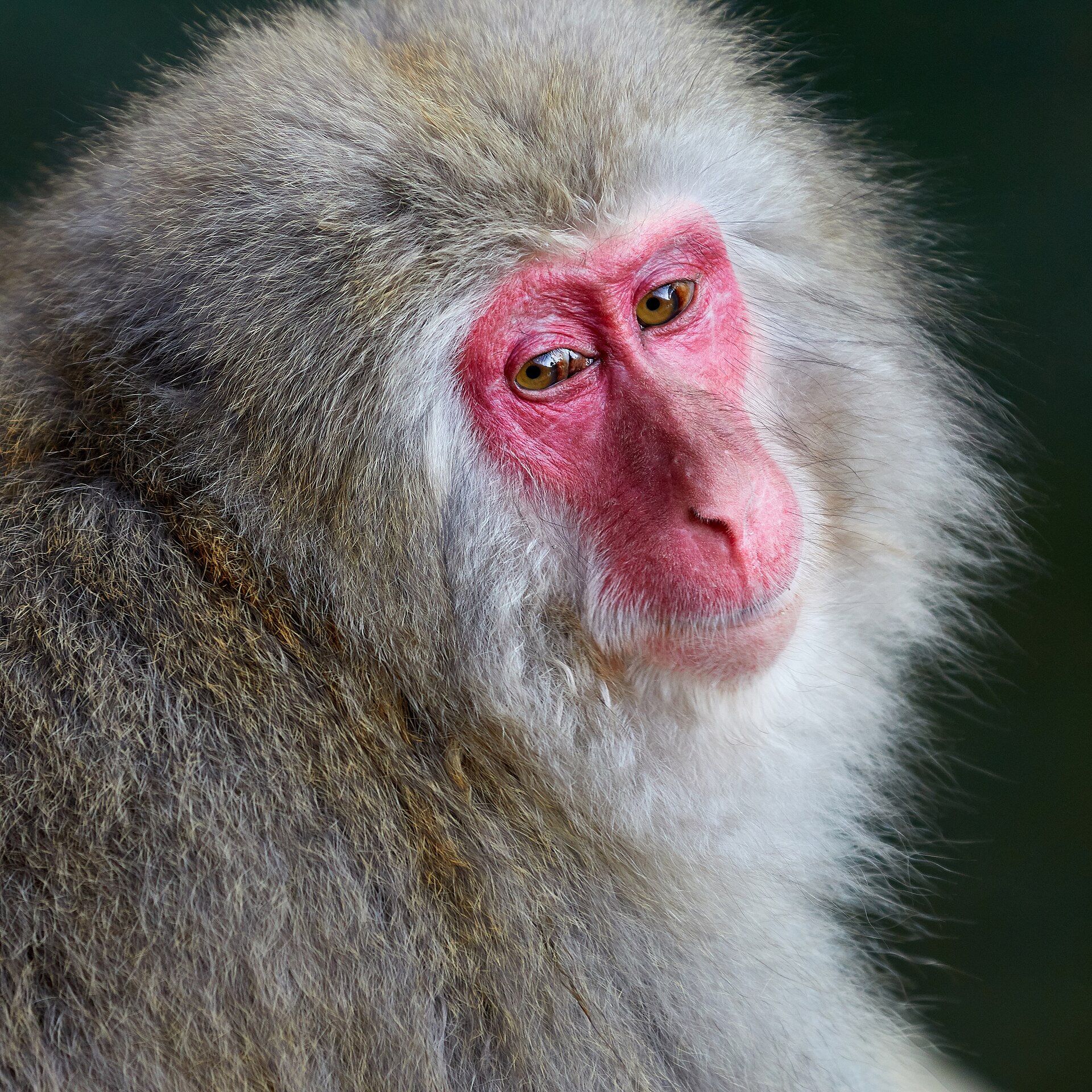
In September 1953, a Japanese schoolteacher named Satsue Mito watched a scrawny, sand-caked sweet potato disappear into a stream — and come out clean. The monkey holding it was an eighteen-month-old female macaque researchers would soon nickname Imo, the Japanese word for potato. Nobody had taught her to do this. She’d just figured it out.
Table of Contents
Within a few years, dozens of monkeys on her home island were doing the same thing, and Imo herself had already moved on to an even cleverer trick. Her story became one of the most cited proofs that animals can invent culture — and, decades later, one of the most famous examples of a true story getting hijacked by a myth.
Quick answer
Imo was a young Japanese macaque on Koshima Island who, in 1953, became the first monkey observed washing sand off a sweet potato in water — a habit researchers then watched spread to dozens of other monkeys over the following years, making her a foundational case study in animal culture.
A research station built out of sweet potatoes
Imo lived on Koshima, a small, forested island off Kyushu, Japan, where in 1948 the ecologist Kinji Imanishi and a team from Kyoto University began one of the first long-term studies of wild primates. To get close enough to tell individual monkeys apart, they used a trick still standard in primatology today: they scattered sweet potatoes and wheat on the beach and watched who came to eat.
The provisioning worked almost too well. It let Imanishi’s team name and track every monkey on the island, including a female born around 1951 they called Imo. On that day in 1953, Satsue Mito, a local schoolteacher who worked alongside the university researchers, watched Imo carry a gritty sweet potato to a freshwater stream, dunk it, and rub the sand off before eating. No monkey on Koshima had ever been seen doing that.
From one monkey to a culture
Imo’s mother picked up the habit next, then her playmates. Over the following years, the behavior spread almost entirely along two lines: family and friendship. Young monkeys who played together learned from each other; older, more solitary males mostly never bothered. It was slow, ordinary, generational learning — the kind of thing you’d expect from any social animal watching a clever neighbor.
Imo wasn’t finished. In 1956, around age four, she solved a second, harder problem: how to separate the wheat grains researchers scattered on the beach from the sand they landed in. Her fix was to scoop up a handful of both and toss it into water — the sand sank, the wheat floated, and she skimmed it off the surface. Later, some monkeys began carrying already-washed potatoes out to the ocean and dunking them again, which researchers suspect had less to do with cleaning and more to do with taste: seawater seasoning, macaque-style.
The part most people miss
Imo’s real story is remarkable enough, but it got a second, far stranger life in 1979, when biologist Lyall Watson published a book called Lifetide claiming that once a ‘critical number’ of monkeys learned to wash potatoes — his famous hundredth monkey — the knowledge instantly leapt across the water to troops on other islands that had never had contact with Koshima, as if broadcast through some kind of collective consciousness. Watson later admitted he hadn’t found this in the actual research, calling it ‘a metaphor of my own making, based on very slim evidence and a great deal of hearsay.’ When skeptics Ron Amundson and Elaine Myers went back to the field records in the mid-1980s, they found no sudden jump, no telepathy, and no hundredth monkey — Koshima’s entire troop numbered well under a hundred animals for years after Imo’s discovery. What actually happened was quieter, and honestly more impressive: one young monkey solved a problem, and her community learned it from her the way communities learn anything — by watching someone they trusted.
Sources
The underlying field research comes from Kyoto University primatologists Kinji Imanishi and Masao Kawai, who documented the Koshima troop’s behavior in the journal Primates.
Satsue Mito, the schoolteacher and field observer who first spotted Imo washing her potato, is profiled on Wikipedia.
The Wikipedia entry on the ‘hundredth monkey effect’ lays out how Lyall Watson’s 1979 book Lifetide distorted the original science, and how researchers Ron Amundson and Elaine Myers, along with the Skeptic’s Dictionary, later corrected the record.
Explore more: More wild animal tales.
Imo the monkey FAQs
Was Imo the monkey a real animal?
Yes. She was a Japanese macaque (Macaca fuscata) living on Koshima Island, first observed washing a sweet potato in September 1953 by field researcher Satsue Mito.
What is the ‘hundredth monkey effect’?
It’s a myth popularized by Lyall Watson in his 1979 book Lifetide, claiming that once enough monkeys learned potato-washing, the skill spread telepathically to monkeys on other islands. Researchers who checked the original field data found no evidence this happened, and Watson later admitted he had invented the claim.
Did other monkeys really learn from Imo?
Yes — that part is well documented. Sweet-potato washing spread through the Koshima troop over several years, mostly along family and friendship lines, in what researchers consider one of the clearest examples of cultural transmission in a wild primate.
Tales You Can Hold
Fun-facts books for curious kids, personalized books that star your child, and more from the FYI Tales Bookstore. Visit the Bookstore.
Photo: Frank Schulenburg / CC BY-SA 4.0, via Wikimedia Commons.