
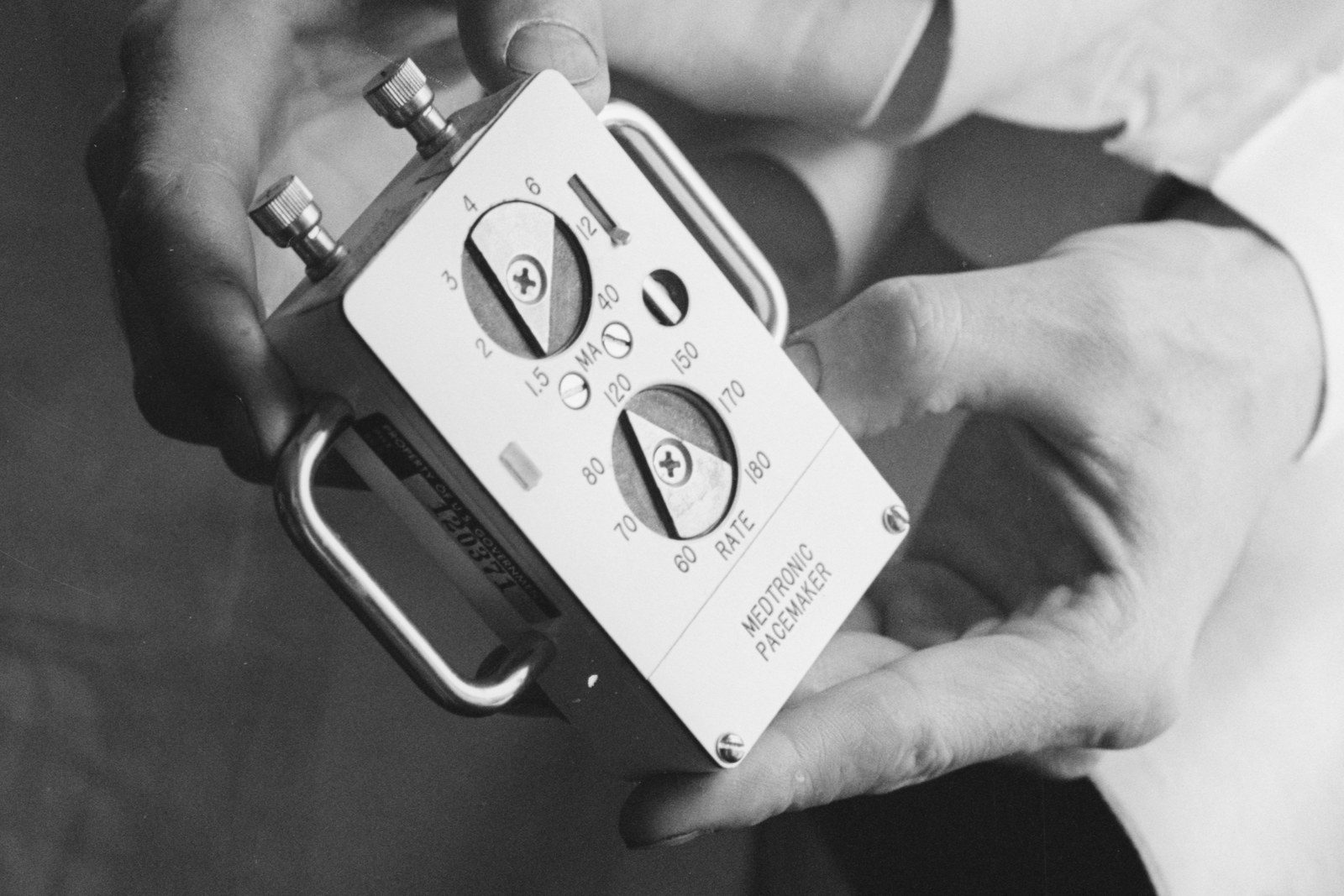
In 1958, an engineer reached into a box of surplus resistors, pulled out the wrong one, soldered it into a circuit anyway, and by the end of the afternoon had built a machine that pulsed with the exact rhythm of a beating human heart. He wasn’t trying to invent anything. He was trying to build a machine that could record heartbeats, not make them.
Table of Contents
His name was Wilson Greatbatch, and the mix-up — a resistor a hundred times too strong for the job — is one of the rare accidental-invention stories that holds up under scrutiny. It’s also, as is usually the case with these tales, only half the story. An ocean away, a Swedish team had already beaten him to the punch by two years, and almost nobody remembers that part.
Quick answer
In 1958, engineer Wilson Greatbatch was building an oscillator to record heart sounds and needed a 10,000-ohm resistor for the transistor circuit. He grabbed a 1-million-ohm resistor by mistake, and the resulting circuit pulsed for 1.8 milliseconds, went silent for about a second, then repeated — the rhythm of a human heartbeat. Greatbatch spent the next two years turning the accident into a self-contained pacemaker, which surgeon William Chardack implanted in a patient in Buffalo in 1960 — the first permanent pacemaker implant in the United States, though not the world’s first implantable pacemaker overall.
A resistor box, a barn workshop, and a very lucky mistake
Greatbatch was an electrical engineer teaching at the University at Buffalo, moonlighting on medical devices with local doctors. He’d been asked to help build equipment to record fast, irregular heart rhythms, and he was assembling a simple transistor oscillator that needed a 10-kilohm resistor at its base. He reached into a box of parts, misread the color bands, and installed a 1-megohm resistor instead — a hundred times more resistance than the circuit called for.
When he powered it up, the circuit didn’t hum steadily the way an oscillator should. It clicked: a pulse lasting 1.8 milliseconds, a pause of about a second, then another pulse. Greatbatch had built enough circuits, and spent enough time around cardiologists, to recognize the pattern immediately. It wasn’t recording a heartbeat. It was capable of driving one.
From a dog in Buffalo to a 77-year-old man’s chest
Greatbatch brought the discovery to Dr. William Chardack, a surgeon at Buffalo’s Veterans Administration Hospital, and his colleague Dr. Andrew Gage. On May 7, 1958, the three tested a refined version of the circuit on a dog whose heart had been deliberately blocked, and watched the animal’s heartbeat fall into step with Greatbatch’s pulses within minutes.
Two years of miniaturizing, sealing, and battery-testing followed. On June 6, 1960, at Millard Fillmore Hospital in Buffalo, Chardack implanted one of the devices into a 77-year-old man with complete heart block — a condition where the heart’s electrical signal stops reaching its lower chambers. The pacemaker itself was about the size of a hockey puck: roughly 6 centimeters across, built from just eight components including two transistors, powered by mercury batteries. The patient, who had no real prognosis beforehand, lived another 18 months. It was the first successful permanent pacemaker implant in the United States — but, as it turns out, not the first in the world.
The part most people miss
Greatbatch didn’t invent the idea of electrically pacing a heart — people had been trying that for decades. In the early 1930s, New York cardiologist Albert Hyman built a hand-cranked device he called an ‘artificial pacemaker,’ and in 1952 Boston cardiologist Paul Zoll got an external version working by sending painful jolts of AC current through electrodes strapped to a patient’s chest, tethered to a wall outlet. What Greatbatch actually solved wasn’t the concept — it was the packaging: a self-contained unit small and reliable enough to live inside a human body indefinitely.
Here’s the twist almost nobody tells: the world’s first fully implantable pacemaker beat Greatbatch’s to a human chest by nearly two years. On October 8, 1958, in Sweden, physician-engineer Rune Elmqvist and surgeon Åke Senning implanted a device — its components hastily molded in a plastic cup of resin because there wasn’t time to build a proper casing — into 43-year-old Arne Larsson, whose heart was stopping dozens of times a day. That first unit died within three hours and had to be swapped for the only backup on hand. Larsson went on to outlive both Elmqvist and Senning, cycling through 26 pacemakers over 43 years before he died in 2001.
And the resistor accident wasn’t really the end of Greatbatch’s story either. Those first implanted mercury-zinc batteries corroded and died within about two years, forcing patients back into surgery again and again. Greatbatch spent the next decade chasing a real fix, and in 1968 he licensed a lithium-iodine battery design that he re-engineered by 1972 into a sealed, corrosion-resistant power source good for roughly a decade. That battery — quieter, less mythologized than the resistor mix-up — is arguably what actually made the pacemaker trustworthy for the long haul, and a version of it still powers most pacemakers made today.
Sources
Create Digital, published by Engineers Australia, for its retelling of the resistor mix-up and Greatbatch’s early testing timeline.
The Heart Rhythm Society’s biographical history of Wilson Greatbatch, marking its 40th anniversary retrospective on pacemaker pioneers.
Wikipedia’s documented biography of Arne Larsson, the Swedish patient who received the world’s first implantable pacemaker on October 8, 1958, built by Rune Elmqvist and implanted by surgeon Åke Senning.
History of Information’s documented record of the first permanent pacemaker implant in the United States, performed by Greatbatch, Chardack, and Gage on June 6, 1960, in Buffalo, New York.
Explore more: More accidental inventions.
pacemaker FAQs
Did Wilson Greatbatch really invent the pacemaker by accident?
Yes — while building a heart-rhythm recording device in 1958, he installed a resistor 100 times stronger than intended and the circuit began pulsing in a rhythm nearly identical to a human heartbeat, which he then developed into a working implantable pacemaker.
Was Greatbatch’s pacemaker the first one ever made?
No. Earlier external and hand-cranked devices existed, including Albert Hyman’s 1930s hand-cranked ‘artificial pacemaker’ and Paul Zoll’s 1952 wall-powered external version. The world’s first fully implantable pacemaker was built by Swedish physician-engineer Rune Elmqvist and implanted by surgeon Åke Senning nearly two years before Greatbatch’s device reached a patient. Greatbatch’s contribution was an independently engineered implantable pacemaker that became the first one permanently implanted in the United States.
When was the first pacemaker implanted in a human?
The world’s first implantable pacemaker was implanted in Swedish patient Arne Larsson on October 8, 1958, built by Rune Elmqvist and implanted by surgeon Åke Senning. Wilson Greatbatch’s device, built after his resistor mistake, was implanted by surgeon William Chardack in a 77-year-old patient on June 6, 1960, at Millard Fillmore Hospital in Buffalo — the first permanent pacemaker implant in the United States.
What happened to the pacemaker’s original battery problem?
Early mercury-zinc batteries only lasted about two years and often corroded, requiring repeat surgeries — Arne Larsson himself went through 26 pacemakers in his lifetime. In 1968 Greatbatch licensed a lithium-iodine battery design and refined it by 1972 into a corrosion-resistant power source lasting about a decade, which became the industry standard.
Tales You Can Hold
Fun-facts books for curious kids, personalized books that star your child, and more from the FYI Tales Bookstore. Visit the Bookstore.