
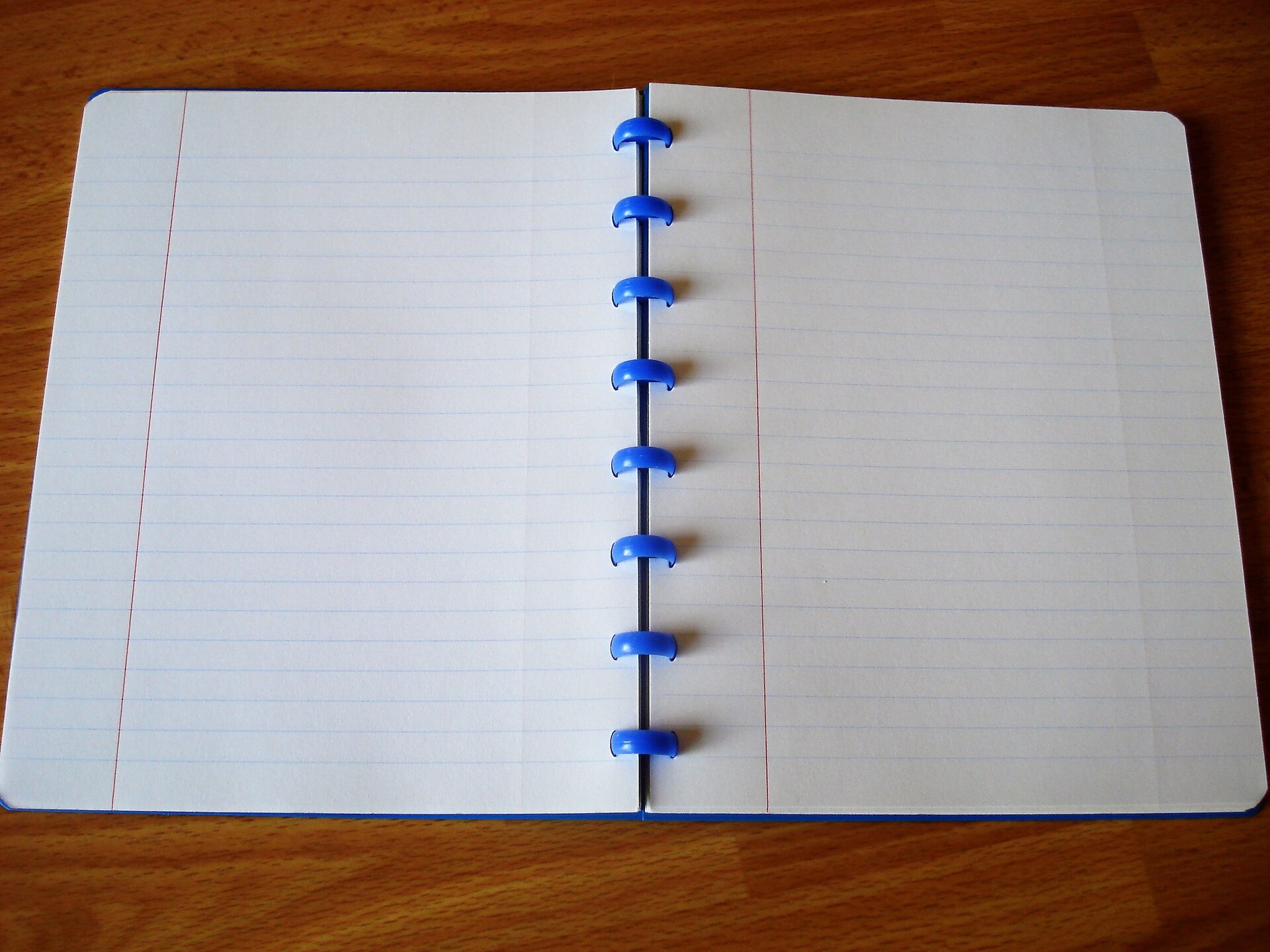
Look at any sheet of notebook paper and you’ll find a strip of dead space running down the left edge — a no-man’s-land where you’re not supposed to write. Ask why it’s there and you’ll almost certainly hear some version of the same story: margins exist because rats and mice used to gnaw through the edges of paper, so people left blank borders as a sacrificial buffer to protect their notes. It’s a great story. It’s also, as far as anyone can actually verify, unsupported by any real record.
Table of Contents
The true story runs through two very different places: a medieval scriptorium where monks left half the page blank on purpose, and a Massachusetts paper-mill scrap heap where, around 1900, a judge asked a young entrepreneur for a favor. Between them, they explain not just why margins exist, but why the standard one is close to 1.25 inches wide.
Quick answer
Notebook margins have two overlapping origins: medieval scribes left generous blank borders on manuscript pages as functional space for page numbers, running titles, cross-references, and reader notes, and the ruled left margin most of us recognize today traces to Thomas Holley’s Ampad paper mill in Holyoke, Massachusetts, where a local judge reportedly requested a marking line around 1900. The popular ‘rats ate the edges’ explanation has no documented source behind it.
A monk’s blank space was never wasted
Open a medieval manuscript and the first thing you notice isn’t the text — it’s how little of the page it actually covers. Book historian Erik Kwakkel, who spent years studying medieval manuscripts (formerly at Leiden University, now at the University of British Columbia), has documented that a typical medieval page was designed to be roughly 50% margin, and sometimes significantly more, even though parchment itself was expensive to produce.
That space wasn’t wasted — Kwakkel describes it as a kind of ‘toolbox.’ Readers and scribes filled it with page numbers, running titles identifying the text, cross-references to other passages, quotation labels, chapter numbers, and glosses that functioned like early footnotes. As the Middle Ages went on, margins increasingly doubled as scratch space for a reader’s own commentary. One theory Kwakkel does not endorse, notably, is that wide margins existed as insurance against future rebinding — the idea being that if a bookbinder later trimmed the page block, a wide margin would absorb the cut instead of the text. When readers have raised that explanation with him directly, Kwakkel has said he isn’t sure medieval scribes were even thinking that far ahead when they laid out a page. It’s a tidy theory, just not one the scholar closest to the material is willing to sign off on.
The scrap-paper hustle that built the modern margin
Fast-forward to 1888, Holyoke, Massachusetts — then the papermaking capital of the world. A 24-year-old mill worker named Thomas Holley noticed that mills discarded ‘sortings’: paper too flawed or mismatched to sell as fine stationery. Holley started collecting the scraps, trimming them square, and stitching them into cheap notepads. The business took off fast enough that he left the mill and founded his own company, later known as Ampad — the American Pad and Paper Company.
The pads Holley sold were plain. The vertical rule came later: sometime around 1900, according to the company’s own history, a local judge asked Holley to add a line down the left side of the page, roughly an inch and a quarter in, so he’d have a dedicated strip for his own annotations separate from his notes. That request is the reason a certain kind of ruled pad is still called a ‘legal pad’ — and it’s a close cousin of the margin printed on ordinary school notebook paper, which only became cheap to mass-produce because machines like the one English inventor John Tetlow patented back in 1770 (originally built to rule music paper) had already turned hand-ruling into an industrial process.
The part most people miss
The rat story is worth pausing on, because it’s the version almost everyone has heard — usually from a listicle — and it never comes attached to an actual source: no cited archive, no named account, no dated incident. Old manuscripts and account books absolutely did suffer insect and rodent damage over centuries of storage, so the idea isn’t crazy on its face. But wide margins show up in manuscript pages more than a thousand years before anyone could plausibly claim they were designed as pest deterrents, and the documented reasons historians actually give — navigation aids, cross-referencing, note-taking space — have nothing to do with mice. Even the more scholarly-sounding theory, that margins were left wide as protection against future rebinding, turns out to be softer than it sounds: the historian most associated with studying these pages has said on the record that he isn’t sure scribes were planning for rebinding at all. That’s the real lesson here — even among legitimate historical explanations, some hold up under scrutiny and some are just plausible-sounding guesses, and the honest answer often involves admitting which is which.
Sources
Erik Kwakkel’s manuscript-studies blog, medievalbooks.nl, where the historian — formerly of Leiden University, now at the University of British Columbia — breaks down medieval page layout, the ‘toolbox’ function of manuscript margins, and, in the post’s comments, his own uncertainty about whether rebinding influenced margin size.
Wikipedia’s entry on ruled paper, which documents John Tetlow’s 1770 patent for a paper-ruling machine and the later industrialization of lined-paper production.
Mental Floss’s history of the legal pad, detailing Thomas Holley’s 1888 scrap-paper business in Holyoke, Massachusetts, and the judge’s request for a margin line around 1900.
Explore more: More true tales from Everyday Objects.
notebook paper margins FAQs
Did margins on paper really start because of rats?
No good evidence supports that claim — it’s a popular but unsourced legend. The documented reasons for wide manuscript margins trace to medieval scribes needing room for page numbers, cross-references, and notes, not pest control.
Who invented the margin line on notebook paper?
There’s no single inventor of margins in general, but the specific ruled left margin found on legal pads — and echoed on much lined notebook paper — is credited to a request made to Thomas Holley of the Ampad company around 1900, reportedly by a judge who wanted dedicated space for his own notes.
Why is the standard margin about 1.25 inches?
That measurement comes from the legal-pad tradition Holley’s company popularized in the early 1900s; it became a de facto standard as ruled-paper manufacturing scaled up over the 20th century.
Tales You Can Hold
Fun-facts books for curious kids, personalized books that star your child, and more from the FYI Tales Bookstore. Visit the Bookstore.
Photo: Ibu / CC BY-SA 4.0, via Wikimedia Commons.