
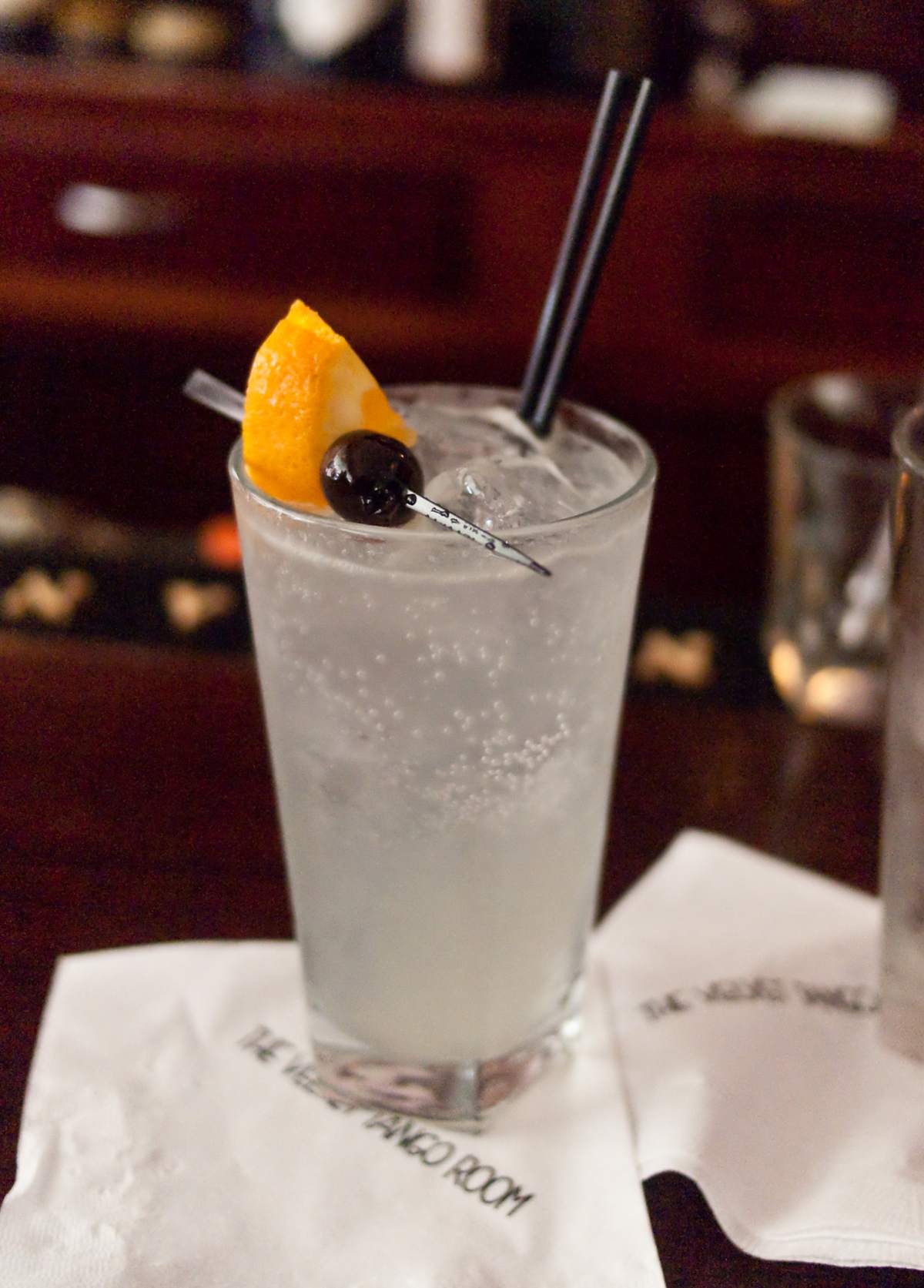
In the spring of 1874, bar patrons across New York kept getting cornered with the same strange question: “Have you seen Tom Collins?” Nobody had, because Tom Collins did not exist. But the question worked so well as bait — it rattled men into storming into crowded saloons demanding to find the stranger who’d supposedly been badmouthing them — that it became one of the biggest practical jokes 19th-century America ever pulled off.
Table of Contents
By the time the joke burned itself out, a gin drink that had quietly existed for years under a completely different name had somehow turned into the “Tom Collins” still ordered at bars today. The hoax is extremely well documented. Whether it’s actually the reason the drink got its name is where historians start disagreeing — and that disagreement is the real story.

Quick answer
In 1874, a nationwide practical joke had strangers asking “Have you seen Tom Collins?”, sending riled-up men charging into bars looking for a man who didn’t exist. Many drink historians believe the bartenders’ running gag during the hoax — holding up a gin punch and announcing “Here’s your Tom Collins!” — is why an older drink called the John Collins got renamed. That’s a widely repeated theory, not a settled fact; a simpler, competing explanation involves nothing more than a change in gin.
A joke built for bars
Decades before anyone invented a fake man to prank, London drinkers already knew a gin punch called the John Collins. It was named, the story goes, for a real headwaiter at Limmer’s Old House, a popular hotel and coffee house in Mayfair’s Conduit Street. The drink was famous enough that the writing team of Frank and Charles Sheridan immortalized the waiter in verse: “My name is John Collins, head waiter at Limmer’s, / Corner of Conduit Street, Hanover Square, / My chief occupation is filling brimmers / For all the young gentlemen frequenters there.” Cocktail historian David Wondrich traces the drink’s gin-lemon-soda-sugar formula to the gin punches served at London clubs like the Garrick, likely carried across the Atlantic by sailors sometime in the 1850s.
Then, in 1874, some unrecorded New Yorker turned a fictional man into a citywide sport. The setup was simple: tell a friend that a man named Tom Collins had been talking trash about him nearby, then watch him march off to confront a stranger who’d never heard the name. Newspapers loved it. The St. Louis Post-Dispatch ran accounts in May and June of 1874 describing the prank in action — including one man who, having already been burned by the joke, flew into a rage and nearly started a brawl over the imaginary insult. The gag spread from New York to Philadelphia, Boston, and St. Louis, and it got big enough that music-hall songs were written about the elusive Tom Collins — copies of which still sit in the Library of Congress.
Here’s your Mr. Collins
As the joke spread bar to bar, some bartenders reportedly leaned into it. When a wound-up patron stormed in demanding “Where’s Tom Collins?”, a bartender in on the gag could grab a gin punch off the rail and holler back something like “Here’s your Mr. Collins!” At the time, the gin behind the bar was almost always Old Tom gin — a sweeter, maltier style than the crisp London dry gin most people drink today. The theory, pushed by Wondrich and others, is that this running joke is what nudged the old “John Collins” into becoming the “Tom Collins”: a fitting, punny name for a drink made with Old Tom gin, delivered at the exact moment the whole country was shouting about a man named Collins.
Whatever tipped it, the renamed drink stuck fast. An 1878 cookbook by Jane Cunningham Croly already listed the Tom Collins among the favorite drinks “in demand everywhere” in New York bars. And when bartender Jerry Thomas’s influential guide, The Bar-Tender’s Guide, was reissued after his 1885 death, it included a Tom Collins recipe that hadn’t appeared in his original 1862 edition — a gap that happens to line up neatly with the 1874 hoax sweeping through the very city where Thomas tended bar.
The part most people miss
Here’s the honest version: the hoax-renamed-the-drink story is a theory, repeated by respected cocktail historians, not a documented fact with a signed confession behind it. A competing, simpler explanation says the name just followed the gin — once Old Tom gin became the default pour for this drink, “Tom Collins” was the natural name, no prank required. The two explanations aren’t mutually exclusive, and nobody alive in 1874 bothered to write down which came first. The confusion isn’t new, either: in 1891, a British physician claimed in print that the drink and its name originated in England, built around an old song called “John Collins.” The satirical magazine Punch promptly corrected him — the song was actually titled “Jim Collins,” and he’d misquoted it besides. Three decades later, the critic H. L. Mencken wrote flatly in The American Language that the Tom Collins’s origin “remains to be established,” since “the historians of alcoholism… have neglected them.” There’s also a competing legend that the drink was invented in St. Louis by Jerry Thomas himself at the Planters House hotel — a claim that falls apart on one simple fact: the recipe is nowhere in Thomas’s first edition from 1862, which it almost certainly would have been if he’d invented it there decades earlier.
Sources
Distilled History, the drinking-history blog run by Cameron Collins, published the deep-dive piece “The Great Tom Collins Hoax of 1874,” which lays out the 1874 newspaper accounts and cites cocktail historian David Wondrich’s research on the John Collins/Tom Collins lineage.
Wikipedia’s “Tom Collins” entry compiles the documented newspaper hoax, the Library of Congress sheet-music record, the 1891 Punch rebuttal of Morell Mackenzie’s English-origin claim, and H. L. Mencken’s 1921 commentary in The American Language on the drink’s unresolved history, along with early printed recipes from Harry Johnson’s 1882 bartender’s manual and Jerry Thomas’s reissued guide.
Explore more: more true food origin stories.
Tom Collins FAQs
Did the Tom Collins Hoax of 1874 really happen?
Yes. It was a documented practical joke where people asked strangers “Have you seen Tom Collins?” to provoke confusion and anger, and it was widely covered by newspapers in New York, Philadelphia, Boston, and St. Louis in 1874.
Did the hoax actually name the Tom Collins cocktail?
That’s the popular legend, and respected cocktail historians give it credence, but it’s a theory rather than a proven fact. A competing explanation credits the switch from Dutch gin to sweeter Old Tom gin as the simpler reason the drink’s name changed from “John” to “Tom” Collins.
Was there a real person named Tom Collins?
No. The man people searched for during the 1874 hoax was invented specifically for the prank. The name “Collins” for the drink itself traces back further, to an earlier gin punch called the John Collins, reputedly named for a real London headwaiter.
Tales You Can Hold
Fun-facts books for curious kids, personalized books that star your child, and more from the FYI Tales Bookstore. Visit the Bookstore.
Photo: Edsel L / CC BY-SA 2.0, via Wikimedia Commons.