
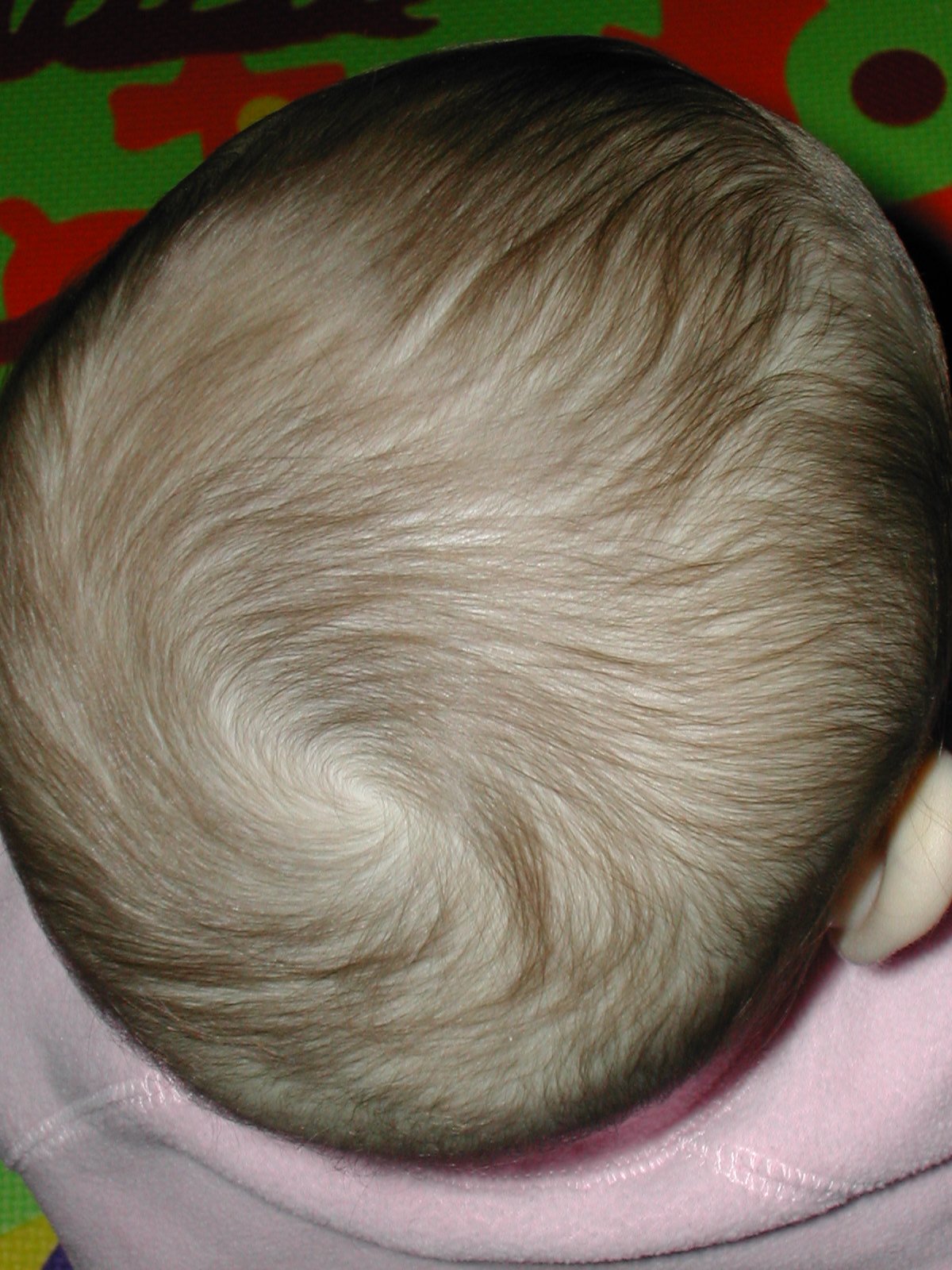
In the 1990s, a geneticist named Amar Klar started hanging around shopping malls in suburban Maryland, not to shop, but to stare at the backs of strangers’ heads. He was counting cowlicks — specifically, which way they swirled. Clockwise or counterclockwise. He never asked anyone their name. He didn’t need to.
Table of Contents
Klar wasn’t chasing a hairstyling mystery. He studies yeast and cell division at the National Cancer Institute, and he had a hunch that the tiny spiral on top of your head might be wired to the same genetic switch that decides whether you write with your left hand or your right. What he found in that mall wasn’t proof, exactly. But it was strange enough, and stubborn enough, that scientists are still arguing about it decades later.
Quick answer
Most people’s hair whorls spin clockwise (roughly 85-90% in typical population samples, though the exact figure shifts by country), and researchers have found that counterclockwise whorls show up far more often in left-handed people. The leading explanation is that whorl direction and handedness may share an early genetic or developmental origin, though scientists disagree on exactly how strong or reliable that link really is.
A geneticist, a mall, and a lot of staring at strangers
Amar Klar’s method was refreshingly low-tech: stand somewhere heads are visible, tally the direction of each whorl, move on. Across his surveys of the general population, he recorded that about 92% of people had a clockwise whorl and roughly 8% counterclockwise — a number that lines up closely with figures reported in later summaries of his work. He hadn’t asked anyone their dominant hand, but he didn’t need to for the first step, since roughly 90% of people are right-handed, and the two ratios were suspiciously close.
The real test came next. Klar tracked down a separate group of people who specifically had counterclockwise whorls and asked about their handedness directly. If whorl direction and handedness were unrelated, you’d expect this group to be about 90% right-handed too, just like everyone else. Instead, it split close to 50/50 between right-handers and non-right-handers. Something about growing a counterclockwise whorl seemed to erase the usual right-handed advantage.
One gene trying to do two jobs
Klar published his data in the journal Genetics in 2003 and proposed a tidy explanation: a single gene, with a dominant version that pushes a person toward both a clockwise whorl and right-handedness. If you inherit even one copy of that dominant version, the theory goes, you’ll likely be a clockwise-whorled righty. But if you end up with two copies of the recessive version, the gene stops steering — your whorl direction and your handedness both become, in effect, a coin flip.
It’s an elegant idea, and it would explain why left-handed and ambidextrous people show something close to an even split of whorl directions while right-handed people overwhelmingly cluster clockwise. But ‘elegant’ and ‘confirmed’ are different things. A single gene controlling something as complex as hand preference, brain lateralization, and hair follicle geometry all at once is a bold claim, and follow-up studies haven’t all agreed. Some later research found no significant link between whorl direction and handedness or language dominance at all, and modern genetics generally treats handedness as influenced by dozens of genes, not one master switch.
The part most people miss
The other tempting explanation for cowlicks — that they spin whichever way the Coriolis effect nudges them, the same force people blame for draining toilets swirling differently in each hemisphere — is a joke that escaped the lab. French pediatric geneticist Marjolaine Willems and her colleagues actually tested it, comparing hair whorls in twins and unrelated children born in France versus Chile, on opposite sides of the equator. Their verdict, delivered with a straight face in the citation for their 2024 Ig Nobel Prize in Anatomy: ‘if toilets aren’t subject to Coriolis forces, hair certainly isn’t either.’ Their real finding was more interesting anyway — identical twins matched each other’s whorl direction far more often than chance would predict, but counterclockwise whorls were also noticeably more common among the Chilean children than the French ones, hinting that whorl direction isn’t pure genetics. Something in early development, possibly linked to the womb environment, appears to nudge it too.
Sources
Wikipedia’s entry on ‘Hair whorl,’ which summarizes Amar Klar’s 2003 findings and the genetic model built around them, along with the criticism that later research has raised.
The Conversation, ‘Why aren’t you a lefty? A geneticist finds clues in kangaroos and shopping malls’ (2018), which details Klar’s mall-based data collection and his proposed single-gene mechanism.
Scientific American, ‘Does the Coriolis Effect Cause Your Cowlick?’, covering Marjolaine Willems’s twin and cross-hemisphere study and its 2024 Ig Nobel Prize in Anatomy.
Explore more: more true stories about the amazing human body.
cowlicks FAQs
Do most people’s cowlicks really spin clockwise?
Yes. Population surveys generally find clockwise whorls are the majority pattern, though the exact percentage varies by study and country, ranging from roughly half in some Japanese samples to over 80% in some U.S. and German samples.
Is it true that left-handed people are more likely to have a counterclockwise cowlick?
Research by geneticist Amar Klar found left-handed people were far more likely than right-handed people to have a counterclockwise whorl, but the link isn’t absolute, and other studies have failed to replicate a strong association.
Does the Coriolis effect cause hair whorl direction?
No. Researchers who studied this directly, including the team behind a 2024 Ig Nobel Prize-winning study, concluded the Coriolis effect is far too weak to influence something as small as a hair follicle.
Is cowlick direction purely genetic?
It appears to be influenced by genetics but not determined by it alone. Twin studies show identical twins often share whorl direction, but not always, and environmental factors during early development may also play a role.
Tales You Can Hold
Fun-facts books for curious kids, personalized books that star your child, and more from the FYI Tales Bookstore. Visit the Bookstore.
Photo: NoJhan (talk) / CC BY-SA 2.5, via Wikimedia Commons.