
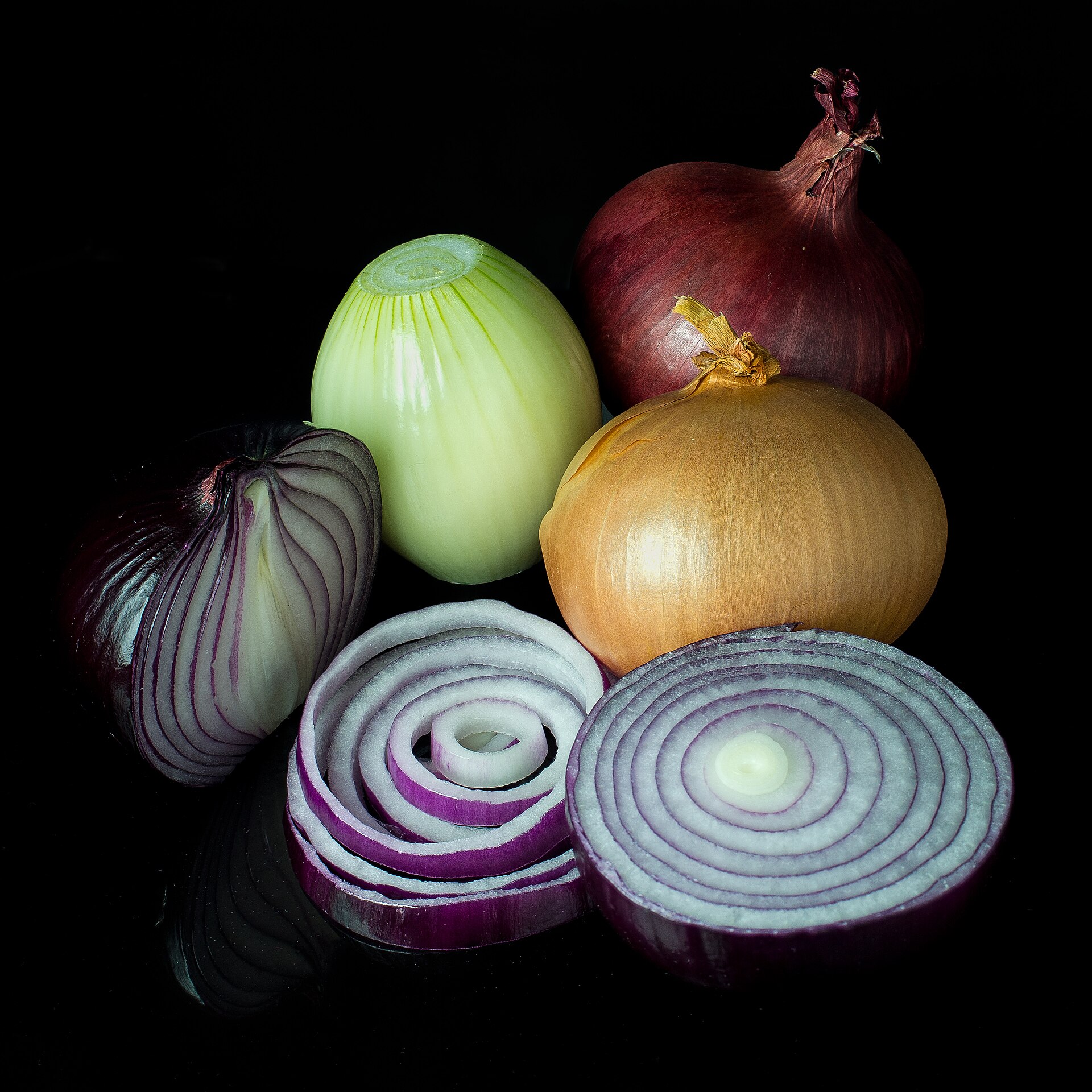
You slice into an onion, and within seconds your eyes are stinging and welling up, even though nothing touched your face. For most of human history, this was just accepted as something onions do, a mysterious tax on French onion soup. Nobody could say exactly which molecule was to blame, let alone why the onion bothered making it.
Table of Contents
That changed in 2002, when a team working for a Japanese food company found the actual machinery inside onion cells that manufactures the gas that makes you cry—and discovered it wasn’t an accident of chemistry at all. It was a dedicated, purpose-built weapon, and finding it overturned decades of assumptions.
Quick answer
Cutting an onion ruptures cells and mixes sulfur-containing compounds with an enzyme called alliinase, forming an unstable sulfenic acid. A second enzyme, lachrymatory-factor synthase, immediately rearranges that acid into a volatile gas called syn-propanethial-S-oxide. The gas drifts up into your eyes, where it activates the same pain-sensing nerve channels (TRPA1) that respond to mustard and wasabi, triggering the reflex tears that flush it back out.
The wrong villain
Chemists had actually pinned down the identity of the tear-gas molecule itself decades earlier. Eric Block, a chemist now at the University at Albany, spent much of the 1970s and ’80s working out its precise structure—confirming it as syn-propanethial-S-oxide in its ‘syn’ (Z) configuration and, in a 1980 paper with colleagues Bazzi and Revelle, even characterizing the stable dimer it forms.
But knowing the molecule’s shape isn’t the same as knowing where it comes from. The standard explanation, repeated in textbooks for decades, was that it was simply a byproduct: onions store flavor precursors called amino acid sulfoxides, and when you cut the cell walls, the enzyme alliinase spills out of one compartment, meets them in another, and sloppily generates the irritant gas as a side effect of building the compounds responsible for onion flavor. Nobody had found any evidence of a separate, dedicated system for tear production—because nobody had gone looking hard enough to notice one enzyme couldn’t be doing both jobs.
A soup company finds the missing enzyme
The search fell, unexpectedly, to industry rather than academia. Shinsuke Imai and colleagues at the Somatech Center, a research arm of House Foods Corporation—a Japanese company best known for curry roux and tofu—were digging into onion biochemistry for commercial reasons. Using a hydroxyapatite column to separate onion proteins, they found something the flavor-byproduct theory couldn’t explain: they could isolate tear-factor production completely apart from alliinase activity.
That meant a second enzyme had to exist. Imai’s team tracked it down, cloned its gene, and expressed the protein in E. coli to confirm it alone could convert the intermediate compound into the tear-inducing gas. They named it lachrymatory-factor synthase. The findings ran in Nature on October 17, 2002 (volume 419, page 685), and they flipped the story: the sting in your eyes wasn’t a chemistry accident. The onion was manufacturing it deliberately, with its own dedicated enzyme.
The part most people miss
Once Imai’s team identified the gene, the obvious next question was whether it could simply be switched off—a tearless onion with full flavor intact. Researchers in New Zealand did exactly that in 2008, using RNA interference to silence the gene, and got onions that produced essentially zero lachrymatory factor. Separately, Bayer had already spent decades cross-breeding onion strains through conventional, non-GMO methods to suppress the same trait, a project that became the Sunion, sold in U.S. grocery stores since 2018.
But scientists who studied the discovery flagged a catch, and it’s the part that rarely makes it into the recipe blogs: the gas probably isn’t there for our benefit at all. Food scientist Kirk Parkin, at the University of Wisconsin–Madison, and Eric Block both pointed out that the compound almost certainly serves the onion as a defense against insects and soil microbes—a chemical trip wire that happens to also work on the much larger mammal holding the knife. Breeding or engineering it away, they warned, could leave a tearless onion more vulnerable to the very pests it evolved to repel. What ruins your knife-work in the kitchen is, from the onion’s point of view, working exactly as designed.
Sources
S. Imai et al., “An onion enzyme that makes the eyes water,” Nature, vol. 419, p. 685 (October 17, 2002).
The Scientist, “The Crying Gene,” reporting on the House Foods Corporation discovery of lachrymatory-factor synthase.
Science News, “Less Crying in the Kitchen: Tasty, Tearfree Onions on the Horizon,” including comments from Kirk Parkin (University of Wisconsin–Madison) and Eric Block (University at Albany).
Wikipedia, “syn-Propanethial S-oxide,” for chemical structure and the biochemical pathway from isoalliin to lachrymatory factor.
Explore more: more Amazing Body stories.
onion tears FAQs
What chemical actually makes onions make you cry?
A volatile gas called syn-propanethial-S-oxide. It forms the instant you cut an onion, when a dedicated enzyme called lachrymatory-factor synthase converts a sulfur compound released from the ruptured cells.
Who discovered why onions make you cry?
Shinsuke Imai and colleagues at House Foods Corporation’s Somatech Center in Japan identified the enzyme responsible and published their findings in Nature in October 2002, decades after the tear-gas molecule itself had first been chemically characterized.
Is there a way to stop onions from making you cry?
Chilling the onion first, cutting it under running water or near ventilation, and using a very sharp blade all reduce how much gas escapes. Bred varieties like Sunions, and experimental gene-silenced onions, cut the lachrymatory factor dramatically at the source.
Tales You Can Hold
Fun-facts books for curious kids, personalized books that star your child, and more from the FYI Tales Bookstore. Visit the Bookstore.
Photo: Colin / CC BY-SA 3.0, via Wikimedia Commons.