
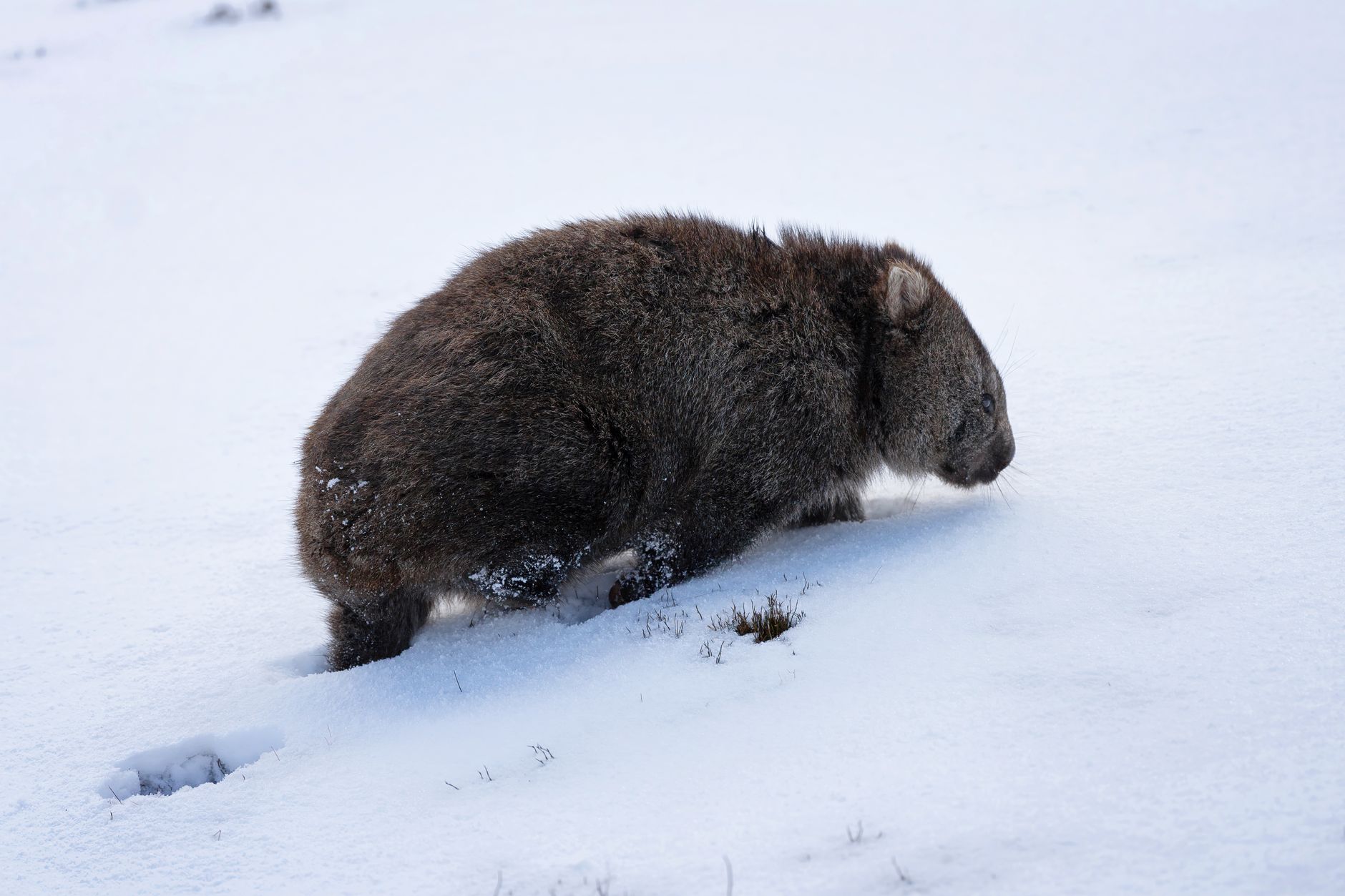
Australia’s bare-nosed wombat is the only known animal on Earth that produces cube-shaped poop — genuine dice-like blocks with flat faces and edges, up to a hundred of them a night. For decades, the question of why wombat poop is cube-shaped sat in the “surely that’s a myth” file. It is not a myth, and in 2018 a team of researchers finally cracked the mechanism.
Table of Contents
Not the exit — the plumbing
The obvious guess (a square exit) is wrong; wombat anatomy at the very end is round like everyone else’s. Mechanical engineer Patricia Yang and David Hu of Georgia Tech, working with wombat researcher Scott Carver in Tasmania, examined wombat intestines and found the real trick: the final stretch of the intestine has alternating zones of stiff and stretchy tissue — measured as two grooved, more elastic regions alongside stiffer ones.
As extremely dry feces (wombats are champion water-conservers, and the dryness matters — soft material won’t hold a shape) moves through, the uneven walls contract at different rates, kneading flat faces and corners into the material over many cycles. Cubes, formed by soft-tissue physics rather than any mold. The team’s follow-up modeling was published in the journal Soft Matter in 2021 — an outstanding pun that the field fully earned.
But why cubes at all?
The leading explanation is marketing. Wombats mark territory by depositing scat on prominent raised surfaces — rocks, logs — and cubes don’t roll off. Better real estate for the scent message. Wombats also have poor eyesight and communicate heavily by smell, so a stable, well-placed cube is the wombat equivalent of a billboard with good structural engineering.
The part most people miss
The discovery won the 2019 Ig Nobel Prize in Physics — the award for research that “makes people laugh, then think” — and the thinking part is real: engineers care because soft-tube systems that produce flat-faced shapes could inspire new manufacturing techniques. Somewhere between a marsupial’s colon and an engineering journal, the humble cube got a new origin story.
More animal engineering: why sea otters hold hands while sleeping.
Sources
- Yang, Chan, Carver & Hu — wombat cube feces research (APS presentation 2018; Soft Matter, 2021)
- Ig Nobel Prize 2019 — Physics citation
- University of Tasmania — Scott Carver’s wombat research

1 thought on “Why Is Wombat Poop Cube-Shaped? Science Finally Figured It Out”