

In 1943, a naval engineer named Richard James knocked a coil of tension spring off a shelf in a Philadelphia workshop. Instead of clattering to the floor, it tumbled end over end in a series of neat little arcs, landed upright, and just kept going. Most people who drop something at work sweep it up and move on. James went home and told his wife he thought he could make it walk on purpose.
Table of Contents
That part of the story gets told at every dinner table and toy museum in America. The part that usually gets left out is what happened fifteen years later, when the man who invented one of the best-selling toys in history gave away the company’s money, walked out on his wife and six kids, and moved to Bolivia to join a religious mission — leaving Betty James to build the empire everyone actually remembers.
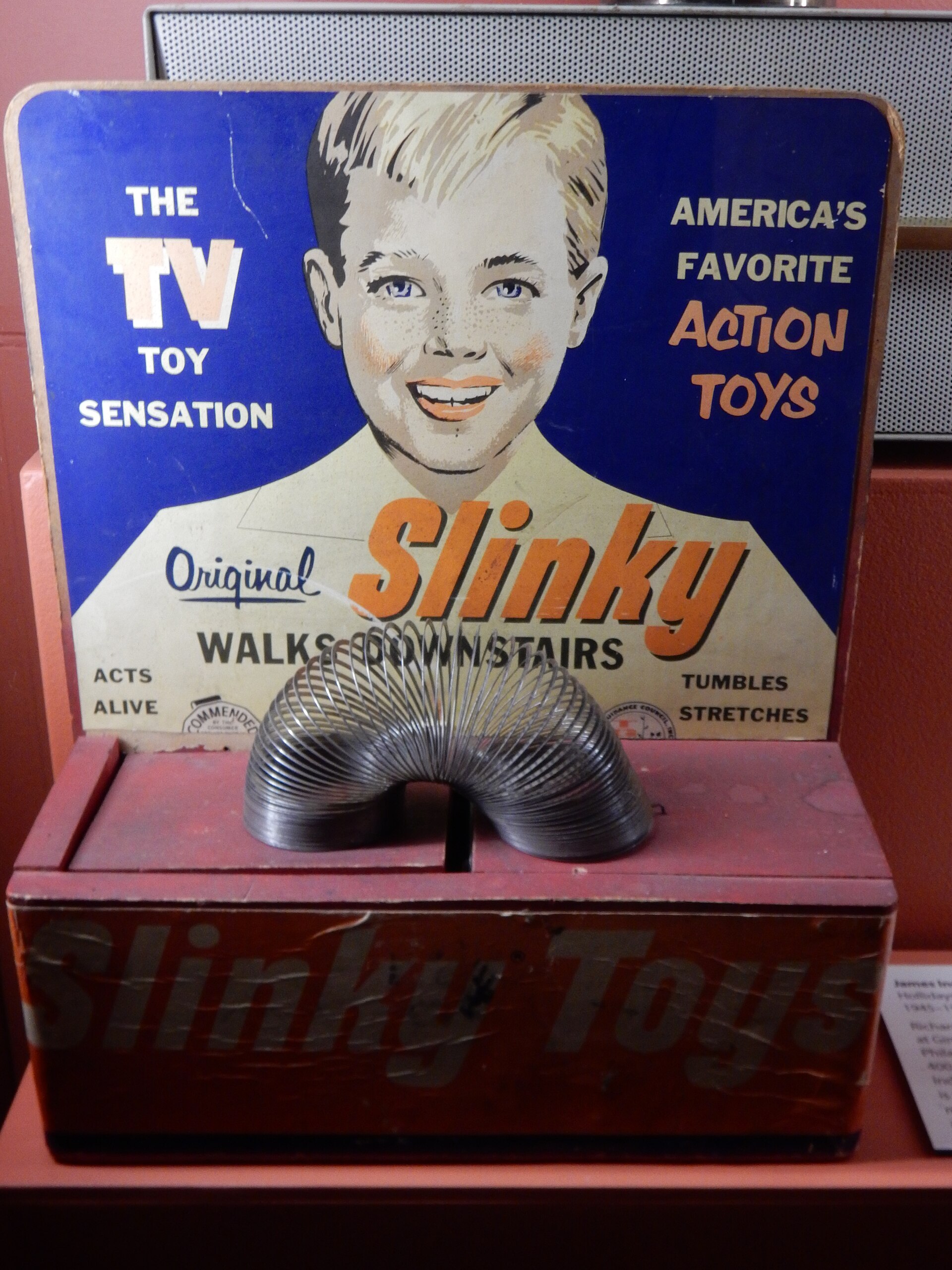
Quick answer
The Slinky was invented by accident in 1943 when naval engineer Richard James, testing torsion springs meant to steady sensitive equipment on Navy ships, knocked one off a shelf and watched it ‘walk’ instead of fall. His wife, Betty James, named it, helped launch it at a Philadelphia department store in 1945, and later ran the company alone for nearly four decades after Richard left.
A dropped spring in a wartime workshop
James was a mechanical engineering graduate of Penn State working on a real Navy problem: how to keep delicate instruments from being shaken apart by rough seas aboard ships. Torsion springs were one option under test, and while handling one on a shelf, he knocked it off. Instead of landing in a heap, it stepped down in a controlled series of arcs — shelf to a stack of books to the tabletop to the floor — then coiled itself upright, ready to do it again.
Betty James later recalled her husband coming home and saying, in effect, that with the right steel and the right tension, he could make a spring walk on command. He spent roughly the next year testing different gauges and grades of wire until he found one that performed the trick reliably. Betty is the one who named it: flipping through a dictionary, she landed on ‘slinky’ — a word for something sleek, sinuous, and stealthy — and it stuck.
Four hundred springs and a sold-out department store table
The Jameses founded James Industries and, for the 1945 Christmas season, set up a demonstration table at Gimbels department store in downtown Philadelphia with 400 units priced at $1 each. Accounts differ on exactly how long it took, but every version agrees on the outcome: the entire stock sold out in under two hours, with shoppers reportedly buying extras as gifts on the spot.
Richard James filed for a patent on the toy, and U.S. Patent 2,415,012, titled ‘Toy and Process of Use,’ was granted on January 28, 1947 — describing a spring made of roughly 80 feet of wire coiled into a two-inch spiral, tuned so it could ‘walk’ down steps or an incline under its own weight, the same basic geometry that still defines a Slinky today.

The part most people miss
By the late 1950s, Richard James had grown deeply involved with an evangelical missionary organization, Wycliffe Bible Translators, and began funneling large sums of the company’s money into it. In 1960, with the business sliding toward bankruptcy, he liquidated assets, gave much of the money away, and left for Bolivia to join the group full-time — leaving behind Betty, their six children, and a company with unpaid bills. Betty later described it, in effect, as losing her husband to a cult; he asked her to leave the children behind and join him. She refused, moved the family back to her hometown of Hollidaysburg, Pennsylvania, and took over as president and CEO of a company she had never planned to run alone.
Betty James spent the next roughly 40 years rebuilding it — cutting costs, keeping the original toy affordable, and eventually launching the ad campaign built around the now-famous Slinky jingle. She bet the company’s future (and reportedly the family’s mortgage) on a 1963 toy fair appearance that revived flagging sales, and decades later rode a second wave of popularity when the Slinky Dog appeared in Toy Story. Richard James died of a heart attack in Cochabamba, Bolivia, in 1974, having never returned to the business or, by most accounts, reconciled with his family. Betty ran James Industries until she sold it in 1998, was inducted into the Toy Industry Hall of Fame in 2001, and died in 2008 — by which point more than 300 million Slinkys had been sold worldwide. The toy people remember as a happy accident survived because of the person almost nobody mentions in the same breath as the invention.
Sources
Wikipedia’s entries on Richard T. James and Betty James, drawn from period reporting and toy-industry histories, detail the 1943 accident, the 1945 Gimbels launch, Richard James’s 1960 departure for Bolivia with Wycliffe Bible Translators, and Betty James’s four-decade leadership of the company.
Smithsonian Magazine’s feature on the accidental invention of the Slinky corroborates the 1943 workshop accident, the January 28, 1947 patent, the Gimbels debut, and the company’s later sales milestones. U.S. Patent 2,415,012, ‘Toy and Process of Use,’ filed by James Industries and viewable via Google Patents, confirms the official patent title and technical specifications of the spring.
Explore more: more accidental inventions.
Slinky FAQs
Who really invented the Slinky?
Richard James, a naval engineer, discovered the walking-spring effect by accident in 1943 while testing torsion springs. His wife, Betty James, named the toy, helped launch it commercially, and later ran the company for decades.
What is the Slinky’s patent number?
U.S. Patent 2,415,012, titled ‘Toy and Process of Use,’ was granted to Richard James on January 28, 1947.
Why did Richard James leave the Slinky company?
In 1960, he gave away large sums of company money to the missionary group Wycliffe Bible Translators and moved to Bolivia to join them full-time, leaving his wife, six children, and a near-bankrupt business behind.
How many Slinkys have been sold?
More than 300 million units had been sold worldwide by the time Betty James died in 2008.
Tales You Can Hold
Fun-facts books for curious kids, personalized books that star your child, and more from the FYI Tales Bookstore. Visit the Bookstore.
Photo: Roger McLassus / CC BY-SA 3.0, via Wikimedia Commons.