
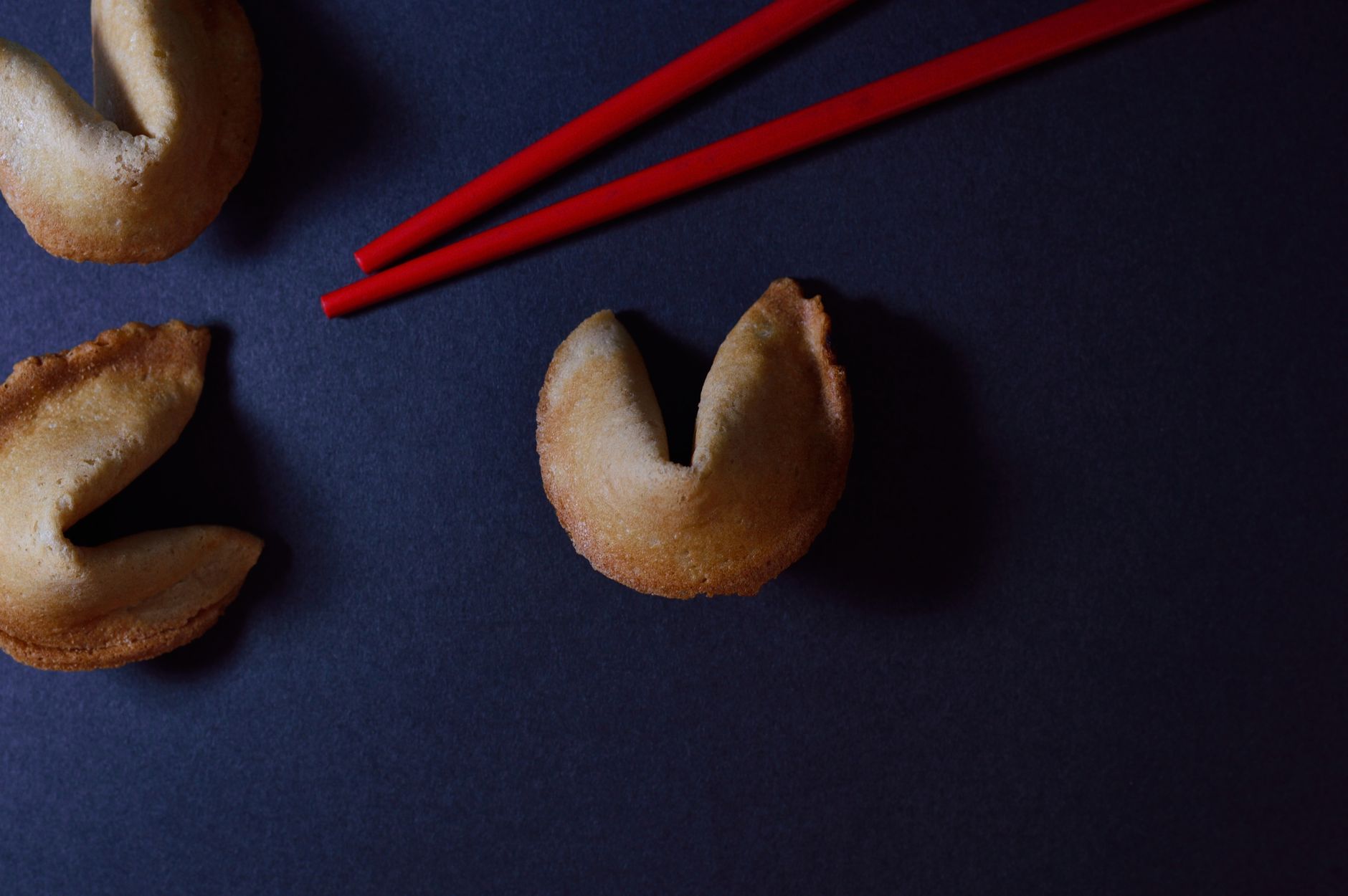
Ask where fortune cookies come from and most people answer “China” with total confidence. The confident answer is wrong: fortune cookies are effectively unknown in China, and their documented ancestors are Japanese. The best evidence points to tsujiura senbei — “fortune crackers” — folded rice-flour wafers with paper fortunes tucked inside, sold near shrines around Kyoto since at least the 1800s.
Table of Contents
A researcher named Yasuko Nakamachi spent years tracing the cookie’s paper trail and found an 1878 Japanese illustration showing a baker grilling the folded crackers, fortunes and all — decades before any American sighting. The Japanese version was bigger and darker, flavored with miso and sesame rather than vanilla and butter, but the fold and the fortune are unmistakably the same object.
California makes it famous
Japanese immigrants brought the cookie to California in the early 1900s. Two origin claims dominate: Makoto Hagiwara, caretaker of the Japanese Tea Garden in San Francisco’s Golden Gate Park, served them around 1914; and David Jung of Los Angeles’s Hong Kong Noodle Company claimed a 1918 invention. The rivalry got so cheerful that in 1983, San Francisco’s mock-judicial “Court of Historical Review” staged a hearing and ruled — shockingly — for San Francisco. A fortune cookie was entered into evidence.
The World War II twist
So how did a Japanese cookie become the signature of Chinese restaurants? During World War II, Japanese Americans — including the bakers — were forcibly removed to internment camps. Chinese-American entrepreneurs stepped into the vacuum, adopted the cookie, and served it to millions of GIs passing through California, who then demanded “Chinese fortune cookies” at restaurants back home. By the 1950s the association was permanent.
The part most people miss
When fortune cookies were introduced to China in the 1990s, they were marketed as “genuine American fortune cookies.” Nobody was wrong: the cookie is Japanese by birth, American by fame, and Chinese only by menu placement — a full circle of borrowed identity baked into a two-inch wafer.
More food myths: the shaky true story of the sandwich.
Sources
- Yasuko Nakamachi’s research on tsujiura senbei (widely covered, incl. The New York Times, 2008)
- Jennifer 8. Lee, The Fortune Cookie Chronicles
- San Francisco Court of Historical Review, 1983 proceedings (contemporary press coverage)