
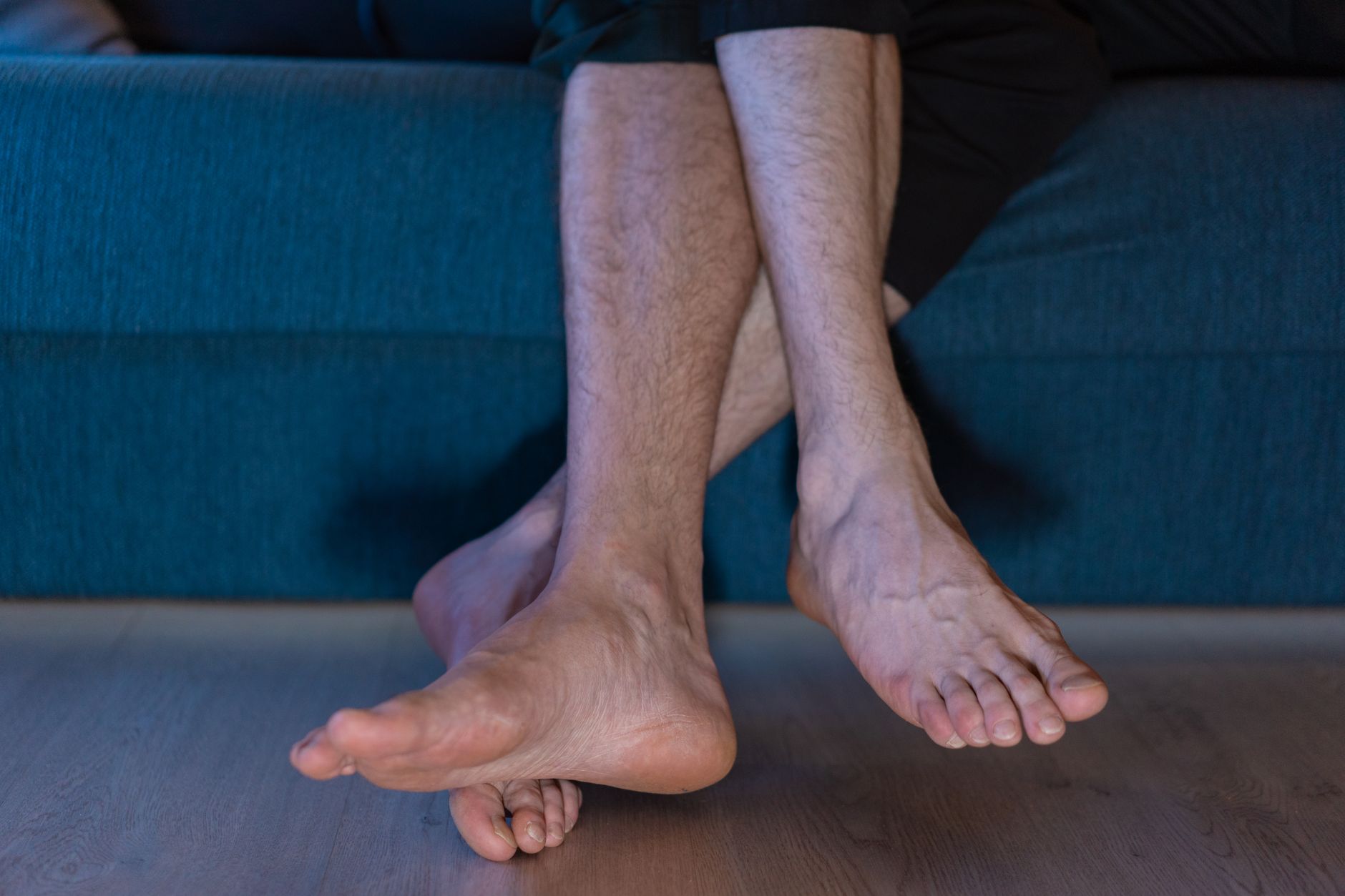
You’re forty minutes into a movie, legs crossed on the couch, and your foot has quietly checked out. It’s not asleep, exactly — it’s numb, tingly, weirdly disconnected from you, like it belongs to someone else. You stand up, stomp around, and mutter the explanation everyone mutters: “Guess the blood stopped flowing.”
Table of Contents
That explanation is almost universal, incredibly confident, and wrong. What’s actually happening in your foot is closer to a data outage than a supply shortage — and untangling it took a Nobel Prize, decades of clinical case reports on squatting fruit pickers, and a surprisingly precise map of which nerve fibers panic first when you sit on them.
Quick answer
Your foot doesn’t fall asleep from a lack of blood — it falls asleep because sustained pressure squeezes a nerve, usually the peroneal nerve at the outside of your knee, hard enough to block its electrical signals, the same way stepping on a garden hose blocks water. The pins-and-needles feeling, called paresthesia, is the signal cutting back in as you release the pressure.
A kinked hose, not a dry riverbed
For a long time, the folk explanation made a certain sense: cut off the blood, cut off the feeling. But neurologists have been correcting that for years. It’s a common misconception that the numbness is about blood flow, says Rebecca Traub, a neurologist at the University of North Carolina School of Medicine — the real cause is temporary compression of the nerve itself. Steven Vernino, a neurology professor at UT Southwestern Medical Center, uses a hose comparison: nerves carry electrical signals the way a hose carries water, and crossing your legs or folding a wrist under you kinks that hose. Nothing is broken. The signal just can’t get through.
The usual culprit is the common peroneal nerve, which runs down the outside of your knee. Unlike most nerves, it isn’t cushioned by much muscle at that point — it lies almost directly against the fibula, covered by little more than skin. Press on it hard enough, whether by crossing your legs, squatting, or resting a knee against a hard armrest, and it’s the first nerve in your lower body to tap out.
The Nobel Prize hiding in your numb foot
The reason your foot goes numb before it goes painless, and why feeling returns in stages rather than all at once, traces back to a 1944 Nobel Prize. Physiologists Joseph Erlanger and Herbert Gasser spent the 1920s and ’30s wiring isolated nerves to an oscilloscope and discovered that a “nerve” isn’t one wire — it’s a bundle of different fiber types, built for different jobs. Thick, fast, heavily insulated fibers carry touch, pressure, and the sense of where a limb is in space; thin, slow, barely insulated fibers carry dull pain and temperature. Erlanger and Gasser split them into classes still used by neurologists today, and won the 1944 Nobel Prize in Physiology or Medicine for it.
That difference in wiring explains a detail almost nobody notices about a sleeping foot: the fat, fast fibers are the most sensitive to being squeezed, so compression shuts them down first, while the thin pain fibers keep working longer. That’s why a foot that’s “asleep” can still register a stubbed toe as unpleasant even when it can’t feel the carpet underneath it — two cable types, two pressure tolerances, going dark on two different schedules.
The part most people miss
The condition has a name in the medical literature that sounds almost like a joke: strawberry pickers’ palsy. In the 1970s, clinicians began seeing farmworkers who spent entire shifts in a deep squat, harvesting berries close to the ground, come in with a numb, floppy foot that wouldn’t lift properly — a documented case of peroneal nerve compression from posture alone, described in journals including JAMA Neurology and Electromyography and Clinical Neurophysiology. It’s the same mechanism as a numb foot on the couch, just sustained for hours instead of minutes. That nerve is the third most commonly compressed in the entire body, after two nerves in the arm, which is why doctors watch for it in anyone immobilized for a long stretch — surgical patients under anesthesia, people in casts, or anyone sedated in one position for hours. In those cases, “it’ll wake up in a minute” isn’t a safe assumption; sustained, severe compression can cause lasting nerve damage, which is why hospitals pad knees and reposition patients on a schedule. Your Tuesday-night numb foot is the harmless, five-minute version of an injury that, under the wrong conditions, isn’t harmless at all.
Sources
Dr. Rebecca Traub of the University of North Carolina School of Medicine and Dr. Steven Vernino of UT Southwestern Medical Center are both quoted on the mechanics of nerve compression versus blood flow.
The Nobel Prize committee’s official record of the 1944 Nobel Prize in Physiology or Medicine, awarded to Joseph Erlanger and Herbert Spencer Gasser for classifying nerve fiber types, documents the discovery behind the fiber-order explanation.
The National Center for Biotechnology Information’s StatPearls anatomy reference on the common peroneal nerve, and JAMA Neurology’s clinical description of “strawberry pickers’ palsy,” document the anatomy and case history.
Explore more: More Amazing Body stories.
feet falling asleep FAQs
Is a foot falling asleep caused by poor blood circulation?
No — that’s the most common myth. It’s caused by sustained pressure on a nerve blocking its electrical signal, not a lack of blood supply, according to neurologists at UNC School of Medicine and UT Southwestern Medical Center.
Why does my foot fall asleep more than other body parts?
The common peroneal nerve runs unusually close to the skin’s surface at the outside of the knee, with little muscle padding, making it the nerve most easily compressed by crossing your legs or squatting.
Can a foot falling asleep cause permanent damage?
Not from everyday sitting — the numbness resolves within minutes once pressure is released. But prolonged, severe compression, such as during surgery, sedation, or in a cast, can cause lasting nerve injury, which is why hospitals routinely reposition immobilized patients.
What is the medical term for the “pins and needles” feeling?
Paresthesia — from Greek roots meaning roughly “abnormal sensation,” a term documented in medical use since the 1830s.
Tales You Can Hold
Fun-facts books for curious kids, personalized books that star your child, and more from the FYI Tales Bookstore. Visit the Bookstore.