
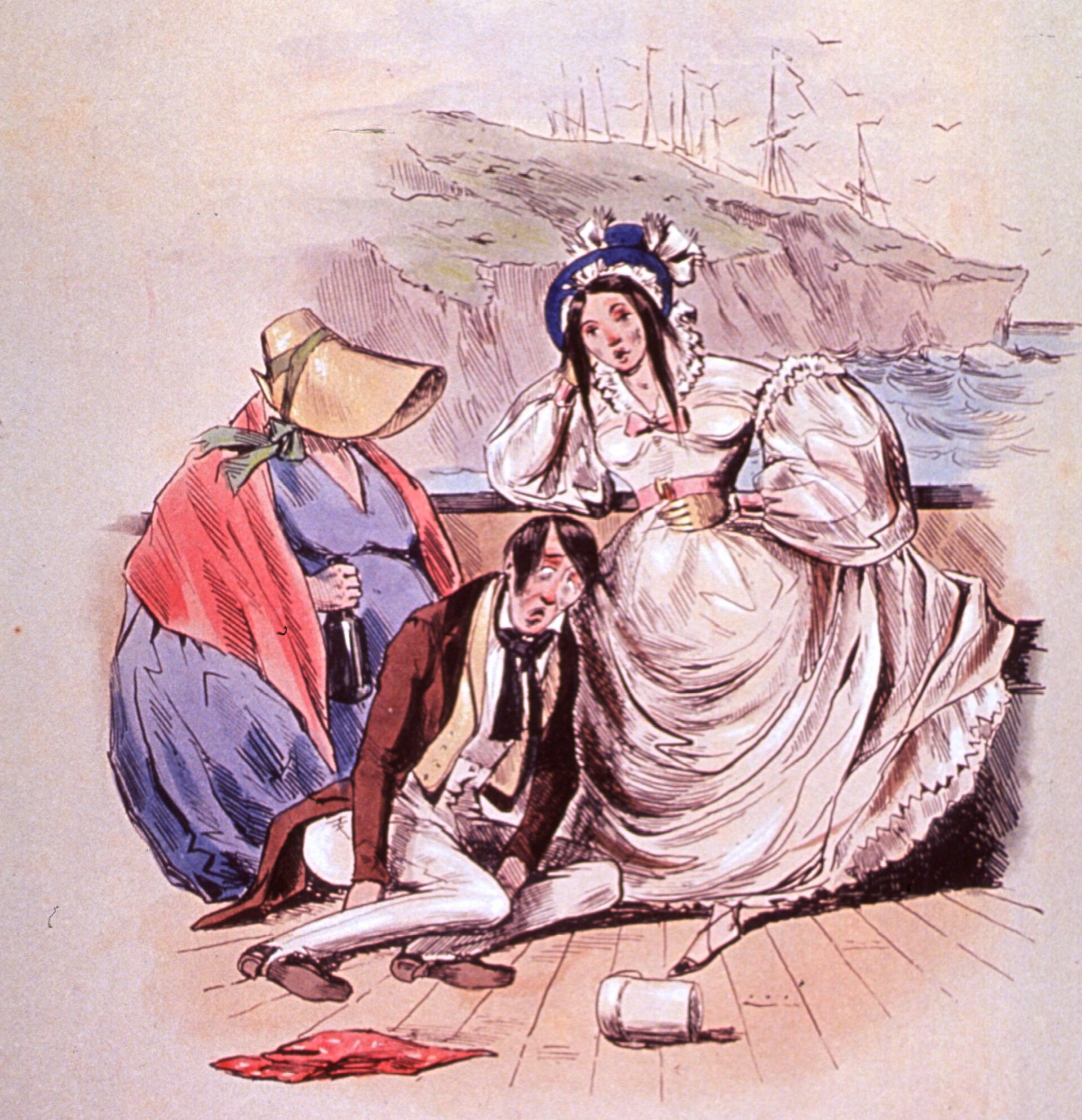
You’re in the back seat, head down in a book or a phone, and thirty seconds later your stomach is staging a small revolt. Up front, the driver is weaving through the same turns, braking at the same lights, feeling none of it. Same car, same road, same bumps — wildly different stomachs.
Table of Contents
For decades scientists assumed this was just about looking out the window. It isn’t. The real answer involves a 1970s theory about your inner ear lying to your eyes, a study that spun people in circles for science, and an evolutionary hypothesis that treats vomiting as a leftover poison alarm. And it turns out the driver’s immunity has a very specific expiration date — one the self-driving car industry is racing to solve right now.
Quick answer
Carsickness comes from a mismatch between what your inner ear feels and what your eyes see — your vestibular system registers turns and stops your eyes can’t confirm, especially if you’re reading or on a phone. Drivers mostly escape it because they control the wheel and can see and anticipate every motion before it happens, not just react to it.
The argument happening inside your skull
In 1975, British psychologists John Reason and Joyce Brand published a book that became the standard reference on the subject, simply titled ‘Motion Sickness.’ Their sensory conflict theory (sometimes called sensory rearrangement theory) argued that nausea isn’t triggered by motion itself — it’s triggered by disagreement between your senses about what’s happening. Your vestibular system, the fluid-filled canals in your inner ear, feels every turn, stop, and sway. But if your eyes are locked on a stationary book page or phone screen, they’re reporting that you’re sitting still. Your brain, faced with two contradictory motion reports it can’t reconcile, treats the confusion as a red-alert glitch worth getting sick over.
It’s a strange system when you think about it — your body isn’t reacting to something dangerous, it’s reacting to a disagreement between two of its own instruments. That framing turned out to explain a huge range of motion sickness triggers, from ships and flight simulators to, later, virtual reality headsets.
The steering wheel effect
But sensory conflict alone doesn’t explain why the person holding the wheel so rarely feels it, even though their inner ear is registering the exact same turns and stops as everyone else in the car. In 1991, researchers Boris Rolnick and Robert Lubow published a study in the journal Ergonomics titled ‘Why is the driver rarely motion sick? The role of controllability in motion sickness.’ They paired up subjects and spun them in a rotating chair designed to provoke nausea — one person in each pair actually controlled the rotation and their own head movements, while their partner was spun through the identical motion passively, with no control at all. The people with control reported significantly less sickness, even though the physical motion each pair experienced was engineered to match.
The takeaway: it isn’t just what you see or how your head moves that matters — it’s whether your brain knows what’s coming next. A driver is constantly generating a mental forecast of the next turn, the next brake, the next lane change, a fraction of a second before it happens. Passengers only get the after-the-fact version. That gap between prediction and surprise, more than the motion itself, seems to be what makes stomachs turn.
The part most people miss
Here’s the twist: the driver’s immunity isn’t really about being a driver. It’s about being the one in control and looking ahead — which means as soon as you take the wheel away, the immunity disappears, even for someone who’s driven that same road a thousand times. Researchers at Mcity, the University of Michigan’s driverless-vehicle testing facility, have flagged motion sickness as a real obstacle to self-driving car adoption, precisely because the technology turns every former driver into a passive passenger with nothing to predict. Up to a third of Americans are considered highly susceptible to motion sickness under ordinary conditions, and autonomous vehicles risk putting all of them in the one seat that never used to bother them. Uber took the problem seriously enough to file a patent application for a ‘sensory stimulation system’ (U.S. Patent 9,789,880) back in March 2016, and it was granted in October 2017 — a setup that uses lights, seat movement, and even puffs of air to warn a passenger’s body about a turn just before it happens, essentially trying to hand back the forecasting ability that steering wheels used to provide for free.
Sources
John Reason and Joyce Brand’s 1975 book ‘Motion Sickness’ (Academic Press), which established the sensory conflict theory still cited in motion sickness research today.
Boris Rolnick and Robert Lubow, ‘Why is the driver rarely motion sick? The role of controllability in motion sickness,’ Ergonomics, 1991.
Mcity, University of Michigan’s driverless-vehicle research center, on its work measuring and mitigating motion sickness in autonomous vehicles.
U.S. Patent 9,789,880 B2, ‘Sensory stimulation system for an autonomous vehicle,’ assigned to Uber Technologies, filed March 3, 2016 and granted October 17, 2017.
Explore more: more amazing body stories.
carsickness FAQs
Why do I get carsick reading in the car but not when I’m driving?
Reading fixes your eyes on something that appears stationary, while your inner ear still feels every turn and stop — that visual-vestibular mismatch is the classic trigger. Drivers rarely read while driving, and they’re also anticipating the car’s movements instead of just feeling them arrive.
Does looking at the horizon actually help with carsickness?
Yes — looking ahead at a fixed, distant point gives your eyes a steady reference that roughly matches what your inner ear is sensing, reducing the sensory conflict that triggers nausea.
Will self-driving cars make motion sickness worse?
Researchers, including teams at the University of Michigan’s Mcity facility, expect it could, since former drivers lose the anticipatory control that used to protect them and become passive passengers instead.
Is carsickness the same thing as seasickness?
They share the same underlying mechanism — sensory conflict between the inner ear and the eyes — which is why the general theory developed by Reason and Brand covers cars, boats, planes, and even virtual reality.
Tales You Can Hold
Fun-facts books for curious kids, personalized books that star your child, and more from the FYI Tales Bookstore. Visit the Bookstore.
Photo: Daderot / Public domain, via Wikimedia Commons.